The views expressed in this article are of the author only and do not necessarily represent those of the Center for Pastor Theologians.
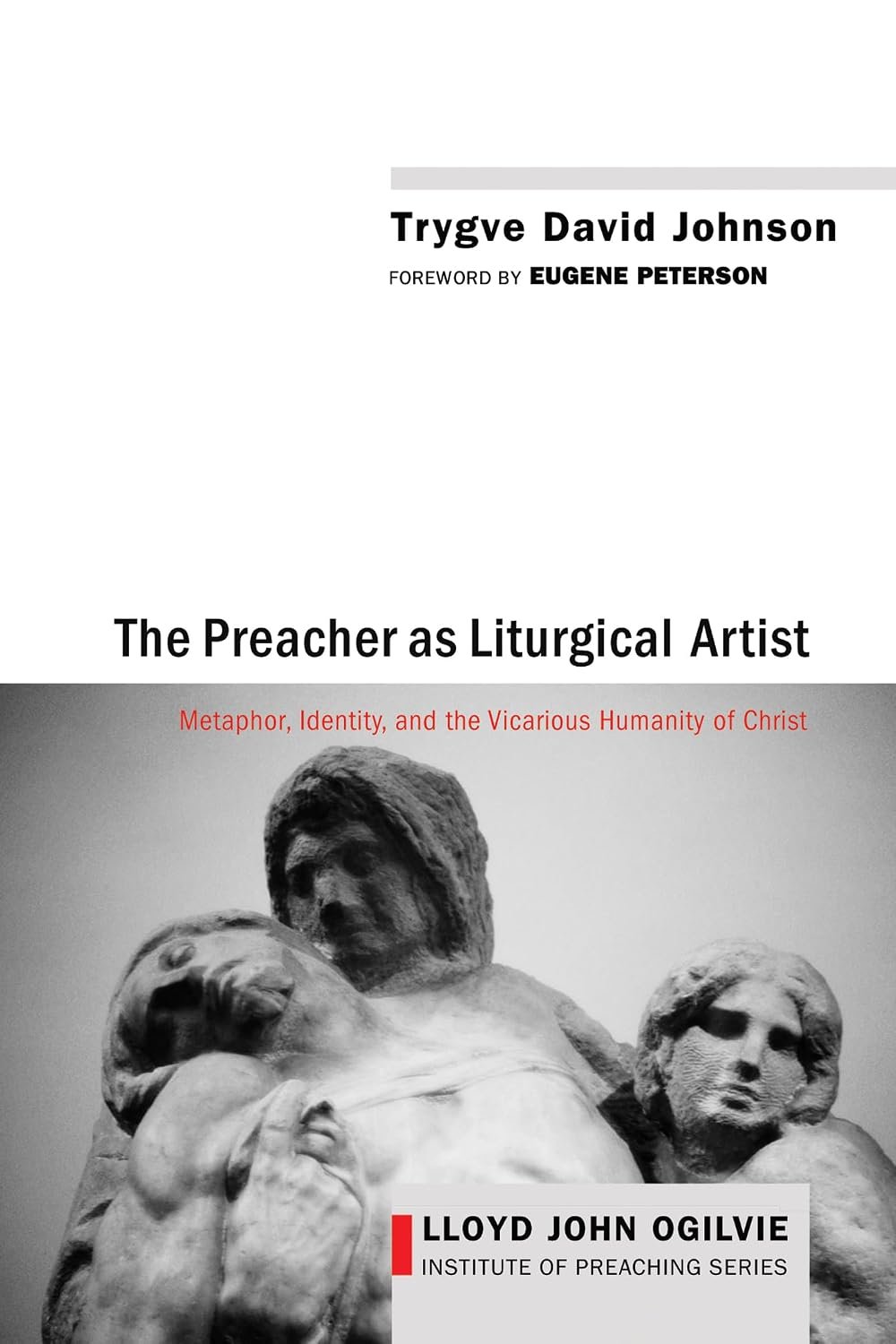
The Pastor as Liturgical Artist: Metaphor, Identity, and the Vicarious Humanity of Christ
Trygve David Johnson
Cascade (2014). 220 pp.
Scholars and thoughtful pastors continue to spill ink in an effort to help preachers flourish in the task of faithfully proclaiming the gospel week after week. While there is no dearth of books that promise rejuvenation to tired homileticians or propose creative preaching practices, the church is in dire need of a paradigm that can guide modern preachers in the task of proclaiming the gospel amidst the postmodern cultural milieu. In his groundbreaking work, The Preacher as Liturgical Artist, Trygve Johnson proposes that we move beyond traditional metaphors for preaching and instead create a new metaphor that can guide modern preachers in their role of creatively and imaginatively preaching the gospel.
Johnson argues that “homiletic identity is shaped by the metaphors associated with the preacher,” and that our particular cultural moment is requires a fresh homiletic identity (p. 28). A preaching metaphor “creates concepts” and “directs the perception, experience, and performance of our lives” (p. 28). Metaphors create perceptions of reality, shape behaviors and practices, and drive the way we “perform” our lives. For Johnson, possessing a solid metaphor for preaching is paramount in the pastoral task of navigating through postmodernity.
Before proposing his own metaphor, Johnson first explores the two predominant metaphors for preaching in the church today: The Preacher as Teacher and the Preacher as Herald. The Preacher as Teacher metaphor finds it origin in the rhetorical approach to preaching advanced by Augustine which seeks to convince people of Christian truth through the power of rhetorical skill and persuasion. While there is much to commend in this metaphor, it lacks creativity and imagination, relies almost exclusively on the preacher’s skill as a public communicator, and trumpets rationalism. The Preacher as Herald metaphor, rooted in the work of Karl Barth, envisions the preacher as a messenger for the King, diminishing the role the preacher plays in the communication of God’s Word and dismissing rhetorical skill as a preaching strategy. Moreover, this approach ignores the preaching style of Jesus, who used an array of rhetorical devices and creative methods to communicate truth (p. 119). Johnson explores the deficiencies of these metaphors in great detail while effectively arguing that there needs to be a fresh metaphor that can guide the homiletical endeavor in our postmodern context.
This is where the metaphor of The Preacher as Liturgical Artist comes in. For Johnson, this metaphor incorporates the best of the Teacher and Herald metaphors while forging a new way forward. Grounded in the life and work of Christ, the Liturgical Artist metaphor is actively Trinitarian, recognizes the creativity found in the “vicarious humanity” of Christ, and encourages preachers to embrace an aesthetic approach to preaching. Johnson believes that preachers are artists who have a role to play in faithfully, creatively, and imaginatively reiterating the gospel (p. 134). The Preacher as Liturgical Artist, according to Johnson, is “not the tortured Romantic notion,” but instead views the preacher as “a skilled artisan who absorbs a tradition and whose skills are grounded” in God’s ongoing work of creation (p. 135). He summarizes, “By grounding preaching in the grammar of the Trinity and . . . within the vicarious work of Christ, preachers are freed to be creative agents, working with rhetorical dexterity amidst a shifting culture . . . preachers are consequently freed up to proclaim the gospel in a variety of ways and in a variety of contexts” (p. 144). In the context of the church’s liturgy, the preacher must work together with other liturgical artists that “together honor God and lead people into his presence” (p. 176). Therefore, “the preacher as an artist finds the fullest expression of freedom within the constraints of the liturgy of Christ’s body, the church (p. 177). As Johnson concludes his work, he writes “This project puts the preacher’s identity squarely in relationship to Jesus, his creative work and life, and the ongoing work of his people . . . the preacher is freed to use all the gifts of humanity as gifts redeemed for artistic expression within the context of the church” (p. 182).
Trygve Johnson has put forward a prophetic and visionary preaching metaphor that will sustain preachers in their task of proclaiming the gospel afresh in the church today. He argues well for this metaphor, which I believe has the potential to impact the landscape of preaching in evangelical churches across the globe. I was particularly pleased to see Johnson’s passion for engaging the artistic dimension of preaching, as the role of aesthetics in Christian formation has generally not touched upon the homiletical task. Johnson’s sustained theological reflection on the ministry of the church exemplifies the model the of the pastor theologian; he not only brings theological realities to bear on ecclesial realities, but actively contributes to theological discourse on preaching. Moreover, his identification of metaphor as a central driving force in preaching practice possesses implications across a vast array of ministry tasks which pastor theologians may want to explore. As a preacher myself, I have benefitted greatly from Johnson’s metaphor, and in fact, have begun to come to the preaching task with renewed excitement, imagination, vision, and energy. This is certainly a book that pastor theologians for whom preaching is a central ministry task or interest should add to their library.

Benjamin Espinoza (PhD, Michigan State University) is the Associate Vice President for Online Education and Assistant Professor of Practical Theology at Roberts Wesleyan College. He is a member of the St. Peter Fellowship of the Center for Pastor Theologians.