The views expressed in this article are of the author only and do not necessarily represent those of the Center for Pastor Theologians.
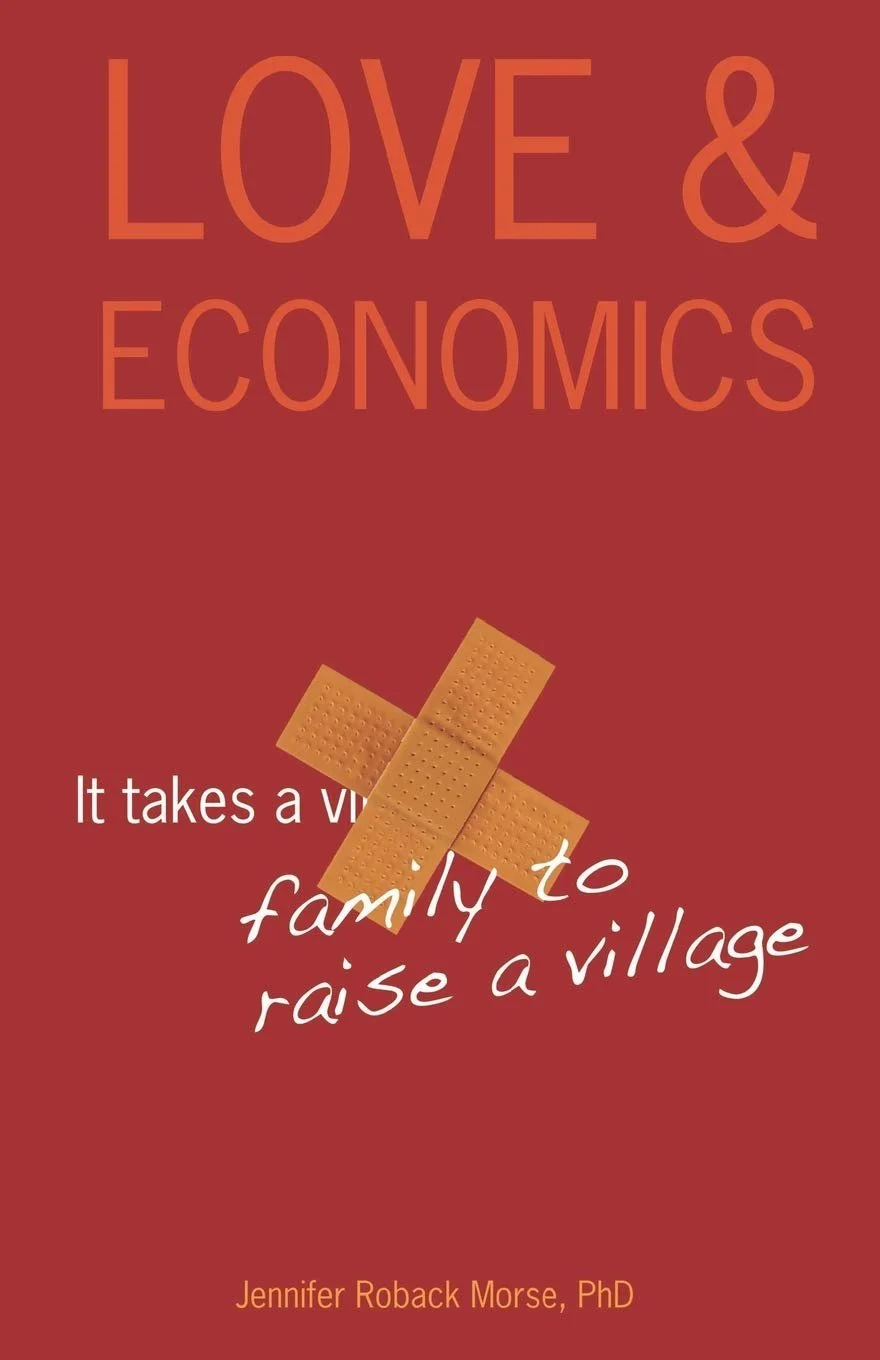
Love and Economics: It Takes a Family to Raise a Village
Jennifer Roback Morse
Ruth Institute (2008). 331 pp.
Jennifer Roback Morse is a trained economist. She has taught at Yale and George Mason; she held a research post at Stanford’s Hoover Institution. Today she directs the Ruth Institute, an organization promoting traditional marriage values and mutual respect between spouses. She is also the Senior Research Fellow in Economics at the Acton Institute.
In Love and Economics, Morse brings her training to bear on the thorny matter of family dynamics in progressive, American society. The book originally appeared in 2001 with the more provocative subtitle, Why the Laissez-Faire Family Doesn’t Work, but the change in labeling has not altered the content. Indeed, putting both subtitles together provides a useful window into Morse’s primary thesis: the health of society depends upon intentional, self-sacrificial family practice. Self-interest may make for successful economic practice, but a family pursuing self-interest will neither thrive nor benefit broader society. Stability within society comes when families commit to love, the giving of self.
The argument of Love and Economics proceeds predictably over twelve chapters. Morse establishes key tenets of laissez-faire economics, shows their application in prevailing theories of family and parenting, and then develops the case for love’s superiority. She does not critique economic theories as such. Her aim, rather, is to show that the family requires a different approach from the free market.
Morse lays the foundation of her argument in the obvious yet profound reality that we begin life with dependence. For a baby to mature successfully, parents must exude love, that is, the giving of self. Rather than investing in their own survival, parents pour themselves with “irrational commitment” into the child’s life (p. 24). Nourished by love, the child learns attachment and trust. A parent’s self-gift becomes the foundation of the child’s health, and, in turn, the social-contract model so dear to economists loses descriptive power. Parents’ love may earn coos and smiles, but there is no equal reciprocity. There is, however, love, and love trumps social contract.
From the parent-child relationship, Morse moves to consider the marital relationship (i.e., the conjugal view.) Just as contract theory is inadequate to describe how parents interact with children, so also it fails in marriage. Morse grants that, of all the familial relationships, that between spouses appears most to mimic social contracts, since (generally) marriage begins with both parties anticipating a better life married than unmarried. There are also the vows and free choices. But, she notes, these superficial similarities fade upon closer examination. For success, marriage needs not contract but love, full self-giving without negotiation.
This examination of love and family relationships occupies Parts 1 and 2. In Parts 3 and 4, Morse extends the argument of love’s centrality to society. Without a love-driven family, naturally self-centered children do not mature into the cooperative adults society needs for healthy functioning. Morse recognizes the controversial nature of these claims, given that even under-parented children develop necessary relational skills. She contends, however, that the exceptions prove the rule; no other institution can inculcate commitment to self-giving, without which society crumbles. At home and beyond, we need love.
Morse writes in a lucid and lively style; reading her book is no hardship—neither is seeing its value. For those interested in social thought, Morse provides a helpful goad to reconsider trendy perspectives. Her case for love’s fundamental importance deserves consideration. For those involved in shaping hearts and minds—I think of clergy especially, Love and Economics merits special attention, since its central claim pertains directly to the ordinary life for which clergy must care. More pastoral attention attuned to the pivotal role of love in the family would bring health to home and church, as well as the society which the church professes to love. For all readers, Morse highlights the significance of the small life; society is shaped, of course, by grand events and big ideas, but love in the ordinary wields an unsurpassed power.
Morse is not alone in this claim. She dialogues ably with philosophers, economists, psychologists and social theorists. Mary Eberstadt’s trenchant How the West Really Lost God has more recently advanced a similar line of thought. Morse is in good company, then, and her conclusions carry added weight. Love and Economics is fine book, worthy of wide readership and even wider acceptance.
Christopher Bechtel (PhD, University of Edinburgh)