The views expressed in this article are of the author only and do not necessarily represent those of the Center for Pastor Theologians.
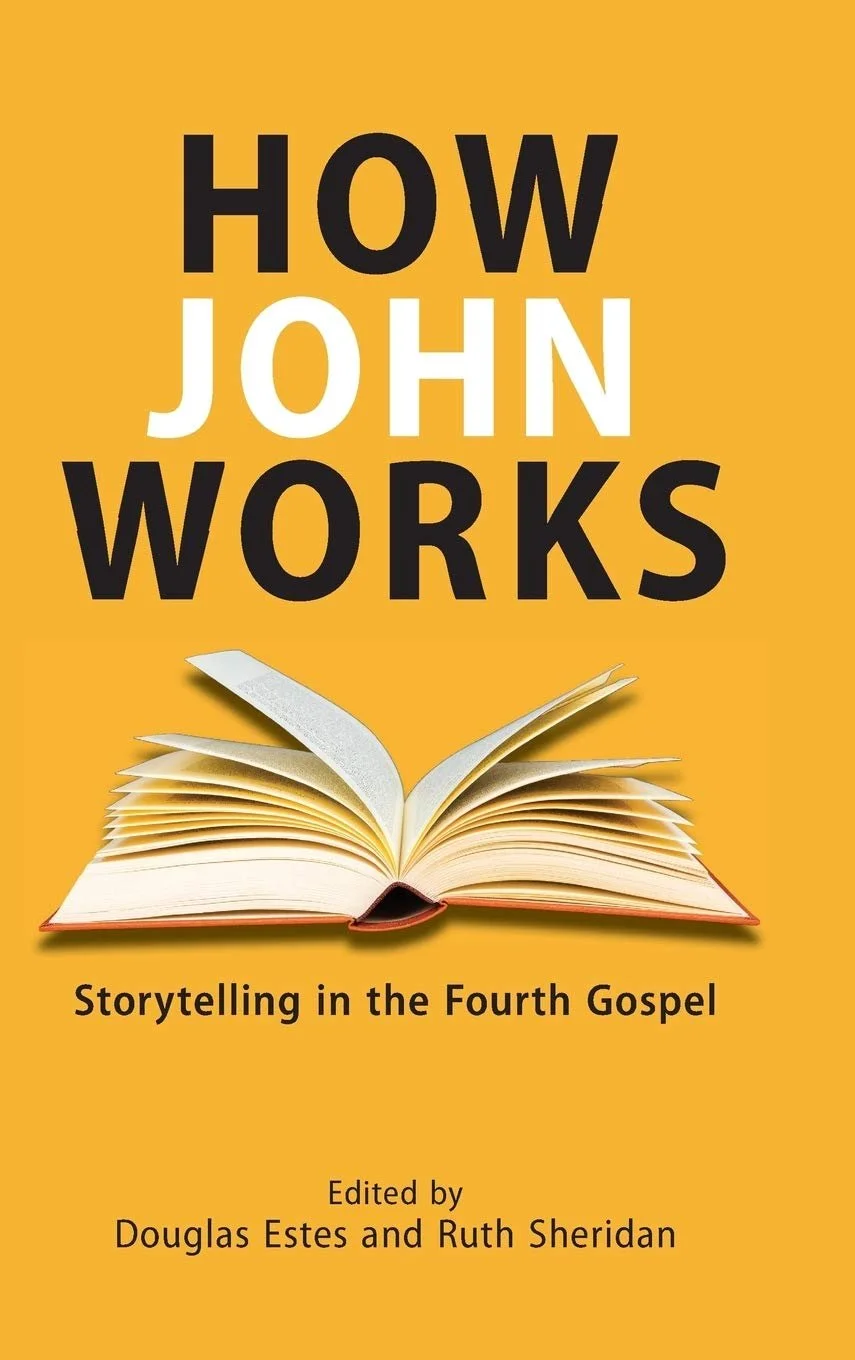
How John Works: Storytelling in the Fourth Gospel
Douglas Estes and Ruth Sheridan, eds.
SBL (2016). 347 pp.
The contributors of the present volume want to take seriously the idea that the Gospel of John is fundamentally a “powerful story” (p.1). Picking up literary examinations of the Fourth Gospel pioneered by Alan Culpepper (Anatomy of the Fourth Gospel), How John Works focuses on examining fifteen narrative components of the Fourth Gospel to calibrate and sharpen our reading of it: genre, style, time, space, point of view, plot, characterization, protagonist, imagery, scripture, rhetoric, persuasion, closure, audience, and culture.
Each essay begins with an educational and (sometimes quite) technical discussion of the literary feature in question prior to illustrating its interpretative significance for readings of the Gospel. Although some readers will find some of the technical portions difficult, others will appreciate the level of detail and scholarly care that has been taken to define the territory under examination. Yet others will perhaps discover rich possibilities for further academic research, for insights in this volume abound.
Since Alan Culpepper himself, as well as Andrew Byers, have recently offered excellent (and overwhelmingly positive) reviews of this volume’s content (see Review of Biblical Literature 07/2017), the present review will aim less to summarize all the chapters and more to illustrate the potential value of this volume for preachers and teachers in the church.
Persuasively arguing that the Fourth Gospel is influenced by the genre conventions of ancient drama, Harold Attridge reveals how the Fourth Evangelist’s dramatic construction powerfully serves in a variety of ways “to display and to invite transformative encounters with the crucified and resurrected Way, Truth, and Life” (p. 22). Dan Nässelqvist examines the “plain,” “middle” and “grand” styles of writing that predominated “during the first centuries BCE and CE” (p. 25), each of which had their own rhetorical functions (to prove, please, or sway). Listening to the sounds of sentences in the Fourth Gospel, for example, whether clashing or soft, can enable the careful reader to detect instances of “veiled or previously unknown irony” (p. 35)—something attentive preachers may well want to do. Time in the Fourth Gospel, demonstrates Douglas Estes, is “warped”, so that “certain ‘massive’ events such as the crucifixion warp the rest of the narrative events toward it” (p. 54). Susanne Luther examines the concept of narrative space, helpfully illumining how “spatial oppositions infer nonspatial meaning” (p. 63); Jesus’ trial before Pilate, for example, which shifts from “inside” to “outside”, invokes a plethora of nonspatial oppositions that ultimately disclose that “Jesus, who is accused on the outside stage is considered innocent on the inside stage” (p.74). Identifying the “five planes on which point of view is expressed in a narrative text: spatial, temporal, psychological, phraseological, and ideological” (p. 81), James Resseguie reflects on features of narrative like “retardation”, which seek to make the “well-known and overly familiar seem unfamiliar” in order, as it were, to “make the stone stony” again (pp. 87–88). Resseguie’s observation that “the changes in names , titles, and epithets—which are often saturated with meaning—are not to be ignored as a marker of point of view” (p. 90), opens up some interesting interpretative insights, as in John 20, where Jesus calls Mary by a variety of different names and titles (see p. 92). Employing A. J. Greimas’ actantial model for reading plot, Kasper Bro Larson talks about how “human beings ‘read for the plot’ to satisfy their desire for meaning” (p. 97). His discussion of the pragmatic and cognitive dimensions of the Fourth Gospel’s plot, as well as how Greimas’ “four phases that the subject (main character) undergoes” (p. 108)—viz., manipulation, competence, performance, and sanction— helps the reader better to understand the (sometimes confusing) role relations and dynamism of this Gospel. Christopher Skinner shows how “the characters of the Fourth Gospel create sympathy among the readers as they are continually pushed toward a decision about the identity of Jesus” (p. 121). In a piece that might be especially inspiring (and perhaps homiletically educational) for preachers assigned with a weekly communicative task, Mark Stibbe shows how the tectonic shift in contemporary storytelling from “telling” to “showing” is an original part of the genius of John’s Gospel, performed as it was originally—orally. Dorothy Lee’s discussion of the “tangled thicket” of imagery in the Fourth Gospel, with the image of the cross winding its way through the entire narrative, is a veritable feast for the preacher, and suggests not a few possibilities for how to preach shorter series from the Fourth Gospel. Rekha Chennattu discusses Scripture and rightly emphasizes that “the words of Jesus are understood as part of the ongoing revelation of God’s interventions in human history and are placed on par with Scripture” (p. 186); critically, the Fourth Gospel shows that “Jesus brought to completion or perfection the entire Scripture for a covenant people that transcends the boundaries of Jewish traditions and history” (p. 186). Suggesting the Fourth Gospel is influenced by ancient rhetoric techniques, Alicia Myers argues that “the gospel proclaims a message meant to convince its audience both of Jesus’s unique identity and the type of discipleship required to follow him” (p. 203). Francis Maloney examines the notion of “closure” in John 20 and 21, concluding that the Fourth Gospel does indeed have two closings: the first (ch. 20) designed to round off the evangelist’s aim throughout the Gospel to generate belief in Jesus; the second (ch. 21) to answer specific questions that arose later within the Johannine community. Differentiating between original, extended, and contemporary aspects of audience, all perceived to exist outside the text, Edward Klink focuses inwardly on the implied audience of the Fourth Gospel, showing how each new generation of the implied reading/listening audience is confronted with Jesus’ seminal question, “What do you seek?”, and invited to “come and see” the Christ for themselves. Finally, Charles Hill argues that the Fourth Gospel was a potent culture-shaping force throughout the first few centuries following its writing in a variety of areas.
Heartily commended.

Ed Gerber (PhD, University of Wales, Trinity Saint David) currently serves as the University Chaplain & Director of Campus Ministries at Trinity Western University in Langley, British Columbia. Before that, he served churches as an ordained minister in Washington State, Iowa, New York, and Langley. Ed is a member of the St. Peter Fellowship of the Center for Pastor Theologians.