The views expressed in this article are of the author only and do not necessarily represent those of the Center for Pastor Theologians.
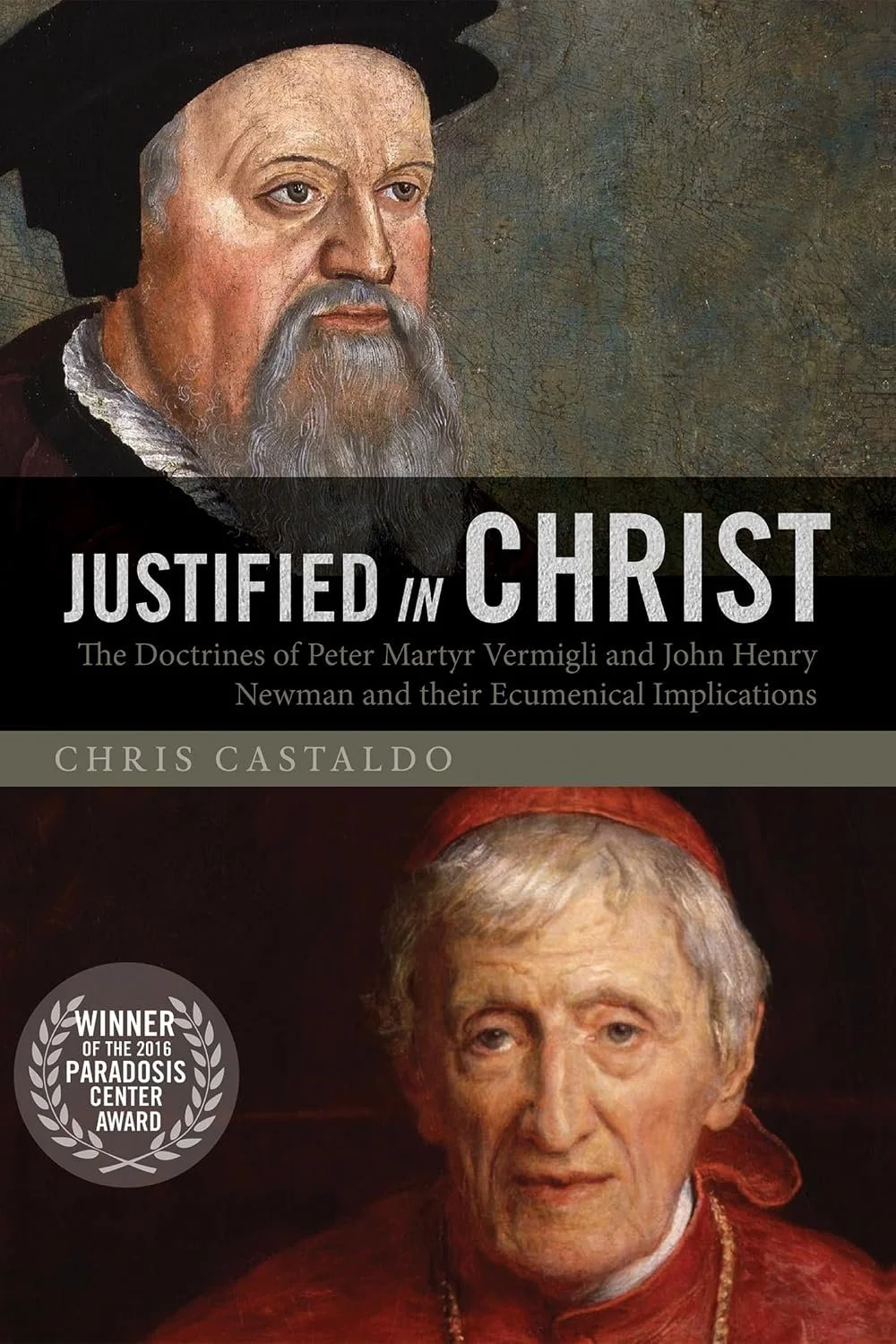
Justified in Christ: The Doctrines of Peter Martyr Vermigli and John Henry Newman and Their Ecumenical Implications
Chris Castaldo
Pickwick (2017). 213 pp.
This well-written and deeply-research book by Chris Castaldo is a must-read for all pastor-theologians who care about both the doctrine of justification and the unity of the Church.
Justified in Christ is the perfect title for this book because it accurately reflects the doctrines of both Peter Martyr Vermigli and John Henry Newman. These are two rather brilliant choices to study for several reasons. Vermigli is an Italian hero of the Protestant Reformation, but less familiar to many Reformed Protestants than Luther, Calvin, Zwingli, or Cranmer. He was also a convert from Roman Catholicism to the Protestant cause. Newman is well-known for his involvement in the Oxford Movement (or the “Tractarians” of the 19th century). He is also famous for converting to Roman Catholicism (originally from Evangelical Anglican to via media Anglicanism to Roman Catholicism). Less well-known is Newman’s understanding of the doctrine of justification, which was right at the heart of his movement toward Rome. Both men were learned theologians (both teaching at times in Oxford), and both articulated unique views on the doctrine of justification. Their views are unavoidably tied up with their historical situations and their personal journeys from one branch of the church to another. Having converted in opposite directions, and articulating unique views on justification, these two great figures make for an especially revealing study. And it is a study full of hope and possibility.
Castaldo organizes his work by analyzing the doctrines of each theologian separately, beginning with Vermigli (since he is historically prior). After examining Newman’s work, he brings the two into comparison. He notes common concerns and commitments between the two as well as their different commitments and conclusions. The final section explores the possibilities for ecumenical conversations between contemporary Reformed Protestants and Roman Catholics, as well as some of the remaining challenges. This section includes an extensive engagement with the Joint Declaration on the Doctrine of Justification signed by the Lutheran World Federation and the Roman Catholic Church on October 31, 1999.
Castaldo highlights two key statements from Vermigli and Newman to illustrate and summarize their respective takes on the doctrine of justification. Vermigli argues, “Since no one has fulfilled or can fulfill (the command to love God with all heart, soul, and strength), it follows that we should fly to Christ through whom we may be justified by faith. After being justified, we may in some way begin to do what is commanded, albeit imperfectly” (p. 45). Conversely, Newman argues, “Justification comes through the sacraments; is received by faith; consists in God’s inward presence; and lives in obedience” (p. 105). Between these two different definitions of the doctrine, a uniquely remarkable amount of overlap exists between the two figures.
There is so much good research in this book that the theological specialist will want to read slowly and dig into the footnotes. For the learned reader serving as a pastor-theologian, it may suffice to focus on Castaldo’s take on the commonalities and differences between Vermigli’s and Newman’s understanding of justification. Their stories are fascinating, and contribute importantly to their formulations, but one can begin by looking at their conclusions before deciding to dig deeper.
What are those common concerns and commitments? Both are opposed to “works righteousness,” or the idea that a person earns justification by inherent merit. Accordingly, both affirm “imputed righteousness” (forensically understood) as an essential aspect of justification. Both are also opposed to “cheap grace,” or the idea that one can be right with God without conforming to holiness. Accordingly, both hold that forensic and actual/operative righteousness should be held together, and that both can be discussed under the rubric of justification. Vermigli believes that justification, regeneration, and sanctification are very closely related, almost like a “triple grace.” At the same time, both theologians distinguish between forensic and actual/operative righteousness. For both Vermigli and Newman, these must go together, but can be distinguished, even if they define the distinction in different ways.
For common commitments, Vermigli and Newman both share an Augustinian view of sin. Humans are utterly lost and without hope apart from the grace of God. They also both affirm the believer’s union with Christ as the key to obtaining all benefits of salvation, especially justification. Relatedly, both affirm the need for the gift of the Holy Spirit, and that believers must be transformed to produce good works. Taken all together, Vermigli and Newman both hold that justification includes a “two-fold righteousness” (duplex iustitia). This means both imputed and actual righteousness go together as part of one doctrine, even if the relationship between the two differs somewhat between the two men. Both believe in free pardon and true renovation of the character.
Despite all these commonalities, some important differences remain. One is Newman’s insistence on the instrumental value of the sacraments for the giving/receiving of justification. This corresponds to his view of the church as an objective body, determined by baptism (and baptismal regeneration). They also differ on the idea of sola fide. For Vermigli, faith is the only instrument for laying hold of justification. But Newman sees faith as just one of several things needed for justifying righteousness, along with the sacraments, love, and obedience. They disagree on the formal cause of justification. For Vermigli, it is the imputed righteousness of Christ. For Newman, it is divine indwelling. This divine indwelling is an “uncreated grace,” because it is the presence of the Holy Spirit. Naturally, this indwelling is righteous indeed, and makes the believer righteous in character. Surprisingly, they differ on the idea of perseverance. For Vermigli, perseverance in faith is a natural and logical result of imputation. But Newman understands justification as something that can increase or decline in a person. In fact, it can even be lost when a person sins. Persons can be restored, but this isn’t automatic. They must seek to be justified again. This is surprising because one might think that an objective, sacrament-based notion of justification, that even includes an element of imputed righteousness, would lead to a strong belief in a fixed and permanent justification. Lastly, Vermigli and Newman disagree on the notion of merit. For Vermigli, our righteous actions are the fruit of the Holy Spirit’s work, and will receive reward, but they are never meritorious in terms of putting God in one’s debt. Newman believed that good works could be genuinely meritorious. The works are “real” in the sense that they come from the person, even if the renovation of a person comes from God.
Castaldo has done us all a great service by bringing Vermigli and Newman into conversation, as it were, to probe the possibilities for further ecumenical conversations on justification, and to highlight the remaining challenges. I recommend this work to all who wish to better understand both the Reformed Protestant and the Roman Catholic doctrines of justification. You will learn more about both in this book. Even if you are a working theologian or learned pastor, you will learn a lot here. The story of justification is not as clear, cut and dried as it is sometimes portrayed (i.e., “This is what Catholics believe… this is what Protestants believe”). There are inaccuracies and caricatures present in churches and seminaries. The whole discussion cannot be reduced simply to Luther and Calvin on one side (and even they are not identical!) and the Council of Trent on the other. It is important to take these things seriously because this doctrine has re-emerged as an important topic of discussion, and there is some confusion in our churches.
Given that we are approaching the 500th year anniversary of the Protestant Reformation, and given that contemporary global challenges are pushing Nicene-orthodox Christians to reconsider their relationships to one another amidst growing adversity and opposition, this book could not be more timely. We need to engage in these discussions deeply, so that we can work together and love and support one another as Christians of different convictions. Castaldo has provided us with a model for how to study and learn from various theological voices, and then how to assess their value and relevance for the current moment. I highly recommend this book, and especially commend it to those who are eager to understand the doctrine of justification (for both devotional and pastoral reasons) and for those who might think they already know all there is to know about it. Vermigli and Newman will surprise you.

Jonathan Huggins (PhD, University of Stellenbosch) is the College Chaplain at Berry College in Rome, GA. He is an ordained Priest in the Anglican Church in North America and a member of the St. Peter Fellowship of the Center for Pastor Theologians.