The views expressed in this article are of the author only and do not necessarily represent those of the Center for Pastor Theologians.
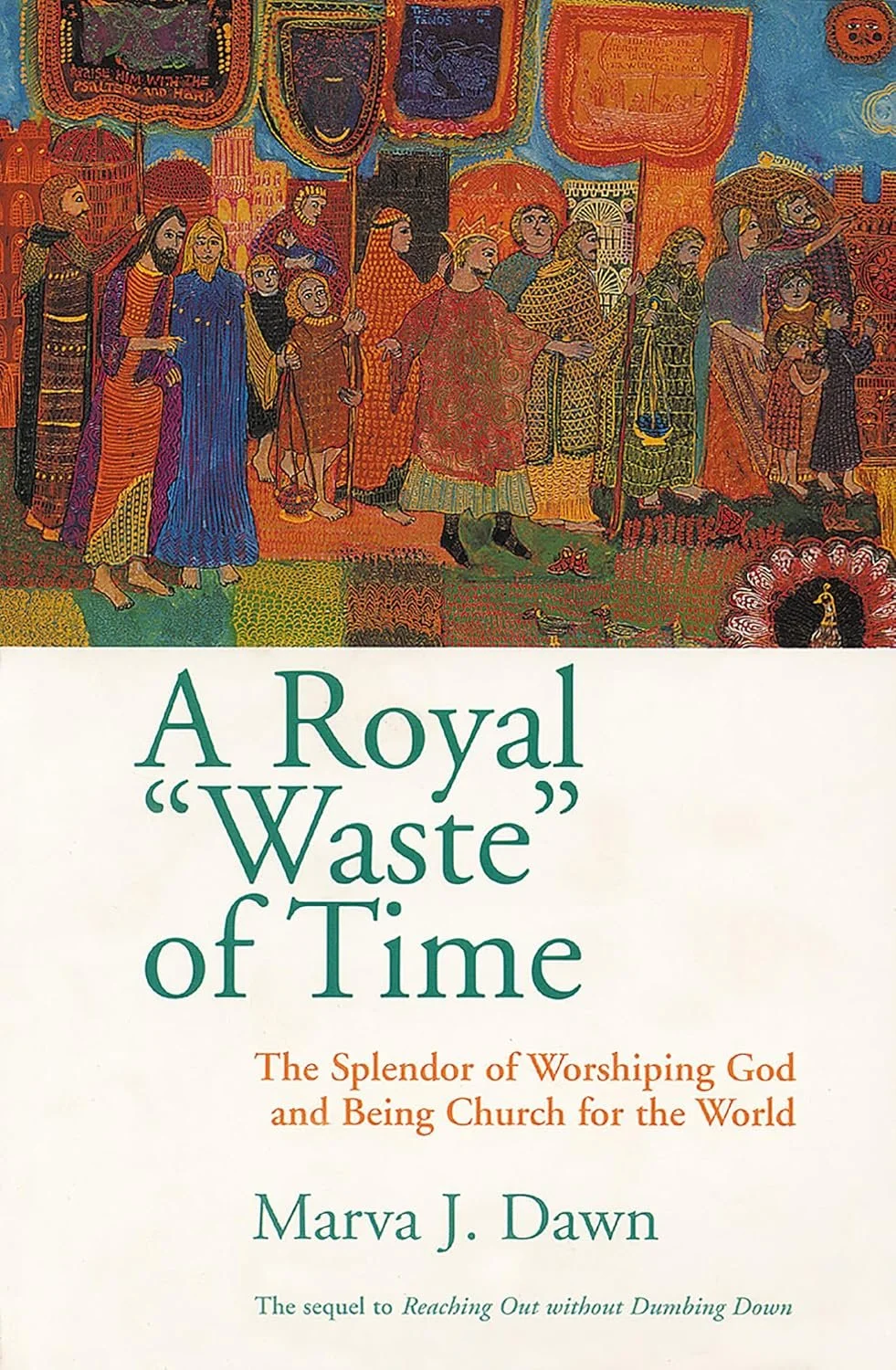
A Royal “Waste” of Time: The Splendor of Worshipng God and Being Church for the World
Marva J. Dawn
Eerdmans (1999). 377 pp.
Given the torrent responses to Reaching Out Without Dumbing Down (1995), Dawn offers this sequel. Her intent is not so much to offer new or sustained theological arguments, but to elaborate on questions arising from her first book by offering a “sampling of responses, advances, [and] new ideas from all those discussions” (p. 6). Even with this aim stated, Dawn nevertheless manages to pull her ruminations (and not a few sermons) together into coherent shape over six sections, thirty-one chapters, of her book.
As with Reaching Out, Dawn begins in Part I of her sequel with cultural criticism, focusing in this work on postmodernity, the dangers of a dumbing and numbing media presence in our lives (especially television), and consumerism. Parts II–VI then variously show how genuine worship—that is, worship which emphasizes the centrality of God and his sacred story/Scripture (Part II), building community (Part III), character formation (Part IV), and making choices and facing challenges while keeping these emphases in mind (Parts V and VI)—guards and equips the Church from succumbing to the harmful characteristics of the aforementioned cultural influences.
Once again in kind with Reaching Out, Dawn’s central contribution in this work resides in her keen and pervasive cultural critique as it applies to dangerous trends in the North American Church. Dawn wrote this book some sixteen years ago amidst the heyday of the “worship wars” and many church’s love affair with the “successes” of Willow Creek. But her insights seem no less relevant for this fact. Specifically, as Dawn establishes the radical loss of historical time, individualism, and various consumerisms (material, relational, emotional) of the current age, she wants us to stop turning our worship services into evangelistic crusades and/or services that are simply catering to what people “want”. Both of these tendencies are dangerous, and may prove deadly for the future of the church.
In the first place, turning our worship services into evangelistic services or “seeker services” is a major category mistake, Dawn argues, because while the latter may have validity, the two are not the same. Worship’s end is the glory of God, designed as worship for the ongoing formation of the disciple amidst an eschatological community of disciples. Evangelism’s end is winning disciples. Thus, properly understood, whereas evangelism is the means by which people are to be drawn into worship, worship is not the means by which people are to be drawn in to be evangelized. Instead, becoming enfolded in the God-centred, Word-centred, death-to-the old-self and being-formed-in-the-new worship of the local church is the end of evangelism. Put otherwise, what happens on Sunday morning must not be tailored to unbelievers, even while being sensitive to their potential presence. Why? Because the Church at worship is not a “vendor of religious services and goods” but a “body of people sent on a mission” (p. 121, quoting George Hunsberger). To start pretending or acting as if worship is for the purpose of evangelism—and to start throwing off age long traditions and ritual in order to shape the services in this direction—is to slip into a marketing mindset that enshrines the spirit of advertising, a rather dangerous modality for the church! As Dawn insists while quoting John Kenneth Galbraith, we must think about it: “the basic purpose of advertising is to get people to buy something they don’t need” (p. 123). Thus, if one accepts McLuhan’s dictum that the “medium is the message,” the church’s embrace of “advertising” to win converts (and or keep parishioners) is a most dubious modality indeed, for it conveys the message that the church is selling something to be consumed and that this something is, at the end of the day, “something people don’t need—a superficial, magical God” (p. 123).
A similar problem obtains with turning our worship services into events that cater to disciple’s tastes and desires. In short, we play directly into the hand of all that is most alarming about our current cultural climate while severing the followers of Jesus from some of the Church’s most longstanding and powerful means of grace. To offer just one example of many, in our television and image saturated age, the image takes precedence over the word. Correspondingly, because images are incapable of logical argumentation, but play on emotion and the elicitation of instant impressions, people’s patience for rational argumentation diminishes in favor of nebulous feelings of well-being until one’s happiness becomes the sole goal of one’s existence. Naturally this loss of patience and capacity to follow an argument in favor of a life of instant and un-abating happiness militates against a faith that is reasonable, cruciform, and calls for the subordination of (ever-shifting) feelings to truth. In rearranging our services to be more appealing, therefore, or to simply try to engender good feelings in parishioners in the here and now, is to collude with forces that are damaging to the faith. As Dawn articulates it: it is to play our hand to a population who has been conditioned to hunger for “strong sentiments for their own sake and not as a response to spiritual truths” (p. 90). We feed the “ceaseless consumption of novelty” (p. 90, quoting Colin Cambell). We facilitate the eclipsing of “the object of Christian belief . . . by interest in the subjective act of believing” (p. 91, quoting Craig Gay in “Sensualists without Heart”, p. 30). Most perilously, in exchange for a faith rooted in the past and buoyed by hope for the future, we collude with “our culture [which] invites us to locate the sum total of human happiness here and now and in the consumption of the fruits of the technological economy” (p. 92, again quoting Gay). We are implicitly divorced, in other words, from all that is most enduring, sustaining, and important. The net danger, suggests Dawn by appeal to Alexis de Tocqueville’s prophetic take on the American situation as whole, is that, if the church continues down this road, its members will “finally become so engrossed in a cowardly love of immediate pleasures that their interest in their own future and in that of their descendants may vanish, and that they will prefer tamely to follow the course of their destiny rather than make a sudden energetic effort necessary to set things right” (p. 93). Not only will this happen, concludes Dawn, but it is happening, as can be seen in our worship—which is, again, why she wrote this book:
for two of the symptoms [de Tocqueville] named concerning society are now manifested in churches conflicts over worship—namely, (1) lack of concern about the future, for many churches throwing out their heritage do not recognize that deep discipleship for the long haul cannot be built on worship not rooted in the deeper wisdom of the larger Church as it has been immersed in the splendor of God; and (2) a tame following of the present course in that congregations are not willing to expend the “sudden energetic effort necessary to set things right” by building genuine community and working on the worship issues in a way that asks the right questions (p. 93).

Ed Gerber (PhD, University of Wales, Trinity Saint David) currently serves as the University Chaplain & Director of Campus Ministries at Trinity Western University in Langley, British Columbia. Before that, he served churches as an ordained minister in Washington State, Iowa, New York, and Langley. Ed is a member of the St. Peter Fellowship of the Center for Pastor Theologians.