The views expressed in this article are of the author only and do not necessarily represent those of the Center for Pastor Theologians.
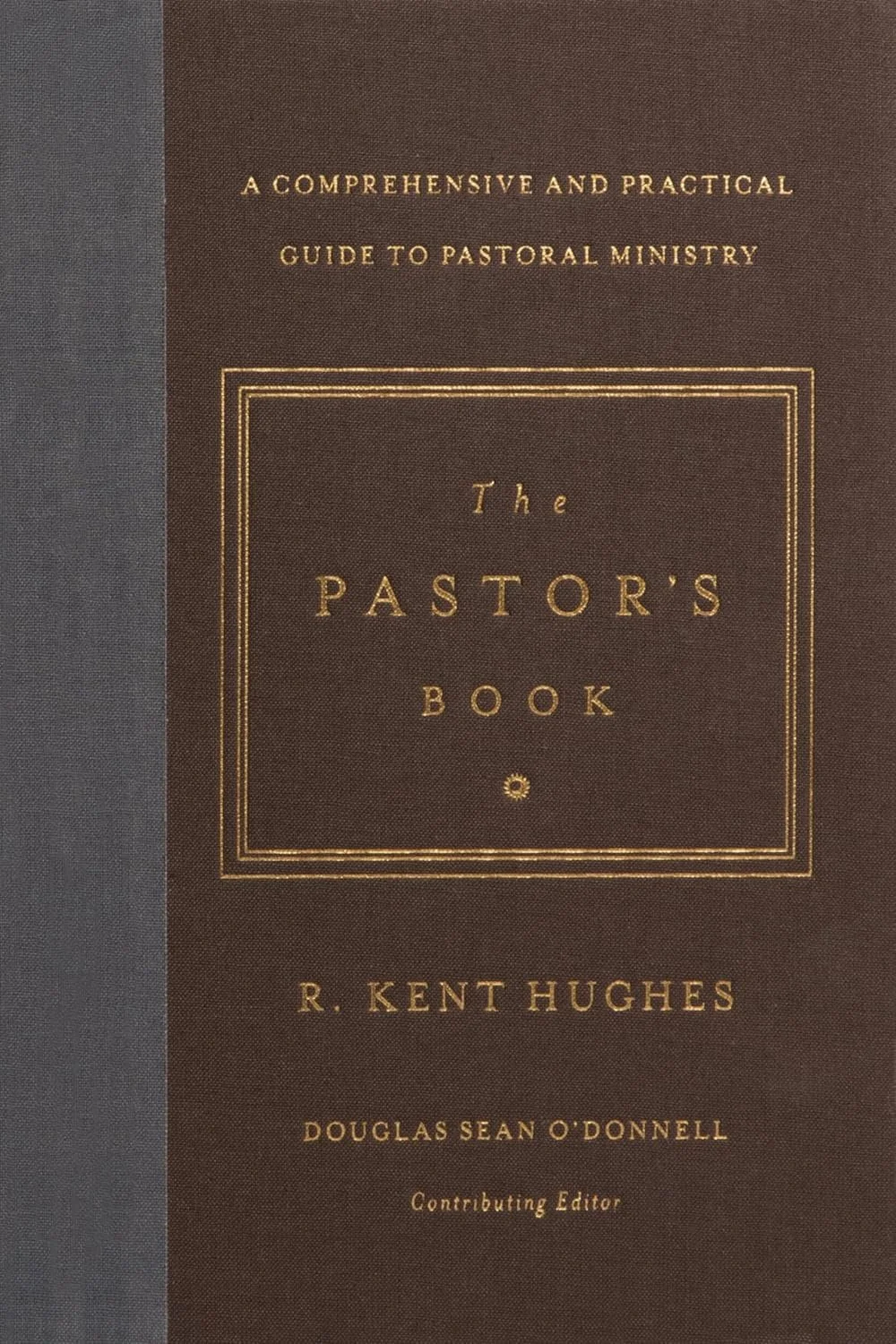
The Pastor’s Book: A Comprehensive and Practical Guide to Pastoral Ministry
R. Kent Hughes and Douglas Sean O’Donnell
Crossway (2015). 592 pp.
The genesis of this book reaches back to the early 1980s, before Kent and Barbara Hughes published Liberating Ministry from the Success Syndrome (1987). That book chronicled crucial lessons that Kent had learned planting a church in southern California. Despite optimism from a strong call, gifted core group, favorable social demographics, and financial support, the ministry languished. Meanwhile, just down the road another evangelical church was mushrooming, the pastor of which can still be heard on national Christian radio offering insight for living. The ensuing discouragement is something about which Kent has been candid:
My long-established world of bright prospects and success had melted around me. I was in the darkest, deepest depression of my life. My memory of this time is of a gray, horizonless sea. A faint light falls from a threatening sky and I am treading water alone, sinking. Soon, I will be below the surface. Melodramatic, to be sure! But that is how I felt. I wanted out (p. 19).
Coming out of these ashes, Kent turned his attention to another definition of ministry success and another kind of encouragement, both of which were trenchantly God-centered. A crucial part of this story, however, is not developed in Liberating Ministry. Kent turned his attention to the Great Tradition in order to mine Christ-centered resources for building pastoral ministry. And that leads us to the book under review, which is an outgrowth of Kent’s ressourcement project, aimed at bringing the most eminent standards of evangelical Christianity to bear upon the services, practices, and ordinances of the local church. The outcome is a delightfully detailed go-to manual of 592 pages that offers wisdom on each of these subjects.
Full disclosure: I am a biased reviewer. Having served under Kent for years at College Church in Wheaton and having followed my friend Doug O’Donnell in my current ministry post, I am favorably disposed to this book. I hope, however, that rather than being a liability, this will enable me to offer an added dimension of insight.
This volume does not suffer from superficiality, a common defect among books that employ the word “comprehensive” in the title. Yes, it is broad. On a macro level it covers “Christian Gatherings,” “Parts of the Worship Service,” and “Ministerial Duties.” Below each of these headings is a litany of lessons, principles, examples, treatises, protocols, selections of poetry, and liturgical outlines. Its Teutonic Gründlichkeit is evidenced in a detailed table of contents, which unfolds for eight full pages. But superficial it is not. In addition to substantive analysis of a given subject, it also provides a host of resources (including sample homilies for marriages and funerals) in the appendix.
O’Donnell is the ideal person to coauthor this book. Because he reflects Kent’s inclinations and ethos more than anyone, he preserves a portrait of God-centered worship that genuinely elucidates the heartbeat of Kent’s four-decade legacy. This personal familiarity enables O’Donnell to retrieve illuminating quotes from Kent’s past, such as the following:
I have come to see that while all of life is worship, gathered worship with the body of Christ is at the heart of a life of worship. Corporate worship is intended by God to inform and elevate a life of worship. In this respect, I personally view how we conduct gathered worship as a matter of life and death (p. 29).
Given the commitment of this volume to God-centered ministry, it is a bit surprising that O’Donnell begins chapter one with Kent’s biography. One might have expected him to initiate the book with a reflection on the beauty and supreme worth of God, especially since Doug is such an evocative writer and quite capable of stirring the heart and theological imagination. This is but a small critique. Kent’s story belongs near the front. Not only is it interesting, it serves a crucial purpose of setting up the God-revering ethic that follows through subsequent pages.
Our authors are clear about the limits of this book: “We wanted to center on pastoral tasks we have thought a lot about and that we feel are often neglected or overlooked, especially by the younger generations of pastors” (p. 17). These tasks are mostly liturgical in nature, such as Sunday worship, annual services, weddings, funerals, public prayers, the use of creeds, hymns and songs, baptism, and communion. They also cover pastoral counseling and hospital visitation. Finally, they acknowledge the importance of such topics as calling to ministry, personal character, family life, and preaching by offering a “Books for Further Reading” section replete with such resources.
With The Pastor’s Book sitting on my desk for the last month, I have opened it numerous times. Each time I have been impressed by its insight. I expect to open it again. In fact, I think I’ll add it to the small collection of books that permanently reside within my reach.

Christ Castaldo is the Lead Pastor at New Covenant Church in Naperville, IL, and is a member of the St. Peter Fellowship at the Center for Pastor Theologians. He writes regularly on his personal blog and has published numerous books on the relationship between Protestantism and Catholicism. His most recent work is The Upside Down Kingdom: Wisdom for Life from the Beatitudes (Crossway, 2023).