The views expressed in this article are of the author only and do not necessarily represent those of the Center for Pastor Theologians.
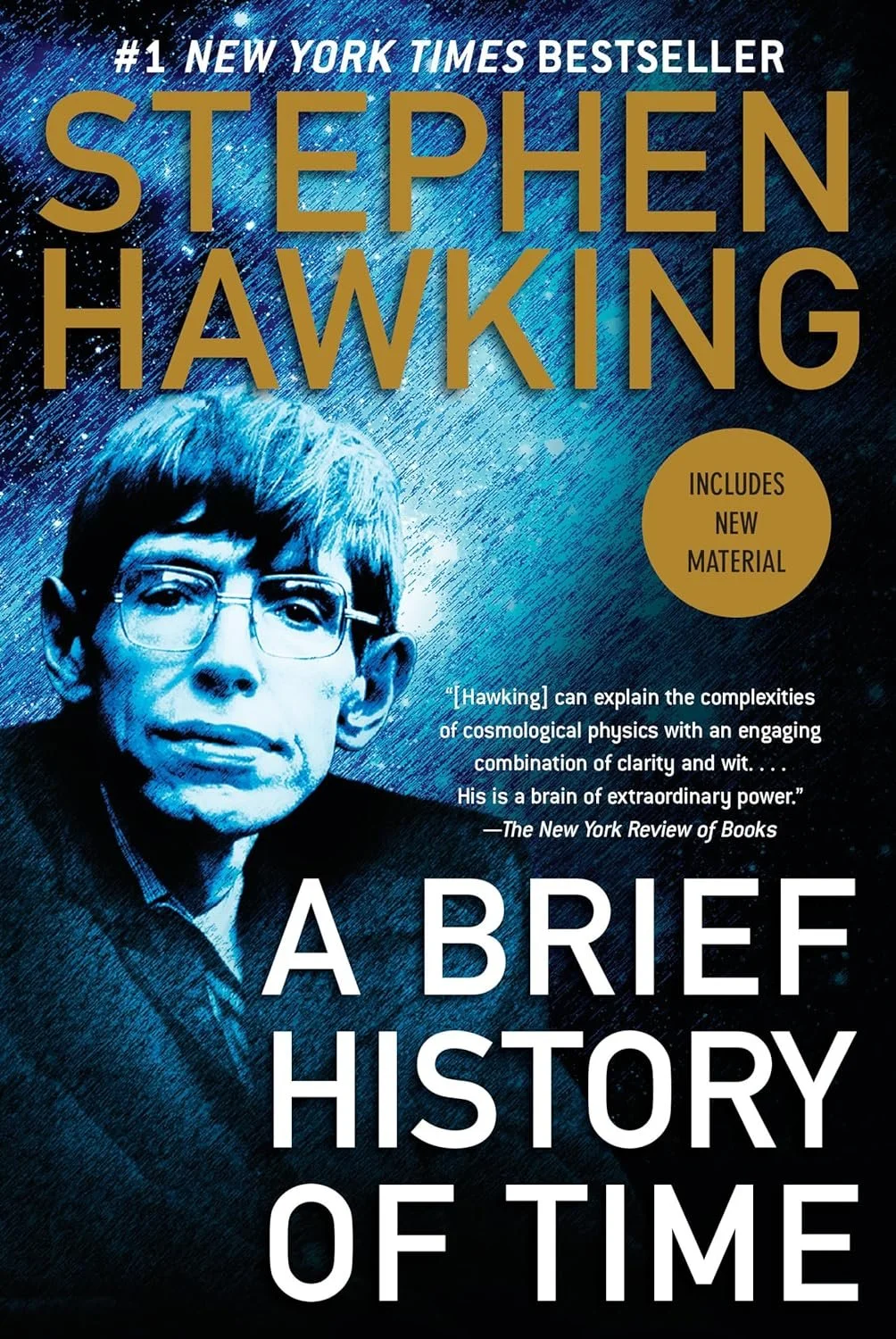
A Brief History of Time: From the Big Bang to Black Holes
Stephen Hawking
Bantam (1990), 198 pp.
Stephen Hawking has been the Lucasian Professor of Mathematics at Cambridge for thirty years and serves as the Director of Research for its Centre of Theoretical Cosmology. Hawking is also a Fellow of the Royal Society and has received the Presidential Medal of Freedom. What seared him on the public consciousness, however, was his decision to write a popular-level work on theoretical physics: A Brief History of Time. In my younger days as an engineer, I fancied myself an armchair physicist. It seemed obvious that when I transitioned into pastoral ministry I should also transition into cosmology; so I picked up a copy of Hawking’s famous book. It was a fascinating read then, and I still recommend it as a primer on general relativity and quantum mechanics.
When I say “popular-level,” I mean the equations have been replaced with illustrations (it even includes a glossary). In relatively few pages Hawking explains how the human concept of the universe has evolved over the centuries so effectively that most readers should have no problem realizing the significance of even high-level concepts such as the three Friedmann models of the universe. Hawking defines the uncertainty principle so clearly that quantum mechanics almost makes sense. He also describes the 1980s model of elementary particles, anti-particles, and force particles in a way that holds up against the more recent discoveries. Most importantly, Hawking shares the passion of his own part in the pursuit of a unified theory with such fervor that even the most uninformed reader will be drawn in. This “theory of everything” dominates Hawking’s thought. He is not simply interested in the origin and fate of the universe; he sees the pursuit of a complete theory of the universe as a search for “the mind of God” (p. 175).
But Hawking is an atheist. His “God” has nothing to do (p. 141). Seeking the mind of God simply means seeking all knowledge, which he believes humans are capable of knowing. This book lays the groundwork for Hawking’s noncontingent universe. He uses the uncertainty principle, the foundation for his understanding of quantum mechanics, to destroy determinism (p. 55, cf. p. 12) as well as any meaningful concept of truth. He applies the theory of relativity not simply to a relative experience of time’s passage, but argues that time itself is relative. Consequently, if both time and space are relative (by practical implication curved), then it is “meaningless to talk about space and time outside the limits of the universe” (p. 33), not because those limits exist but because they are curved back on themselves, much as a sphere can be thought of as infinite from a two-dimensional perspective (cf. pp. 44, 116). Hence, a universe without beginning or end.
Pastors should be concerned. Hawking begins his book with a humorous response to an astronomy lecture: “What you have told us is rubbish. The world is really a flat plate supported on the back of a giant tortoise.” When asked what the tortoise was standing on, the doubter continued, “You’re very clever, young man, very clever. But it’s turtles all the way down” (p. 1). As much as he tries to justify himself (and discredit theism), that is what Hawking himself offers in this book—an infinite stack of turtles (Hawking would likely say that they curve back on themselves). Sometimes answers like this are all that can be given. For example, force particles cannot be detected, and so they are said to be “virtual” (p. 69). Other times Hawking has no better option. For example, he associates the fine-tuning argument of creation (including arguing that a number of initial conditions of the universe would all result in the same current condition, pp. 124–32) with the weak anthropic principle, even using it to demonstrate why there are only three space dimensions (pp. 164–65). He resorts to the many-universes theory (called here the “sum over histories” and “imaginary time”) to keep a Creator away from his finely-tuned universe. The most important proposal of this book, that quantum mechanics demonstrates a finite universe without a boundary, is itself “metaphysical” and unprovable (p. 136).
For anyone interested in Hawking’s more recent thought, the sequel to A Brief History of Time is The Grand Design with Leonard Mlodinow (not A Briefer History of Time, also with Mlodinow, which is a disappointing abridgment and reorganizing of the former). In The Grand Design, Hawking uses quantum mechanics to explain the idea of the multiverse in much greater detail. Most importantly, he is able to put more flesh on the bones of string theory (which was still young in the 1980s), declaring it the only viable candidate for a “theory of everything.” According to Hawking, string theory removes the singularities that demolish general relativity, which in turn provides the occasion for Hawking to explain much more clearly his alternative to the singularity known as the Big Bang as well as black holes.
Anyone who reads this review should appreciate the underlying tension of A Brief History of Time: Hawking has isolated himself from philosophical or theological engagement. In his conclusion he notes that philosophers have not been able to keep up with scientific theories and thus have no place in any meaningful discussion because they cannot contribute anything of value (p. 174; cf. his response to the Pope, p. 116). I do not know what the answer is to that exclusion. I am an honors graduate in engineering, and I cannot begin to understand the mathematics. But that does not mean there should be two separate and mutually exclusive discussions of ultimate truth (or even can be).

Matt Ward (PhD, Southwestern Baptist Theological Seminary) is the Associate Pastor at First Baptist Church of Thompson, GA. He is a member of the St. John Fellowship of the Center for Pastor Theologians.