The views expressed in this article are of the author only and do not necessarily represent those of the Center for Pastor Theologians.
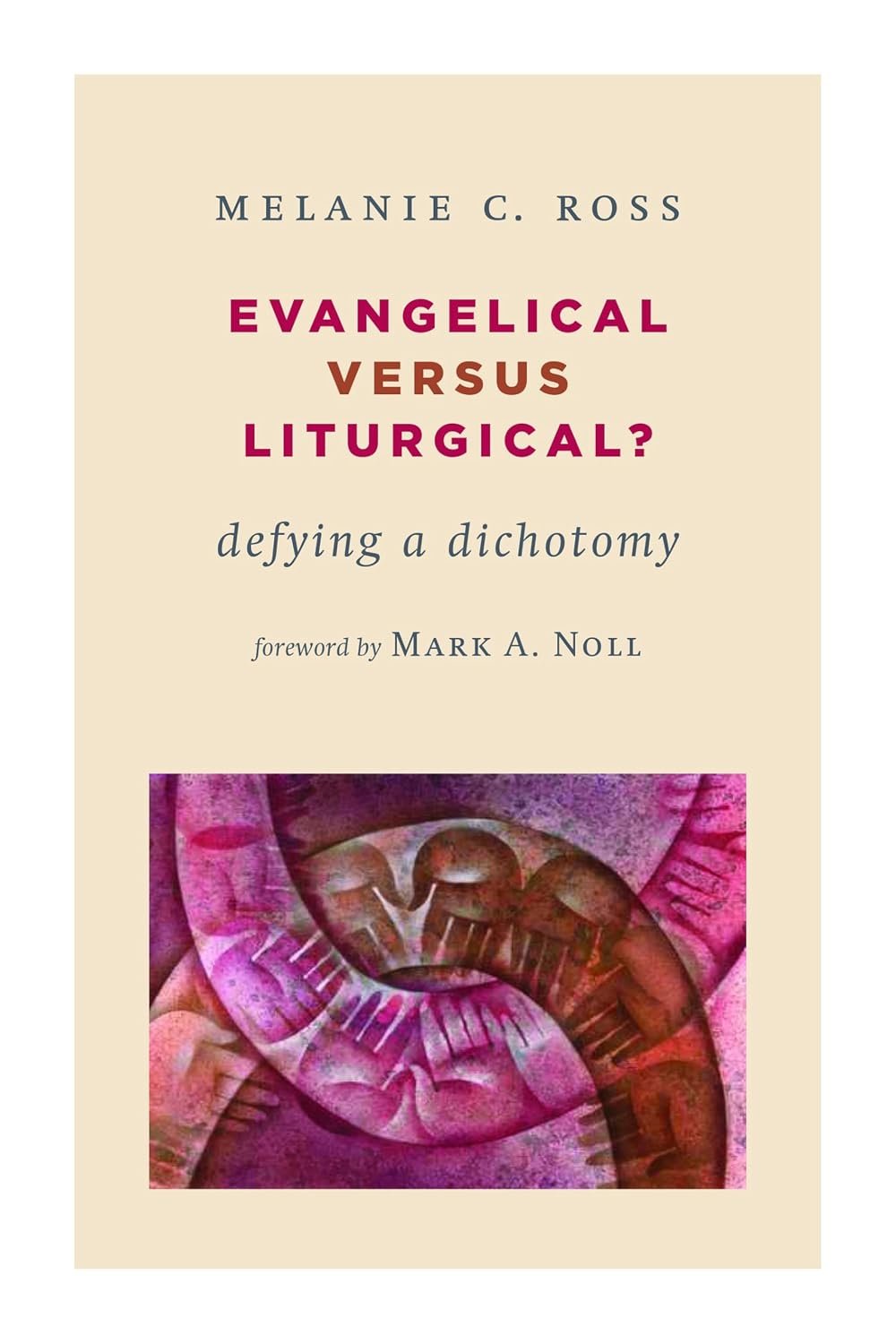
Evangelical Versus Liturgical? Defying a Dichotomy
Melanie C. Ross
Eerdmans (2014). 149 pp.
Melanie Ross has provided us with a very promising work addressing what some have called the “worship wars.” In this short volume, Ross deals most directly with a perceived dichotomy between “liturgical” and “evangelical” worship services. Her work is relevant to current church discussions on worship style given the dual trend of liturgical attraction and contemporary style among younger believers. In the Foreword, Mark Noll notes,
The result of her pioneering effort is a challenge to scholars of liturgy to recognize that ‘free churches,’ which may be inert to traditional or formal liturgical studies, nonetheless can possess responsible (if unconscious) liturgical traditions. Along the way it shows that these churches have often developed insights about worship that formally trained liturgical scholars need to appreciate, and that these churches deserve a place at the table in liturgical study more generally (p. x).
We have worship music-oriented movements such as Passion and Hillsong music, which are duplicated all over North America on any given Sunday. And we have the emergence of many new Anglican churches (and others) which attract young people and offer a more historic version of Christian liturgy. These two impulses would seem to reflect a rather pervasive dichotomy in worship style. However, Ross argues that the dichotomy is not so pervasive, and is not necessary, if believers from both high and low church traditions can learn to consider one another more justly.
Ross is assistant professor of liturgical studies at Yale Divinity School and the Yale Institute for Sacred Music. This book is a kind of practical distillation of her doctoral thesis, with most of the technical jargon replaced with highly-readable prose. Her work begins by introducing the problem and leading the reader through a discussion on the historical origins of evangelical worship styles. Though Charles Finney is often thought to be paradigmatic of this style, with his threefold ordo of warm up, sermon, conversion, Moss suggest that George Whitefield may be a better model of evangelicalism. His approach brought together believers of diverse backgrounds (an ecumenical vision) united around the “New Birth.” Along the way Ross is critical of liturgical scholars like James White who seem unfairly prejudiced against evangelical worship styles.
The next section presents the first of two church case studies. This one focuses on a nondenominational megachurch in Milwaukee called Eastbrook church. It is a fascinating and extremely diverse congregation with a rich combination of spiritual fervor and theological depth. The story of this church (and the other one in case study #2) make for interesting reading. In this case, she uses the chapter to reflect some on the role of theological difference in shaping liturgical preference. Some churches defy the dichotomy between pragmatism and ecumenism, but Ross wants to note that theological differences between liberal and evangelical Christians pose a greater threat to unity than worship style.
The next section discusses the relationship between scripture and liturgy. For Ross it is not the case that liturgical churches are more biblically sophisticated and nuanced while evangelical churches are more hermeneutically immature. Rather, evangelicals make their own nuanced and sophisticated contributions to biblical and theological interpretation. To show this she brings together some interesting discussion partners: Aiden Kavanagh, Louis-Marie Chauvet, and Gordon Lathrop on the liturgical side, John Webster and Kevin Vanhoozer on the evangelical side. Readers will enjoy the resulting sparks.
In the next section Ross addresses the criticism of Gordon Lathrop that some aspects of (what he calls) the “frontier tradition” look more gnostic than Christian. Ross disagrees with this assessment, and looks to the work of Miroslav Volf, After Our Likeness (1998), for a more favorable assessment of evangelical thought. This section also contains a comparison between the Fourth Gospel’s relationship to the Synoptics and evangelicals’ relationship to the ecumenical tradition. Ross finds parallels between John’s Gospel and evangelicals, such as an emphasis on personal faith, de-emphasizing hierarchical offices, and the prioritization of Christology (pp. 92–98). All of this serves the goal of showing “that nonsacramental Christianity is one faithful way of embodying the shared confession of faith” (p. 99). Ross certainly values sacramental liturgy. But she advocates for a “both-and” model rather than an “either-or” one.
The second case study looks at West Shore Evangelical Free Church in Mechanicsburg, Pennsylvania. This church also defies the dichotomy of liturgical verses evangelical. The church serves about 2500 people a week. The pastor has a PhD in theology from Cambridge, and the congregation serves the local community in numerous ways. They have a coherent theological model that guides their church- “Becoming like Jesus: Head, Heart, Hands, Knees, Feet.” It’s another example of a lively evangelical church with a rich theological rationale for it worship and ministry. Ross concludes, “West Shore stands as a powerful reminder that the full range of worshipful responses to the gospel cannot be specified in advance” (p. 124). These examples show that evangelical churches have something to offer the liturgical tradition. Ross is not arguing that such churches should be merely tolerated as permissible, but that they actually contribute to our worship theology and practice.
This is an especially important book for anyone who thinks that high church, historic liturgies are best. And all the more important if one supposes that approach to be the most biblical, theological, and formative for a Christian community. Her research clearly demonstrates that there are evangelical churches that do not use the ecumenical ordo (word, bath, table, prayer), but who are nonetheless thinking deeply about their worship gatherings. These evangelical churches care very much about biblical and theological faithfulness and depth. They also care very much about shaping the lives of their members in a Christ-like direction. This is the real strength of the book. Though thoroughly immersed in the study of the Church’s historic liturgies, Ross does not argue that evangelicals need to become more like the “liturgical” churches. She wants evangelicals to appreciate and know liturgical theology, but she doesn’t prescribe the ecumenical form for everyone. She actually shows how evangelical churches can be faithful and intelligent in crafting worship services that still reflect evangelical roots. Ross believes that the church can do better, in finding common middle ground, than the false dichotomies of liturgical/ evangelical will allow. Her work is a positive contribution toward that end.
Pastors, and others who lead in worship, should be intentional and thoughtful in preparing worship services. Listening to wisdom from the past and learning from good contemporary models is always a fruitful endeavor. This work will help church leaders think well about worship, and lead to richer worship services.

Jonathan Huggins (PhD, University of Stellenbosch) is the College Chaplain at Berry College in Rome, GA. He is an ordained Priest in the Anglican Church in North America and a member of the St. Peter Fellowship of the Center for Pastor Theologians.