The views expressed in this article are of the author only and do not necessarily represent those of the Center for Pastor Theologians.
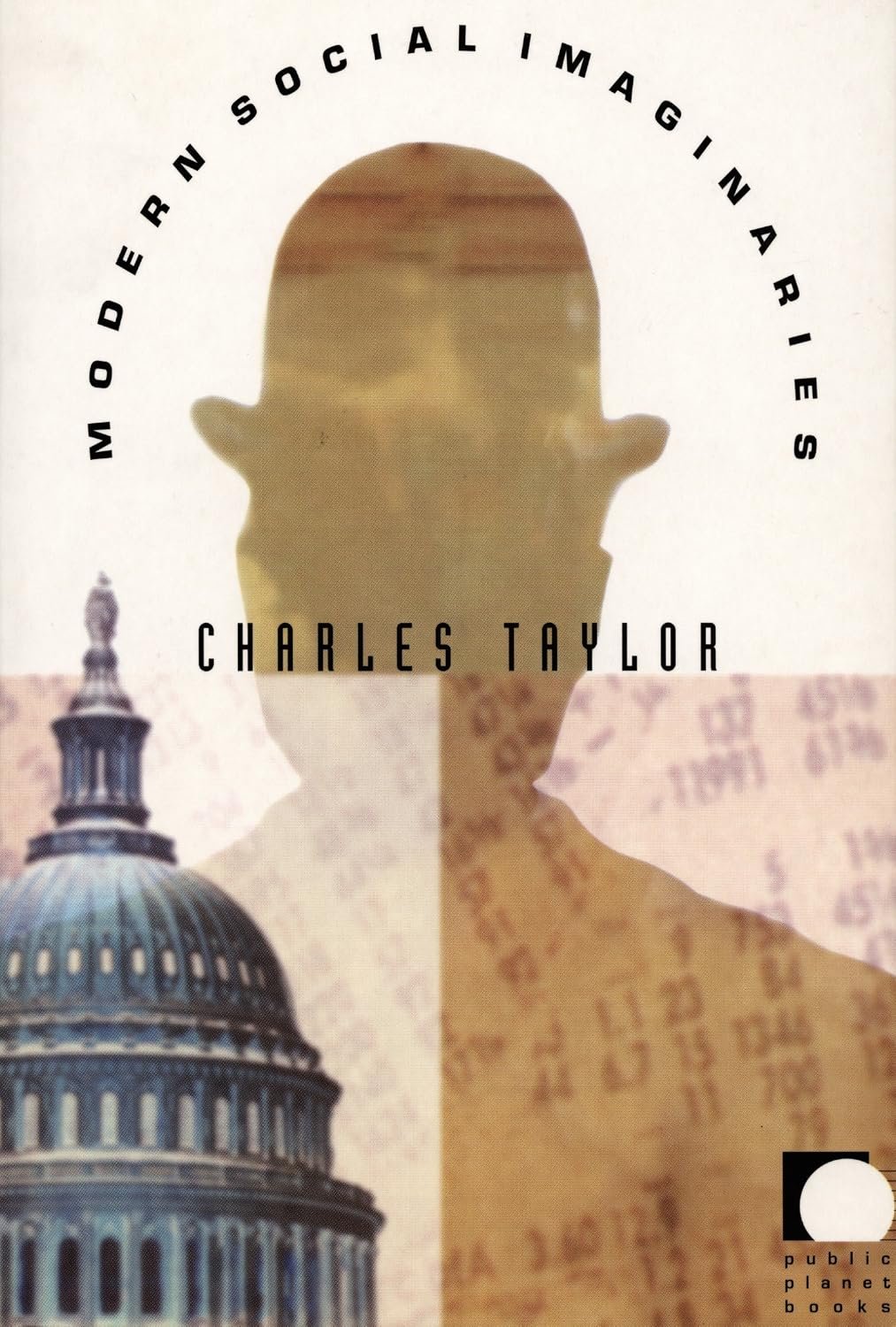
Modern Social Imaginaries
Charles Taylor
Duke University Press (2003). 232 pp.
Charles Taylor’s book Modern Social Imaginaries may be best understood as a prequel to his major work, A Secular Age. The latter, much larger work represents Taylor’s programmatic treatment of secular thought in terms of history, development, and scope. Modern Social Imaginaries, smaller and easier to digest, speaks to the popular ideologies of modernity that gave rise to the concept of secularity. And it is Taylor’s focus on the “popular” that makes this work so interesting. Consider his term “imaginaries:” they are “…the ways people imagine their social existence, how they fit together with others, how things go on between them and their fellows, the expectations that are normally met, and the deeper normative motions and images that underlie these expectations” (p. 23). Social imaginaries differ from social theory. This is important, because Taylor concentrates on “ordinary people” and how they “imagine” their social surroundings, which is “not often expressed in theoretical terms.” To clarify, social imaginaries are transmitted in more than just social theory texts, and are expressed also in stories, legends, images, and (for the contemporary) film, television, and podcasts. So this work is helpful not only for the cultural theoretician or even a genealogist of thought, but also for people who wish to understand more fully the current cultural milieu like clergy-people, politicians, or advertisers.
Taylor joins thinkers like John Milbank, David Bentley Hart, Louis Dupré and others in assessing a common thread in modern social imaginaries: a tendency toward metaphysical flattening. For Taylor, this flattening of the imagination concomitant with the migration of value from transcendence to the individual (immanence) redefines human conception of the moral. No longer is the modern ethical imagination formed by notions of virtue and patterned by cosmology, hierarchy, or even through various modes of mediated relationships; now, the good is democratized because each individual possesses “direct access.” Whereas past imaginaries followed a sort of cosmological hierarchy where access to the ultimate good was indirect and came by way of mediation (via shamans, priests, kings, political rulers, etc.) the modern person claims direct access. According to Taylor then, what counts as the “ultimate concern,” ontic primacy, the sacred, has significantly changed with the advent of modernity. And Taylor is not alone in this assessment. He fits into a rich cohort of thinkers and projects that trace the moving target of ultimate concern through epochs. Take for example John Milbank, and his analysis of secularity through social theory and its implicit metaphysics, or sociologist’s Bronislaw Szerszynski’s genealogical analysis of the changing location of the holy from nature to the transcendent realm of the divine to the individual and ultimately toward human technology in his work Nature, Technology, and the Sacred. Others include William Cavanaugh’s Migrations of the Holy, which follows the shift from individuals to communities; Dominic Erdozain’s new book The Soul of Doubt, which is much like Taylor’s overall project in that it seeks to discover the religious roots of doubt and secularity. And in his recent work Beyond Secular Order, Milbank asserts that modern metaphysical flattening is a precursor to the flattening of biblical exegesis, which yields only one, strict and literal meaning of holy texts.
Taylor’s contribution to this rich conversation about this shift in thought engages recent, popular examples. He reveals that for moderns, unlike premoderns and medievals, the ontic primacy of a transcendent sphere has been unhitched and moved from the vertical to a horizontal axis. The first and most obvious consequence of this shift is that the divine is either denied or ignored, or perhaps just one option among many. Contemporary ecclesiological life reveals the shift as well with phrases like “church shopping,” “marketing,” or “target audience,” along with the advent of “spiritual but not religious” modern/postmodern person that holds deeper-than-materialistic beliefs, yet who also denies the requisite formative community of belief (church community, or organized religion) or even a set of prescribed rituals and symbols.
Another difference that Taylor points out between premodern and modern social imaginaries involves the concept of time. Moderns have abandoned the premodern view of time’s verticality, mediation, and social embeddedness in favor of linearity and endless progressiveness. The object or destination of this progress is not exactly defined. It seems to change with each generation like a moving target. In this way, the modern social imaginary resituates time away from past contingencies like authority, tradition, and older forms of polis like the church and toward the perceived advances of individuals in terms of happiness.
Taylor’s analysis is a helpful addition to the conversation about modernity’s effect on culture. His prose is approachable as he addresses the following cultural realities: individualism, market-driven trends, progressivism, and the retreat from the necessity of religion. Following this analysis history and calculus that has produced the current world, while giving insights for critique. Finally, readers will find in Modern Social Imaginaries a helpful starting point for engaging Taylor’s larger magnum opus—A Secular Age, a landmark text which is also a worthwhile read.

Jarrod Longbons (PhD, University of Nottingham) is the Senior Minister at Peachtree Christian Church in Atlanta, GA. Jarrod is a member of the St. Peter Fellowship of the Center for Pastor Theologians.