The views expressed in this article are of the author only and do not necessarily represent those of the Center for Pastor Theologians.
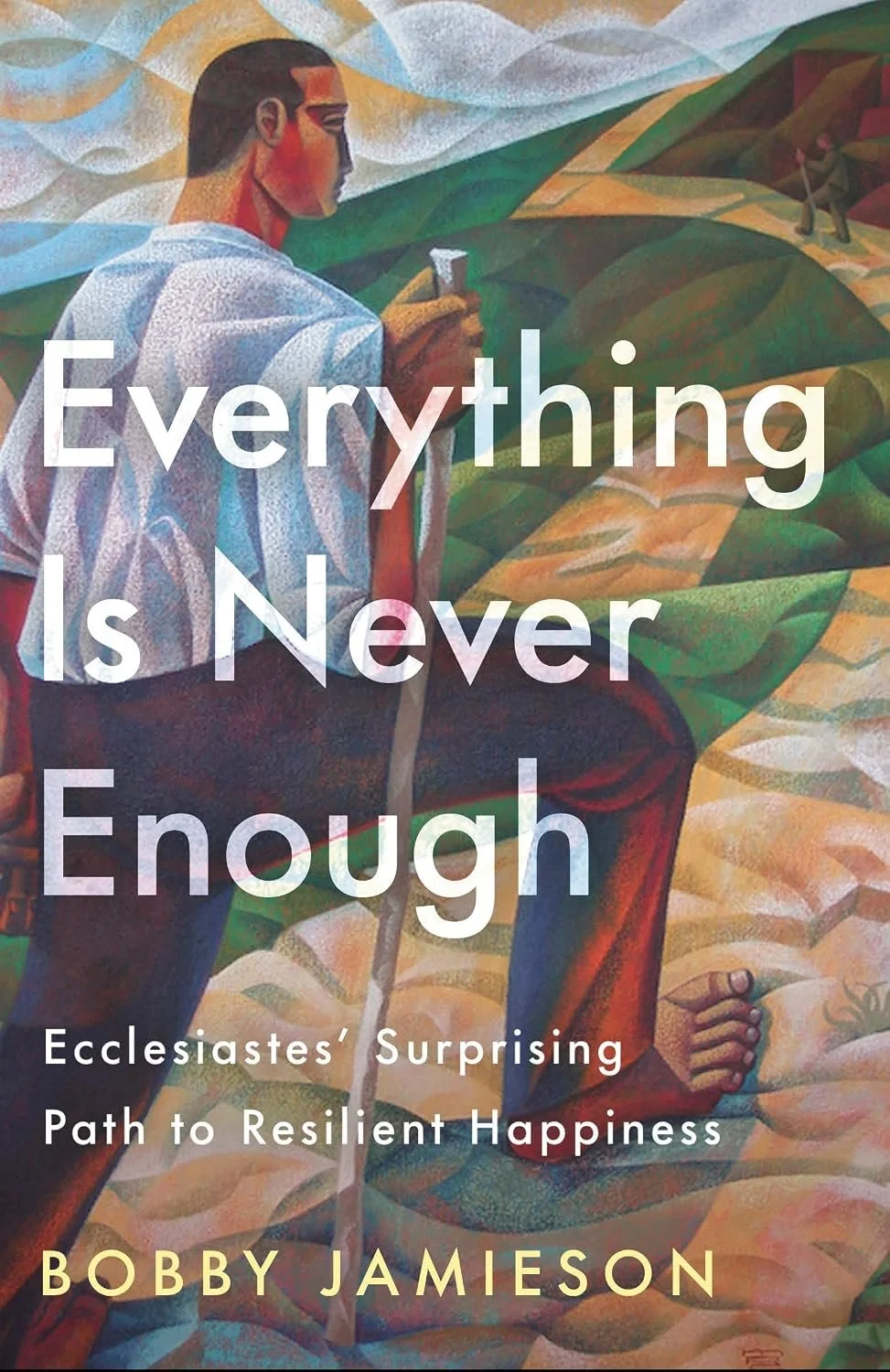
Everything Is Never Enough: Ecclesiastes’ Surprising Path to Resilient Happiness
Bobby Jamieson
Waterbrook (2025). 255 pp.
Everything Is Never Enough made a big splash in 2025, earning book awards from both Christianity Today and The Gospel Coalition. The title itself deserves an award as it memorably pinpoints the main theme of Ecclesiastes and orients the reader toward what everyone asks at some point in their life: Is this all there is?
Jamieson constructs Ecclesiastes as a three-storied house. The first floor, ה chapters 1–11 in Jamieson’s book, explores what Jamieson calls an “absurd” world. His controlling image of “absurd” derives from his interpretation of hevel (the primary word-motif of Ecclesiastes) as uncontrollable (chapter 1) and absurd (chapter 11). The bulk of the chapters on the “first floor” of the house drag us through how we are never content, never satisfied, and never happy in this absurd world. Depressing. But without being dragged through each room on the bottom floor, readers would not grapple with the broken pieces of their lives that keep coming up empty.
The second floor of the house, chapters 12–19 in Jamieson’s book, beckons us to find joy while living in our absurd world. Now Qohelet, the writer of Ecclesiastes, climbs up to the second flood and discovers that happiness is a gift from God, not something we obtain on our own. The third floor, chapters 20–21, stages Qohelet at the top of the house, where he finds that the fear of God and the promise of judgment are the way forward, even when contradictions appear. The book then concludes by inviting the reader to embrace the gospel for true happiness in an absurd world.
As a pastor theologian, I found the book insatiably meaningful, and you will too. Jamieson captures his readers with the words of Qohelet and then draws them into pressing concerns everyone faces. I wanted to keep reading this book.
The book also sings with lyrical writing. Jamieson’s talent for startling images repeatedly captivated me:
You are made from earth dust, and one day the dust that used to be you will disperse into the earth. The dead skin cells that your body sheds become a small portion of the dust that settles on every surface of your home. Next time you spray a shelf and wipe it down, consider it a preview. That’s a very little bit of you; soon it will be all of you. (p. 97)
How can you not pause at these words and ponder the mysteries of life and death? What Jamieson accomplishes is the very goal of biblical wisdom literature: to explode the illusions we have constructed. He stuns the reader with penetrating questions and images that demand our attention. It got mine.
To appreciate this book, however, you need to realize it is not an exegesis of Ecclesiastes. Jamieson is not an OT scholar and does not claim to be. But he is an excellent pastor theologian. It would be better to market this book as meditations inspired by the book of Ecclesiastes. These meditations are in conversation with a wide range of partners, but chiefly the work of Harmut Rosa, a German sociologist. Out of over 200 sources cited in the endnotes, only one third are biblical studies-oriented; the rest are an eclectic assortment drawn from philosophy, theology, and sociology. As a result, the book is swimming not in the sea of biblical studies but in uncharted waters for Ecclesiastes. Reading Qohelet in conversation with these partners is a fascinating intertextual dialogue that I honestly enjoyed, but often, Jamieson’s conversation refashions Qohelet into a sociologist or philosopher rather than the biblical writer he is.
At times, this was disorienting to me as an OT professor. The book was not careful with the exegetical questions that emerge in Ecclesiastes. Jamieson also clearly depends on Michael Fox, an OT scholar specializing in wisdom literature. Fox’s interpretation of Ecclesiastes, particularly his translation of hevel as “absurd,” is not convincing to many other scholars, myself included. The “absurd” has more to do with the worldview of phi losopher Albert Camus than Qohelet himself. Too often, Jamieson brings ideas that intrude upon the text of Ecclesiastes without respecting the author’s own contextual environment.
I also kept asking myself, “Who is this book for?” It is masterfully written; it sings; but it is unclear on who should listen. Some sections speak to the Christian “intelligentsia,” those immersed in philosophy or sociology, which can be off-putting to the common reader. Yet other sections address a lay audience who could not care less about who Harmut Rosa is; they are simply struggling to get on their feet and make it through the next day. Maybe that is the mark of a good book: pulling in readers from many different audiences. But I think the lack of a clear audience obscures the good work of what Jamieson is showing us in the pursuit of happiness.
Still, that does reflect the wild ride of Ecclesiastes, does it not? Do not let my criticisms stop you from reading this well-written book. It gave me much to think about and sharpened my own views on how we navigate this broken world while looking to God as our true source for happiness. And for that, I am thankful.

Michael Lyons (PhD, Hebrew Union College) serves as Associate Professor of Old Testament and Hebrew at Columbia International University. He is a member of the St. Basil Fellowship of the Center for Pastor Theologians.