The views expressed in this article are of the author only and do not necessarily represent those of the Center for Pastor Theologians.
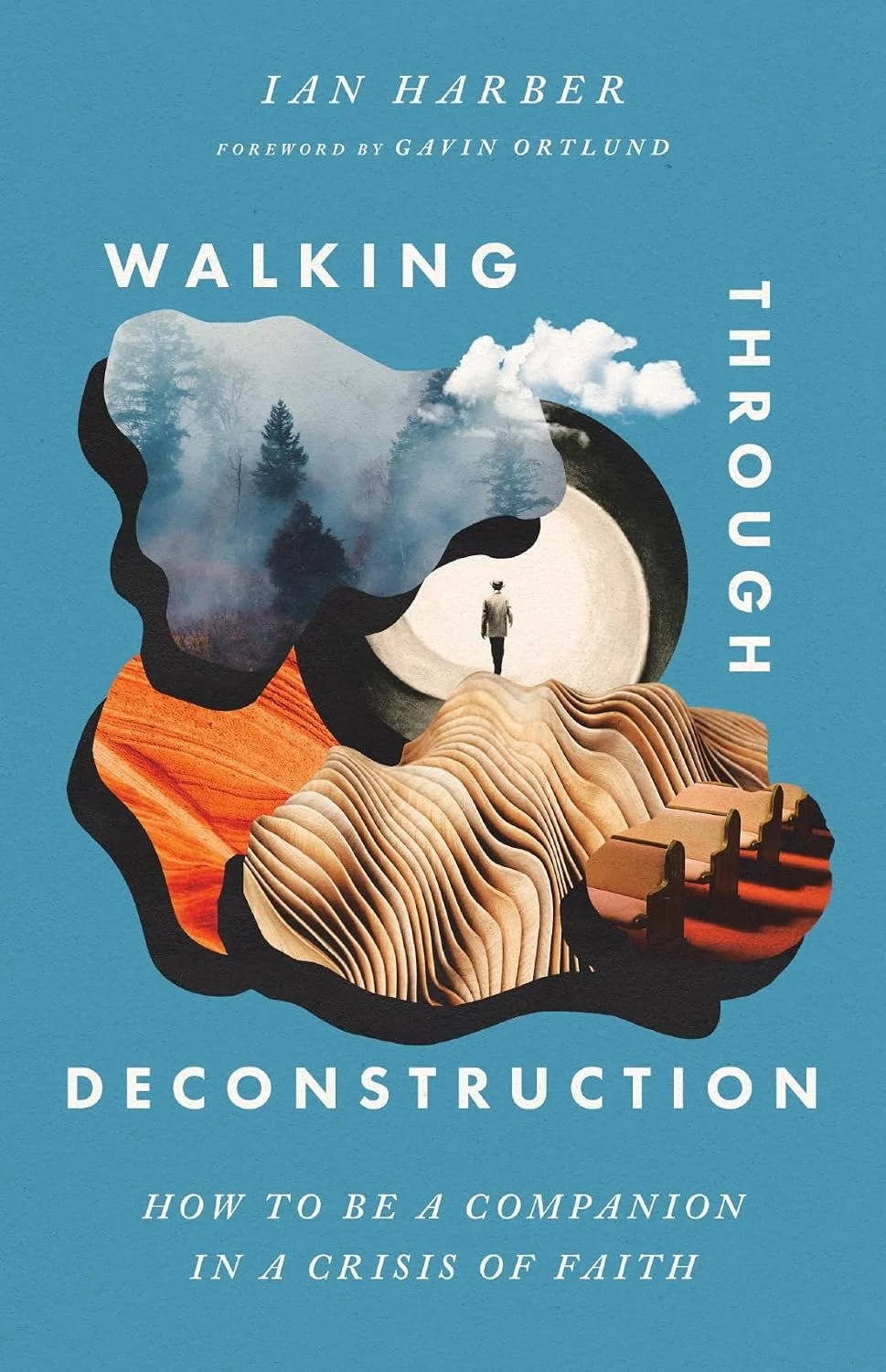
Walking Through Deconstruction: How to Be a Companion in a Crisis of Faith
Ian Harber
InterVarsity (2025). 198 pp.
All pastors and church leaders have felt the sting of watching someone to whom they ministered walk away from the Christian faith. While not a new phenomenon, the cultural abdication of religious belief is revealing itself in a new way. This new slant on an ancient practice is a postmodernist angle called deconstructionism. Ian Harber’s, Walking Through Deconstruction: How to Be a Companion in a Crisis of Faith, is a great resource for any Christian wrestling with such an ideology or walking with someone who is. As Harber explains, deconstructionism is a doubtfulness that “leads to the questioning of core doctrines and untangling of cultural ideologies that settle in a faith that is different from before” (p. 25). Harber is not writing from an outsider’s perspective; he also went through a tumultuous season of deconstruction. His hope is that describing some of the pain and struggles he endured will benefit others.
Harber aims “to help [readers] understand why others are deconstructing” their long-held beliefs (p. 11). He intends to aid the church as it navigates the complex waters of someone’s personal loss of faith. As someone who has been severely injured in his personal church experience, Harber’s counsel not only encourages but also opens a window to see God’s grace on display.
The book is bifurcated into two parts: “Deconstruct” and “Reconstruct.” In part one, the author explains the general process of dismantling the faith. Though the reasons and motivations behind deconstruction are diverse, one underlying feature is common: a crisis of faith. The first section of the book shows how this crisis manifests itself in personal belief, in the church, and in the individual. Deconstruction cannot simply be understood as an intellectual journey away from the faith of one’s childhood. In fact, many times the abandonment has little to do with an intellectual shift. The doxastic transition is more of a holistic than merely rational change. In describing his own deconstruction, Harber quite often uses the word “feel” rather than words that indicate a more cerebral process. According to the author, one does not choose to deconstruct per se (p. 23). The multitude of reasons may vary, but Harber writes that it is more appropriate to claim one has been deconstructed rather than one has deconstructed.
In the second part Harber offers hope. He advises readers on how to help someone in the process of reconstructing faith. In doing so, he offers two crucial keys: the importance of sound theology and a healthy church. A proper understanding of Christian beliefs, according to the author, is essential for rebuilding a damaged faith. Harber writes, “A right view of God is like cleaning the window of our soul so we can see the beauty of God and his world in all its brilliance” (p. 168). A formative feature of reconstruction is a correct view of who God is and what he desires of us.
One of the most impactful discussions within the book is the need for a healthy church in the life of someone reconstructing his or her faith. When coming back to the Christian faith, Harber realized he needed a good local church (p. 50). He writes that it is impossible to live the Christian life alone. One needs the church like a child needs a mother (p. 163). Harber does not mince words in his admonishment of watered-down, shallow ministry philosophies proliferated in the evangelical world today. He writes that many churches have become “platforms for the personalities of pastors, worship leaders, and influential figures. Instead of embodying ideals, they express personalities” (p. 71). Rather than form people into the image of Christ, these churches use people as a means to their pragmatic ends. Though not explicit, Harber shows that such ministry directives may draw a crowd, but they do not form healthy Christian disciples.
Walking Through Deconstruction is a valuable tool for any Christian seeking insight for how to minister to those in spiritual turmoil. Harber’s specific advantage is that he writes from a personal perspective. His counsel is not that of a trained theologian or pastor, but of one who has experienced the pain and heartache of a crisis of faith. Thus, readers should not expect the book to parse theological and philosophical ideas with academic preci sion—that is not the book’s focus. Furthermore, one should not expect to find crisp philosophical arguments meant to counter those deconstructing. Harber emphasizes that not everyone’s journey is like his, and his goal is not to provide a sledgehammer argument for those entangled in the bowels of the crisis. Instead he offers a hand to all who, directly or indirectly, are traversing a dark night of the soul.
Chad Meeks (PhD, The Southwestern Baptist Theological Seminary) is the Lead Pastor, Cedar Heights Baptist Church, North Little Rock, AR. He is a member of the St. Hildegard Fellowship of the Center for Pastor Theologians.