The views expressed in this article are of the author only and do not necessarily represent those of the Center for Pastor Theologians.
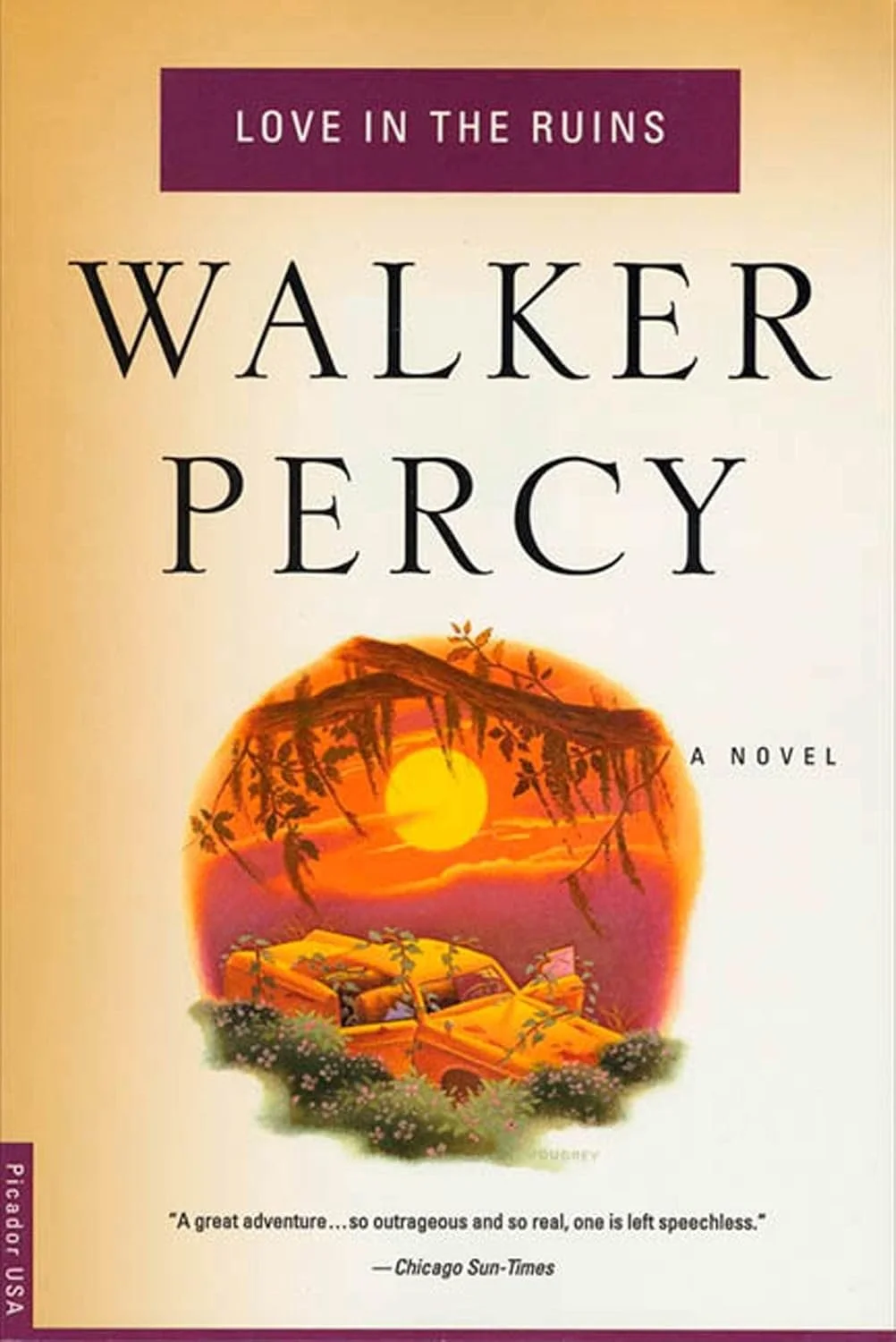
Love in the Ruins
Walker Percy
Picador (1999). 416 pp.
First published in 1971, Love in the Ruins was the third novel by Walker Percy, an influential Southern writer and winner of the National Book Award. It is a passionate, messy, confusing narrative – necessarily so, since it is told by Dr. Tom More, a mentally troubled psychiatrist living in the town of Paradise, Louisiana. Dr. More has lost his young daughter to cancer and his wife to an affair; has attempted suicide and spent time in a psychiatric ward; is a raging alcoholic; and is psychotic, experiencing frequent delusions and hallucinations. The line between reality and delusion in the narrative is therefore blurred. Readers must evaluate what’s really happening (including whether a character Dr. More repeatedly describes exists outside his own mind).
As the novel begins, Dr. More believes the world is mere hours from an apocalyptic crisis; not a physical catastrophe but rather a “psychic” one, “an unprecedented fallout of noxious particles that will settle hereabouts and perhaps in other places as well” (p. 5). These particles will “rive the very self from itself ” (p. 5). They will therefore exacerbate what More has come to see as the fundamental, and unique, human problem. While animals are pure organism, and angels are pure spirit, humans are simultaneously both. Because of this, they experience fleshly desires but can also engage in abstract, higher thought. Over-emphasis on the spiritual side results in “angelism,” a condition in which a person thinks only in abstract thought and is therefore disconnected from the real bodily life around him and capable of committing atrocities (p. 328). But over-emphasis on bodily desires results in “bestialism,” a focus only on one’s natural drives (including sexual desire). The uniquely dual nature of humans means that the outer, social self can ‘fall’ from the inner, secret self (p. 36).
Dr. More’s grandiose plan (for which he confidently expects to receive a Nobel prize) is to restore people to themselves, to “weld the broken self whole.” He asks, “What if man could reenter paradise…and live there both as man and spirit, whole and intact man-spirit, as solid flesh as a speckled trout…yet aware of itself as a self!” (p. 36). Dr. More longs to bridge the chasm that “has rent the soul of Western man ever since the famous philosopher Descartes ripped body loose from mind” (p. 191). He believes this inner division of mind and body is responsible for the terrible fractures within society. “The world is broken, sundered, busted down the middle, self ripped from self and man pasted back together as a mythical monster, half angel, half beast, but no man” (p. 383). Love in the Ruins is set in a time of racial tension, as wealthy white people perpetuate racism and local black residents attempt forcibly to seize control of white properties. It is also a time of political fracturing between conservatives and liberals.
But Dr. More has discovered how to do heal the inner break that leads to these societal breakdowns. Religion is not the ultimate answer. Though Dr. More appreciates religion (he is himself a lapsed Catholic), he sees Christ’s sacrifice as ineffective in achieving reconciliation. The solution he’s invented is a small device called the More Qualitative-Quantative Ontological Lapsometer, so named because it can both measure and mend the “lapse” of the outer self from the inner self. Simply swiping it across one’s forehead will unite the mind and body in wholeness, inoculating people against the imminent psychic catastrophe of noxious particles. Individuals are beckoned (in Johannine terms) to use and benefit from the Lapsometer: ‘Drink this drink and you’ll never want a drink’ (p. 211).
If all this sounds ludicrous and confusing, it’s because it is – and I think Walker Percy intended it to be. What Love in the Ruins does masterfully well is to describe the broken, fractured condition of the individual and the world, and the passionate human longing for relationship, connection, and meaning within the fallen world. It also describes some of the various human attempts to make sense of the world, provoking the question of which attempts are effective and how they might fit together. Percy uses Dr. More’s psychotic musings and pseudo-religious, pseudo-scientific ideas to probe some of the key boundary markers within our experience – those between body and spirit, religion and atheism, sanity and insanity, objectivity and subjectivity, and religion and science. Mad Dr. More blurs the lines between science and religion. His goal of quantitatively measuring emotions and states of mind, and his metaphysical declarations on the basis of these measurements, confuse and repel his medical colleagues. But More’s mash-up raises the question of what is quantifiable and what is not, what is the proper role of religion, and what is the proper role of science. And Dr. More is himself a picture of the very divisions he describes: he loves rigorous scientific thought, yet is driven by his fleshly passions for women; he’s drawn to belief in God, but has an ambivalent relationship with religion.
In the end, Dr. More’s madness raises the question of whether the “sane” individuals in the novel are really any more effective than he is in their attempts to deal with the fallen condition of the world. And perhaps the bizarre story line of Love in the Ruins is not quite so far from reality as we might think. It is intriguing to ponder the similarities between the psychotic, promiscuous, charismatic Dr. More, with his Lapsometer and his small but devoted band of supporters, and the equally bizarre, promiscuous, charismatic L. Ron Hubbard, founder of Scientology, offering his devoted followers salvation through his E-meter and his many levels of secret knowledge.
How might the world be healed and united from its fallen, fractured condition? It’s a question many seek to answer, and a question Love in the Ruins forces us to ponder.

Stephen Witmer (PhD, University of Cambridge) is the Lead Pastor at Pepperell Christian Fellowship in Pepperell, MA. Stephen is a member of the St. Anselm Fellowship of the Center for Pastor Theologians.