The views expressed in this article are of the author only and do not necessarily represent those of the Center for Pastor Theologians.
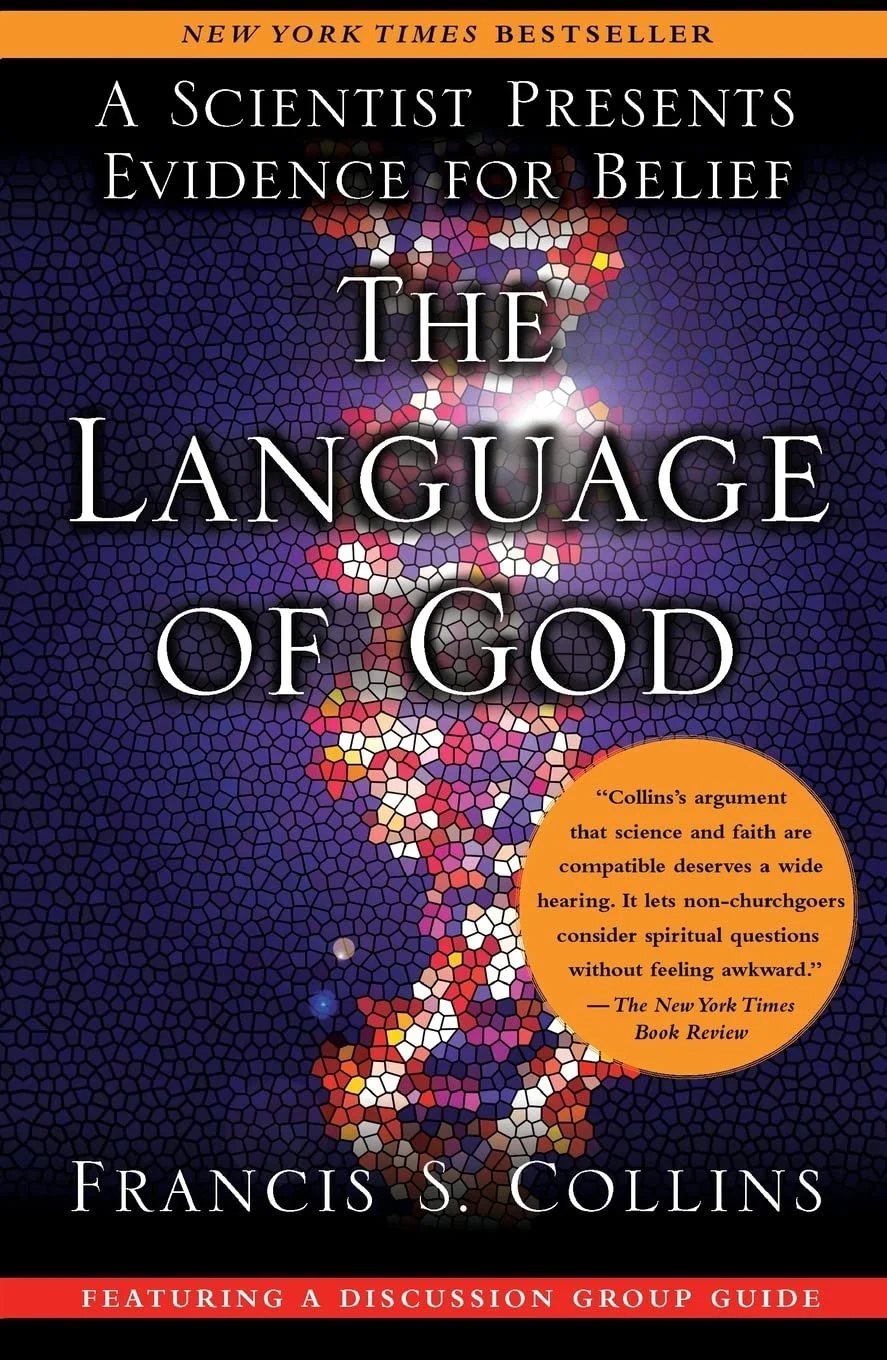
The Language of God: A Scientist Presents Evidence for Belief
Francis S. Collins
Free (2006). 305 pp.
Although I’m no scientist, I don’t think it is controversial to call the Human Genome Project the most significant scientific advance since Einstein’s theory of relativity. It has advanced our knowledge of DNA, genetic material, and the makeup of human biology in ways that would have been unthinkable just a few years before its completion. To the surprise of many, the director of this project, Francis Collins, is a fervently committed Christian. In The Language of God, Collins describes his journey from unbelief to faith and then provides an overview of several ways that his scientific research supports his theistic and biblical faith.
While a common experience for many Christian scientists is to walk through an existential crisis during college or graduate school before eventually discovering that their scientific research and biblical faith were much more compatible than they were led to believe. Collins’s experience, however, was different. He grew up in a non-religious home and drifted toward atheism during his college years. However, when confronted with the vibrant faith of Christians while in medical school, Collins was driven to return to reconsider his assumptions. As he encountered C. S. Lewis’s argument for Moral Law, in Mere Christianity, and began to consider the compatibility of science and faith, like Lewis himself, Collins essentially moved from atheism to theism and from theism to Christianity.
Collins’s personal journey from unbelief to belief is an important part of the book; however, most of the book is devoted to exploring and explaining the relationship between scientific evidence and biblical faith. Collins admits upfront that he is not writing theology. He is a scientist explaining the concord between science and faith.
After the introductory section (chapters 1–2) recounting his own journey and considering the plausibility of a worldview that allows for the supernatural, the rest of the book focuses on two major issues: scientific evidence for human existence (chapters 3–5) and the major options for the relationship between this evidence and biblical faith (chapters 6–11).
In the discussion of the question of human existence, Collins considers a number of topics ranging from the history of scientific theories on origins to the Big Bang to the makeup of cells, but the heart of his argument, found in chapter five, unsurprisingly focuses on human genetics. Here Collins retells the story of the Human Genome Project in more detail and then considers the implications of what they had discovered. In short, he argues that the evidence broadly supports Darwin’s theory of evolution.
Following his argument for the genetic evidence for evolution, part three presents a case for the compatibility of evolutionary theory and biblical faith. Collins argues that the scientific evidence for evolution is virtually undisputable; nonetheless, most Americans continue to resist it because they see it as incompatible with both our personal intuitions and, more significantly, the biblical account of human origins. The rest of the book considers the question of whether the relationship between an evolutionary theory of human origins and biblical faith should be antithetical.
Collins presents four possible solutions to this question: 1) science over faith; 2) faith over science; 3) science supplemented by faith where necessary (“science needs divine help”); 4) science and faith in harmony. We cannot examine any of these arguments in detail; however, in his preferred option, science and faith in harmony, Collins concludes that the overwhelming clarity of the scientific evidence and ambiguity of the biblical account should lead us to conclude, like C. S. Lewis, that the account in Gen 1–2 is non-historical.
The book concludes with an exhortation to both believers and unbelievers alike to go where the truth takes them. Once again relying largely on Lewis, Collins urges his readers toward theism that takes account for all of the clear scientific evidence without excluding the overwhelming arguments for the existence of Moral Law in the universe. Following this, Collins includes an appendix treating some of the difficult questions surrounding current advances in bioethics. Again, while the issues are complex, Collins rightly warns us that our track record as a human race should make us slow to assume that scientific enhancements of the human race would really be for the common good, rather than the good of an elite class or nation.
When considering how to best evaluate this book, as mentioned above, I am not a scientist. I don’t have the capacity to evaluate the biological or genetic arguments that Collins sets forward in this book. However, I don’t think the arguments hinge on science alone. In short, I’m not fully convinced by Collins’s exegetical and biblical assumptions.
First, while Collins’s discussion of the various interpretations of Gen 1 throughout the centuries is largely sound, I’m less sure of his conclusion that “it is fair to say that no human knows what the meaning of Genesis 1 and 2 was precisely intended to be” (p. 153). We should certainly recognize that faithful Christians can disagree over the meaning of these chapters, there is not an unlimited number of valid interpretations of the text. There are really only a handful of interpretations of the text and, while we should hold our view with appropriate humility, I am confident that many Christians now and in centuries past have held the correct interpretation of Gen 1–2.
Secondly, in light of the clear meaning of Paul in Rom 5:12–21 and 1 Cor 11:45–48, I continue to think it is highly improbable that Gen 1–2 does not intend to communicate the existence of a historical Adam. Even if our current interpretations of the genetic evidence seem to point away from a historical Adam, the exegetical evidence for this is strong enough to force us to reconsider the scientific evidence.
Our knowledge of the genetic evidence and its interpretation are constantly changing; the exegetical evidence is not. While we certainly should be open to improving our understanding, we must be careful not to let our current scientific understanding too quickly trump the church’s consensus through the centuries. Our level of scientific understanding is vastly different now than it was two decades ago. Our exegetical understanding of the historicity of Adam and Eve is not entirely different than it was two centuries ago.
This leads to a concluding observation. The rapid expansion of our knowledge of human genetics is a gift from God for which we should be thankful. But the pace of this growing knowledge is very different than the pace of our growth in theological and exegetical understanding. Perhaps there is a different exegetical answer to the question of the history of Adam and Eve; however, we should be slow to press the church to adopt novel approaches to this question and quick to submit to the historical consensus of the church.
I praise God for the work of Francis Collins and the Human Genome Project. I am also grateful for his evident desire to serve the Lord through his scientific research. I would commend this book to anyone wrestling with the relationship of faith and science. However, the exegetical and historical evidence continues to lead me to resist jettisoning the historical Adam. Until then, we should have the confidence that the scientific evidence will eventually advance to help us see the fuller picture and the humility to continue to search the Scriptures to see where we our understanding may be wrong.

Chris Bruno (PhD, Wheaton College) is the President of Oahu Theological Seminary where he also serves as Professor of New Testament and Biblical Theology. He has written and contributed to many books, most recently The Divine Christology of the Apostle Paul (IVP, 2024, with John J. R. Lee and Thomas R. Schreiner). He is a member of the St. John Fellowship of the Center for Pastor Theologians.