The views expressed in this article are of the author only and do not necessarily represent those of the Center for Pastor Theologians.
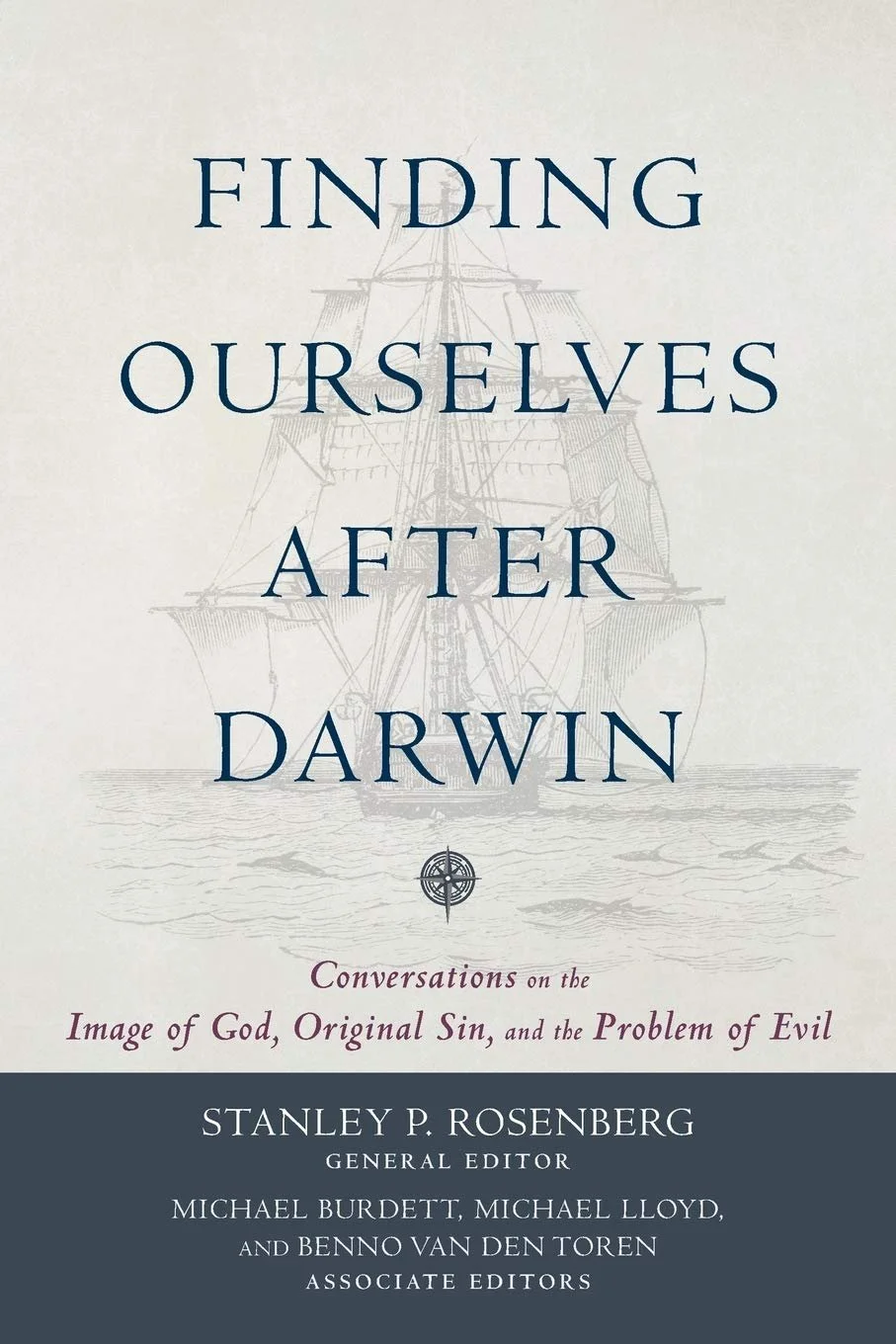
Finding Ourselves After Darwin: Conversations on the Image of God, Original Sin, and the Problem of Evil
Stanley P. Rosenberg et al., eds.
Baker Academic (2018). 384 pp.
For those who believe along with Augustine that all truth is God’s truth, no matter where it is found, the continued separation of science and religion in popular imagination is not only regrettable, but dangerous. One can find this separation among both believers and nonbelievers, and unfortunately one can also find it reinforced by those on either side of the debate. High-profile figures in both the academy and the church too often mistreat or misunderstand scientific arguments or religious interpretations, speaking only to the faithful with their misleading rhetoric. Metaphysical arguments are passed off as scientific arguments or vice versa, and anecdotes demonstrating the animosity of one side towards another abound. Perhaps nowhere is this continued separation and even conflict between science and religion more evident than when it comes to evolutionary theory.
These concerns drove the four editors of this volume to organize a research group to engage contemporary scientific discoveries in evolutionary theory from the perspective of historic, orthodox Christianity. Their goal was to think through key areas of theological anthropology such as the image of God, original sin, and the problem of evil, using the discoveries and interpretations of contemporary science as a dialogue partner. The research group consisted of scholars from different denominational backgrounds who participated in several colloquia and a grant project funded by the BioLogos Foundation. There they presented and debated the ideas and research that make up the essays of this book. These events took place at Wycliffe Hall at Oxford, where the editors of this volume all serve as faculty.
In that spirit, the purpose of this book is not to provide a definitive explanation of any of these doctrines, but to present several different theological approaches, methods, and insights that might help provide understanding for the reader who is diligently seeking it. As the introduction points out, this is not a “four-views” book presenting mutually exclusive positions with the goal of having the reader choose one. Some authors support other authors, while others disagree. Some positions critique other positions, while some are complementary. The book offers several possible answers, not definitive answers, and consciously acknowledges the limits of both current scientific theory and knowledge in general.
Following two introductory essays introducing the issues and reflecting on the difference between settled doctrines and theological systems, the book is divided into three parts, each with a respective editor. Part One addresses issues concerning the image of God, Part Two examines issues surrounding original sin, and Part Three focuses on issues raised by the problem of evil. Each part is structured the same way, beginning with a brief introduction by the editor and then moving to an article outlining the key issues raised by the interplay between contemporary science and orthodox Christian theology. Several chapters addressing those issues then follow, offering a variety of approaches to the issues raised, including biblical, historical, systematic, and philosophical. Put together, each part offers a wide-ranging discussion of a particular doctrine. The respective editors end each part of the book with a reflection on the main thoughts presented in the essays as well as a brief list of further readings.
The book’s strengths and weaknesses are inherent in its goals and structure. The essays are consistently well-written and well-researched, and they certainly succeed in stimulating thought and discussion. They do exactly what the editors hope they will do. For example, I read it while preaching through Genesis 1, so I was particularly interested in the essays on the image of God. J. Wentzel van Huyssteen’s essay helpfully articu lated some of the primary contemporary questions and challenges to the doctrine of the image God that evolutionary theory raises. I was not only prompted to think through the doctrine in a fresh way, but was able to bring some of this thinking into my preaching on the subject. Each of the essays on their own, examining the image of God from a functional, structural, relational, or eschatological perspective, did the same. However, since all of the essays approach the doctrine from different perspectives, they raise much more questions than they provide answers. For those with the background and time to think through these issues and incorporate them into their ministries, that is worthwhile, and I would recommend this volume for that purpose. The book advances the discussion and bridges the popular separation between science and faith for those with the theological background to thoughtfully consider the different proposals. For those without a strong background in theology or at least someone well-versed in it to serve as a sounding board, this book would be less helpful.

Gary L. Shultz, Jr. (PhD, Southern Baptist Theological Seminary) is the Associate Professor of Theology and Editor of Baptist University Press at Baptist University of Florida. He is a Senior Fellow of the Center for Pastor Theologians.