The views expressed in this article are of the author only and do not necessarily represent those of the Center for Pastor Theologians.
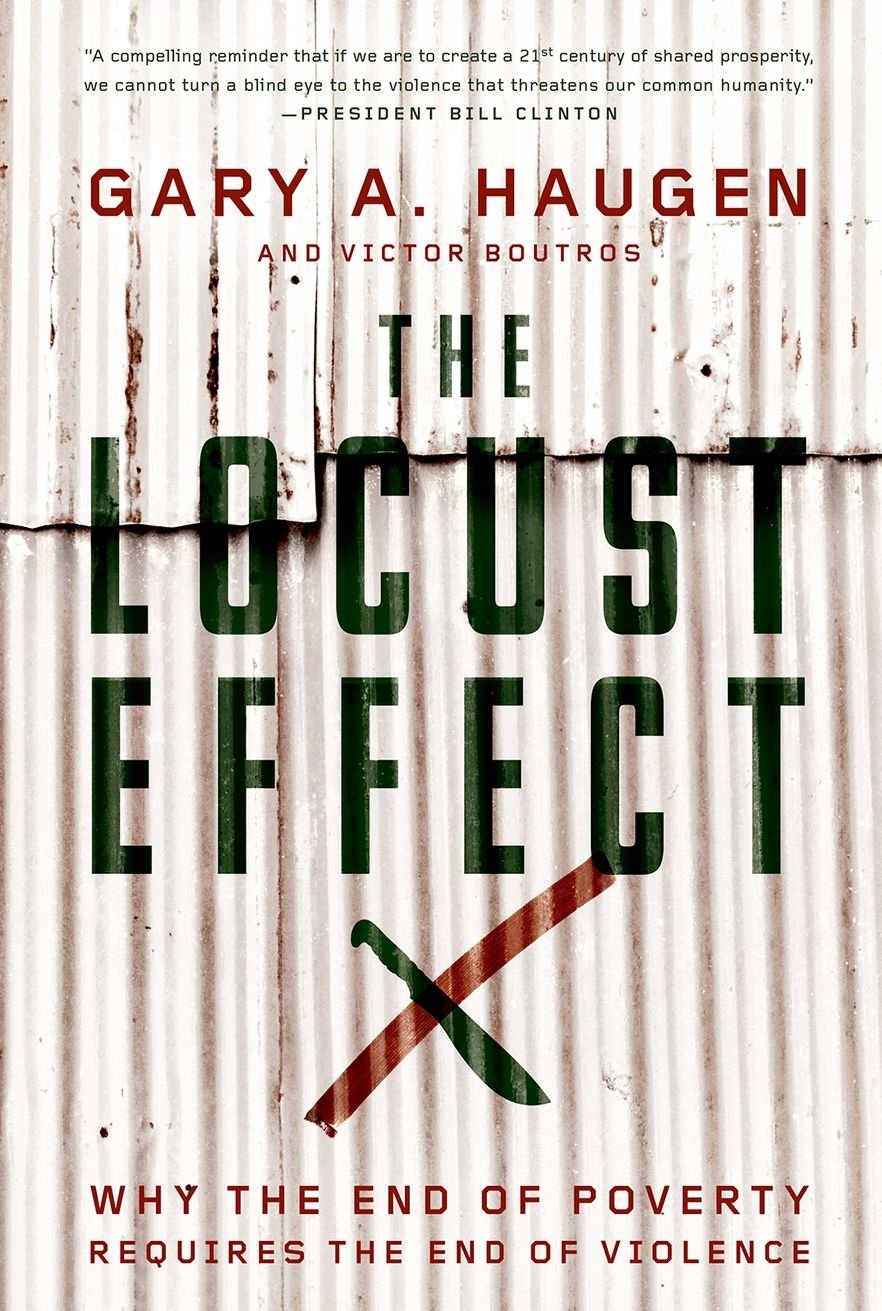
The Locus Effect: Why the End of Poverty Requires the End of Violence
Gary A. Haugen and Victor Boutrous
Oxford University Press (2014). 368 pp.
For the past month, the American public has watched the streets of Ferguson, Missouri burn with rage and acrid smoke. The occasion for this burning: the shooting of an black teenager by a white police officer. In many respects the discourse surrounding these events has been predictable. For some, they represent another iteration of America’s long-standing devaluation of black personhood. For others, they are but one more example of lawlessness vindicating itself through tropes of racial victimization. For others, they represent the infringement of a militarized state into the unarmed sanctity of American communities. And for still others, especially the families, these events simply represent unending grief. By turns (and this too is predictable) each of these themes has emerged powerfully before the American civic imagination only to disappear again—like shadows in the riot-smoke—into the volatile opacity of our common life.
But something unusual is also taking place. Perhaps because of the intractability of these more enduring themes, much of the most substantive public conversation has begun to coalesce around an issue related to—yet slightly different from—each of these: the meaning of law enforcement. In one respect this too is a long-standing American theme. Indeed, at times—as with the Fugitive Slave laws of the 1850s, the Convict Leasing trials of the 1920s, and the War on Drugs of the 1980s—it has been a national obsession. And yet even so, the conversation emerging in the wake of Ferguson is unique. This is because the conversation is less about law enforcement and race or law enforcement and militarization but about law enforcement itself. When we, the people, confer the power of lethal force upon our neighbors, what do we intend? In a democratic order policed by its own citizens, there are few questions more foundational to civic thriving than this.
But where does a Christian look for substantive answers to these questions? As a scholar of African American history, a theologian devoted to questions of the public good, and a pastor involved in the training of law-enforcement officers, I have spent the better part of a decade in search of the answer to this question. And strangely, neither my seminary training nor my graduate work—though both were deeply committed to notions of the language of the common good—ever engaged this issue at all. Because of this, I consider the publication of The Locust Effect an event of unusually significant import.
In one respect this is because of its contribution to the global conversations surrounding poverty. Gary Haugen of the International Justice Mission and Victor Boutros of the United States Department of Justice have both given the bulk of their careers serving the world’s poor. Over the course of these careers they have seen that much of the “poverty” conversation focuses on economic development, educational support, and medical care as the best hope for poverty’s end. And this is true. What Haugen and Boutros have learned however—and this is the essence of the book’s argument—is that because of the “plague of violence” that afflicts the world’s poor, none of these strategies finally can be effective. Through a combination of heart-rending accounts and hard-data presentations they show that in the absence of such structures, economic resources are stolen, educational opportunities are foreclosed (children who are raped on the way to school stop going to school), and medical care vanishes. The end of poverty, in other words, requires the end of violence through the development of just structures of law enforcement. Indeed, in their account, this is the very purpose of law enforcement: protecting people (especially the poor) from the violence that, like so many locusts, consumes their flourishing.
In another respect it is important because of its contribution to global conversations about power. For a great number of years public conversations about power—and particularly about martial power—have been almost wholly binary in nature. On one hand, there are those who take an almost wholly procedural approach, arguing that—given the lawlessness of communities—law enforcement is a necessary evil. On the other hand, there are those who take an almost wholly deconstructive approach, arguing—especially in the wake of Foucault—that law enforcement is little more than a thinly veiled expression of the collective will to destroy those who are weak, marginal, and taboo. Setting aside the relative merits of these perspectives, it is important to understand that both have infected discussions about law-enforcement with an evident and inescapable cynicism. Part of the significance of Haugen’s and Boutros’ argument is that they offer a positive alternative to either of these views. In their account law enforcement is best understood neither as an indication of our collective evil, nor as an extension of our collective libido dominandi, but as an expression of our collective desire to guard the weak and the vulnerable from those who would prey against them. This reframing is profoundly important, and, if taken seriously, could change the global discourse surrounding the meaning and purpose of force.
In a final respect it is important because it holds promise to reignite the imagination of the institution most broadly devoted to the care of the world’s poor—the Christian church. It does this not only by foregrounding the plight of our poorest neighbors around the world—a task to which Haugen has faithfully devoted himself—but also by challenging Christians to think in more robustly institutional terms about what it means to care for our neighbors. That is, rather than thinking about the care of the poor in merely relational, evangelistic, or charitable terms (as so many Christian community and global development initiatives seem to do) Haugen and Boutros urge the church to think in institutional and systemic terms, to ask ourselves: “What kind of economic, educational, ecclesial, medicinal, and martial institutions do our neighbors need? And how can we devote ourselves to building and sustaining these institutions?” These are the questions that, in the long-run, will need to be both asked and answered if the poor are to be lifted up, and The Locust Effect can help the church to do both.
Soon, if the pattern holds, the smoke will blow away, the heat will cool, and the world will turn its eyes from Ferguson, Missouri. But the poor will always be before us. And in seeing them we will be faced, indeed as we are at this very moment, with the question of how to care for them. As we labor to answer this question, The Locust Effect has much to teach us. And if we listen, it may be that when the poor and the police meet in the streets, that meeting will lead not to harm, but to hope.
Gregory Thompson (PhD, University of Virginia)