The views expressed in this article are of the author only and do not necessarily represent those of the Center for Pastor Theologians.
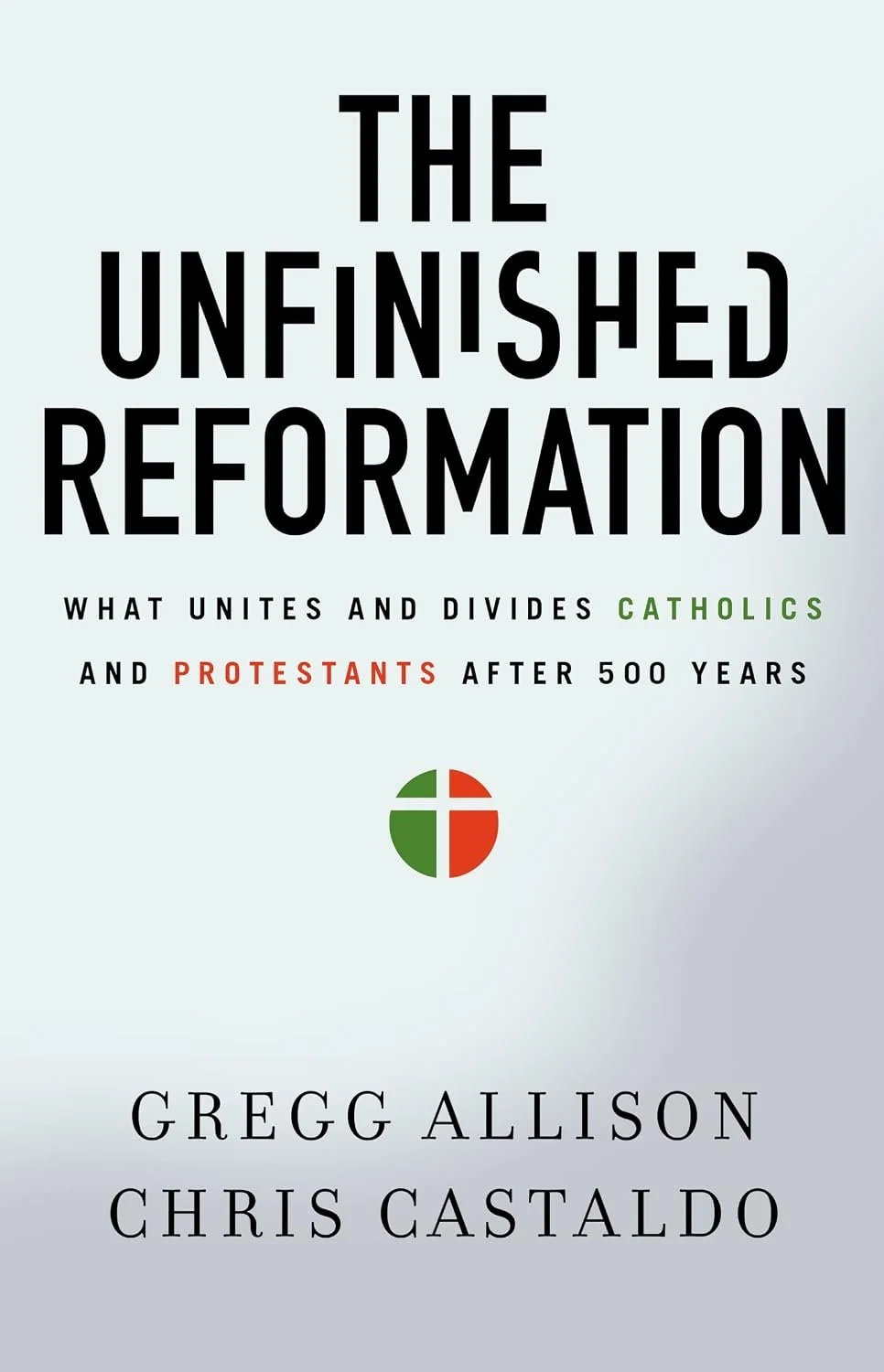
The Unfinished Reformation: What Unites and Divides Catholics and Protestants after 500 Years
Gregg Allison and Chris Castaldo
Zondervan (2016). 171 pp.
The 500 year anniversary of Martin Luther’s 95 Theses has brought a renewed interest in studies and questions associated with the Protestant Reformation. Not least of these is whether the Reformation has reached its shelf life or whether its children should continue on in protest against the Roman Catholic Church (RCC).
Gregg Allison and Chris Castaldo, who have each previously published works related to Catholicism, tackle this question in their recent The Unfinished Reformation: What Unites and Divides Catholics and Protestants After 500 Years. The ability to answer the question of whether the Reformation maintains any continued relevance is contingent on one’s knowledge of the theological differences that led the Reformers to protest, and whether those differences continue to maintain any significance. As the authors state, “We cannot judge whether it is finished, of course, unless we understand how it began” (p. 15).
However, the goal of Allison and Castaldo is not so much as to provide a history lesson, (although there are elements of relevant historical information), but to provide an overview of the theological framework that unites and divides Protestants and Catholics. This element of uniting and dividing is what gives the book its primary value. To be simplistic, Protestants can be divided into three broad categories on the question of the current relationship between Protestants and the RCC (p. 139).
There are those that seek to declare the that Reformation is over and any differences between Protestants and the RCC are too minimal to warrant any formal separation. On the other side are those that seek to mimic Luther and Calvin’s posture toward the RCC in belief that she represents the antichrist and, therefore, “adopt an adverbial posture and avoid constructive engagement” (p. 139). However, in the middle are a host of Protestants that are simply unsure of how to articulate a more nuanced position. On discussions related to the Trinity there is unanimity, yet great unease when unpacking how one is justified before God.
It is to this middle group that Allison and Castaldo’s work will find its greatest appeal. The authors provide a clear description of the theology that unites and divides Protestants and Catholics throughout their work. They accomplish this by avoiding bombastic language that often suffers “from selective quotation[s] without regard to official documents” (p. 31). Instead, Allison and Castaldo offer descriptive analysis of ten areas where Protestants and Catholics stand together and the major areas where they diverge in their teaching.
This framework allows the authors to hold a posture of grace and charity toward the RCC, yet also clarity where important disagreements remain. There is encouragement, according to the authors, in the movement from Rome on issues related to salvation and justification. With Vatican II the RCC now affirms Protestants can be saved outside of the RCC, although to be fair, the same is said for sincere Muslims and atheists (p. 144). In regard to justification, Allison and Castaldo see updates to the Catechism of the Catholic Church that include fragrances of Christ’s imputed righteousness as a significant point of encouragement (pp. 143–47).
The final verdict for the authors as it relates to the question of whether it is time to close the curtain on the Reformation is a “no, but”. There is recognition of the “development of mutual awareness” and occurrences of “selective collaboration”, yet, “unless the Catholic Church undergoes radical reform according to Scripture the Reformation will necessarily continue” (p. 151).
No doubt, some will argue the authors were too generous toward Catholic teaching, while others will say they were not generous enough. Even if one disagrees with the authors’ conclusion, the benefit of the book remains because of the clarity it offers in describing where there is agreement and disagreement between the two.
One reason for the likely diversity of responses is the complexity of a work like this. Although Allison and Castaldo presume to speak for Protestants, the innumerable denominations and split offs from the Reformation churches are a testament to the reality that contemporary Protestants do not speak with one voice on the major issues addressed in the book. Because of this, a more accurate sub-title would be What Unites and Divides Catholics and Evangelicals. However, the reality is even evangelicals do not speak with one voice on this question.
While most evangelicals will agree that biblical fidelity and necessity of gospel clarity push the Reformation onward, one hopeful takeaway for readers is that the goal of the Reformation should not and cannot be indefinite protest against Rome. As the authors make clear, real doctrinal differences remain and these differences are significant enough to remain Protestants. However, Christ and the unity of his church body demands that we acknowledge separation cannot be our final resting place.

Cory Wilson (PhD, RTS) serves as a Pastor at City Church in the Cleveland area. He is also the President and Co-Founder of Emmaus Theological Seminary. He is a member of the St. Peter Fellowship of the Center for Pastor Theologians.