The views expressed in this article are of the author only and do not necessarily represent those of the Center for Pastor Theologians.
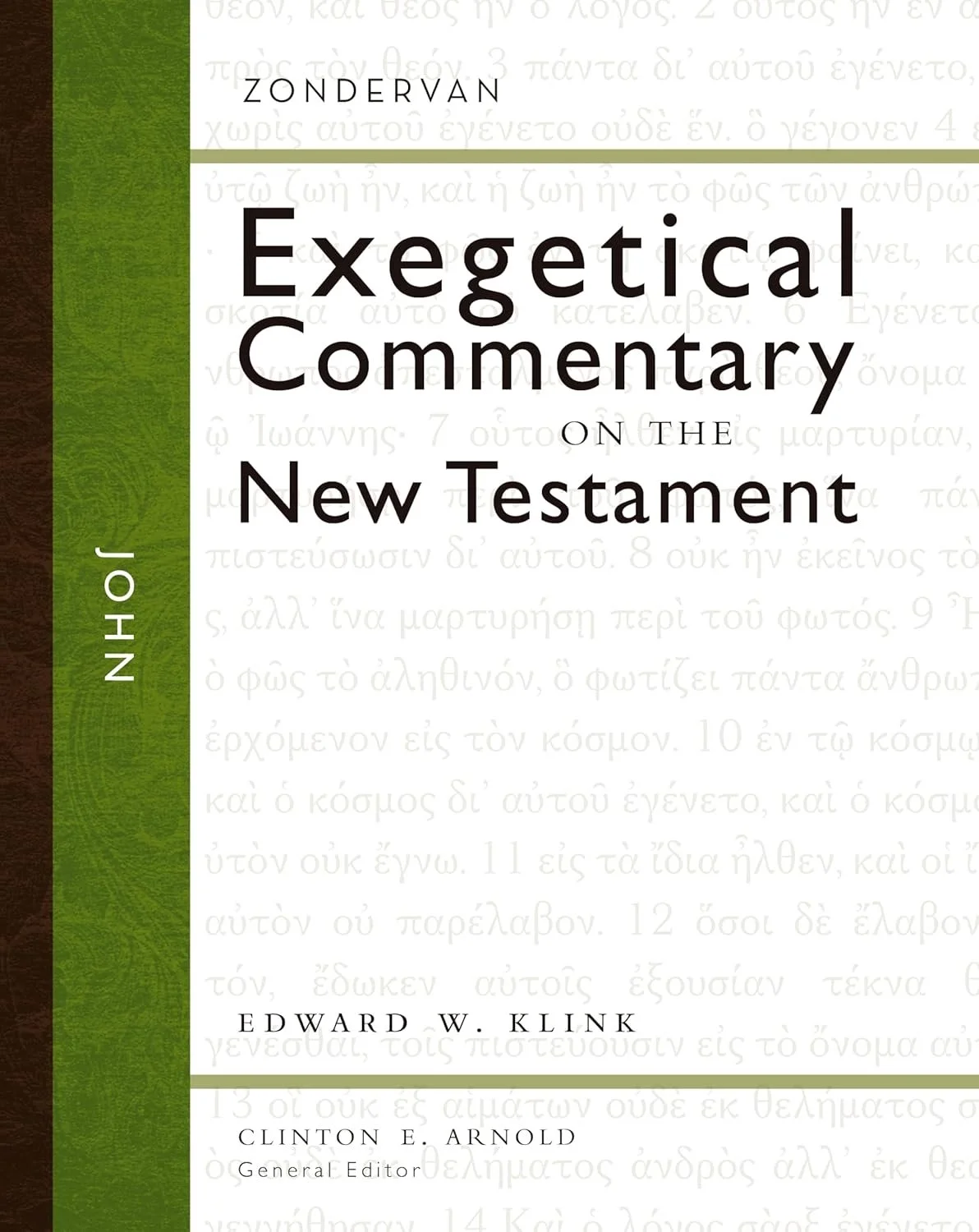
John
Edward W. Klink III
Zondervan (2016). 971 pp.
Edward Klink’s major new commentary on the Gospel of John advocates and advances, explicitly and from first to last, a confessional approach to the Gospel. There are numerous helpful exegetical insights throughout (e.g., the identification of seven formal dialogues in the first half of the Gospel; the distinguishing of an “historical story” and a “cosmological story” within the Gospel’s plot; the Old Testament background to Jesus’ “turning” in John 1:38), but the commentary’s thoroughly worked out confessional approach is its main contribution to Johannine studies.
In a long (53pp), important, and hermeneutically sophisticated introduction, Klink distinguishes critical and confessional approaches to the biblical text, arguing that proper biblical interpretation requires clarity on the approach being pursued: “the exploration of what this Gospel means cannot begin until we have explained what this Gospel is, for interpretation is guided by the nature of its object” (p. 24). Importantly, the confessional approach recognizes both the divine identity of the Gospel of John as Christian Scripture and the “full historicity” of the biblical text (p. 24). The confessional approach is, in Klink’s view, the only correct approach. “Not to treat this Gospel as Scripture is itself a form of eisegesis, and it is a disobedient hearing of the (canonical) text’s own claim and of the God by whom it was authored” (p. 25).
Interpreting John’s Gospel from a confessional perspective requires, among other things, understanding it within the larger canon of Scripture, since it was always intended by God to be read that way. The historical and canonical contexts of John’s Gospel function “symphonically to communicate the intended fullness of the Word of God” (p. 28). Because the Gospel is divinely authored, it is also necessary to relate it to eternal theological truths (such as the Trinity), as embodied in the historic creeds of the church. This yields a method of interpretation in which the Gospel is “read and applied by both exegetical and dogmatic reasoning” (p. 33). The text of the Gospel itself, as opposed to the historical events narrated by the text, is the locus of authoritative revelation, since the text combines the narration of the events and their correct interpretation (p. 34). Therefore, the commentary-proper focuses on interpreting the text of the Gospel itself. Reconstructing historical events and understanding how events described in John’s Gospel fit with events described in the other canonical gospels are matters of apologetics, not interpretation per se. They are addressed in the commentary because of their pastoral relevance to readers (for the record, Klink argues for two temple cleansings, and for compatibility between John and the Synoptics concerning the date of the Last Supper and crucifixion).
The major achievement of the commentary is its working out of the confessional approach in a detailed, passage-by-passage exegesis of the entire Gospel. For example, when Klink discusses the meaning of “lamb of God” in John 1:29, he opts for a meaning that includes John the Baptist’s frame of reference as well as the full canonical context. This allows “lamb of God” to be understood ultimately in light of the Apostle Paul’s teaching on the sacrifice of Christ. Klink’s approach also allows him to have his cake and eat it too regarding the debated Eucharistic imagery of John 6. The imagery clearly alludes to the manna of the wilderness wanderings, but also makes “impressions” that “reverberate across the entire canon,” including New Testament Eucharistic passages. Other examples of Klink’s confessional approach include his discussion of the eternal generation of the Son in the course of an exegesis of John 1, and the development of a Trinitarian theology of faith, and a discussion of election, in the course of his exegesis of John 6.
Klink rightly argues against the common twentieth century scholarly approach of reconstructing a “Johannine community” from the text of the Gospel itself. Rather, the Gospel was “intended for a broad readership and was intended to cooperate with the general witness of early Christianity” (p. 65). According to Klink, John’s Gospel was written in the first century, by John the son of Zebedee. All twenty-one chapters were part of the original Gospel, which John wrote “to explain Jesus to the reader” (p. 883) in the hopes that he or she would believe in Jesus Christ. The Gospel is an invitation to “participate in God” by becoming part of his family and joining in his mission to the world. Because it is an invitation, “not to respond to the Gospel is a form of rebellion, a rejection of the living voice of God” (p. 886). John’s Gospel understands there to be continuity between the old and new covenants, with God’s people understood as one “recreated” people, inclusive of Jew and Gentile. The old covenant brought grace, but the grace of the new covenant has brought grace to its “ultimate and final expression” (p. 116). The new covenant is, in fact, “grace in place of grace” (John 1:16).
I am not persuaded by every exegetical argument of the commentary. For example, I am not sure ginomai in John 1 carries as much weight as is suggested, and I do not think the full extent of the exegetical debate in John 6 is recognized. There’s also a potential concern that the rather in depth introduction, which is important for articulating the commentary’s main contribution (its confessional approach), will nonetheless be very technically demanding for many pastors (the primary audience for this commentary series). But this is an outstanding commentary, which will serve the Church well. Klink’s dual identity as a scholar and pastor is reflected throughout, not least in his use of rich and memorable language (e.g., “just as the Gospel’s prologue serves to lift the reader…so the Gospel’s epilogue serves to land the reader,” p. 893). I’m particularly grateful for this commentary’s methodological rigor, attentiveness to the text, clear and elegant style, and manifest devotion to the Jesus of whom the Gospel speaks.

Stephen Witmer (PhD, University of Cambridge) is the Lead Pastor at Pepperell Christian Fellowship in Pepperell, MA. Stephen is a member of the St. Anselm Fellowship of the Center for Pastor Theologians.