The views expressed in this article are of the author only and do not necessarily represent those of the Center for Pastor Theologians.
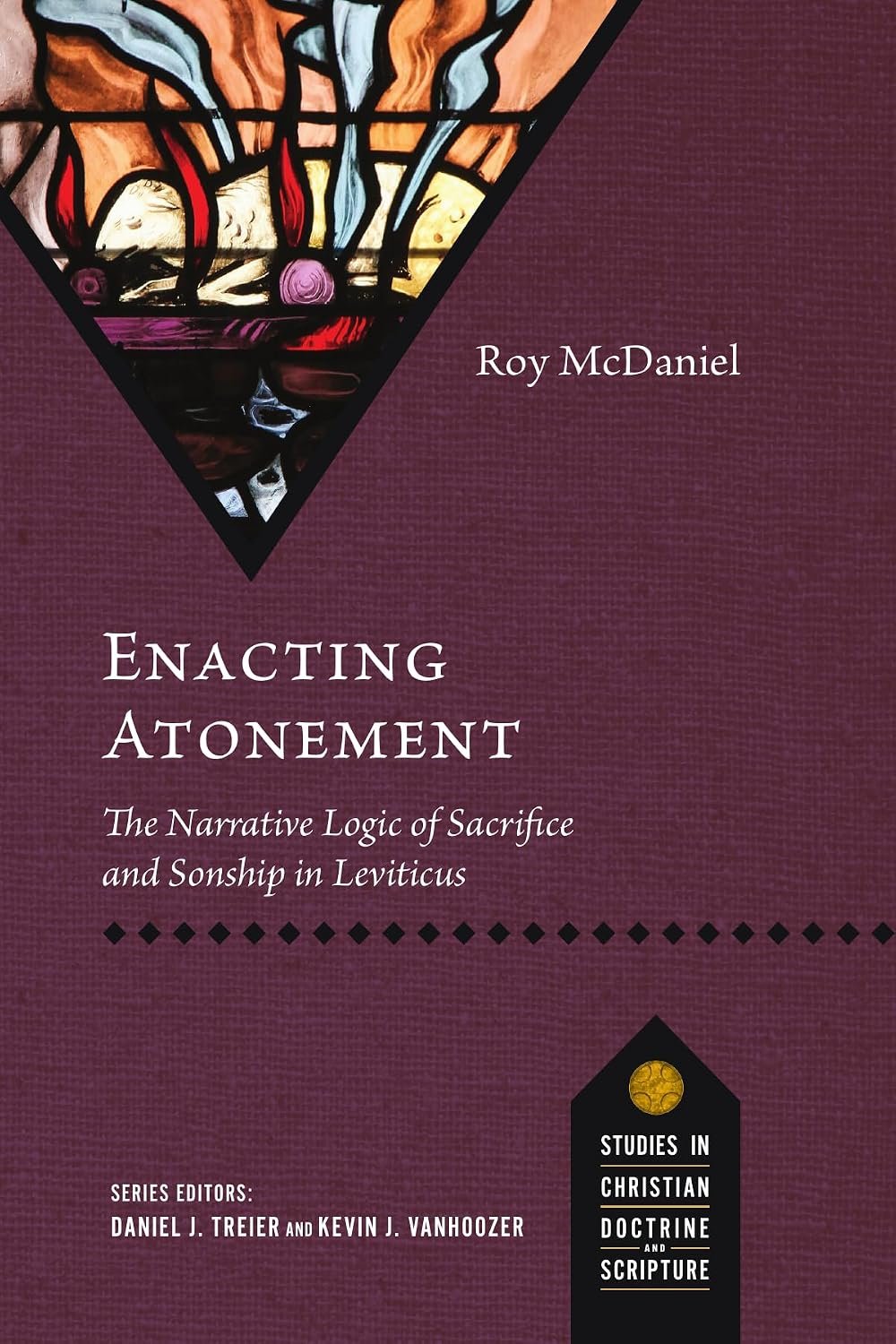
Enacting Atonement: The Narrative Logic of Sacrifice and Sonship in Leviticus
Roy McDaniel
IVP Academic (2025). 264 pp.
What book of the Bible has gained the reputation of being most irrelevant to the Christian life? What book causes many well-intentioned Scripture reading plans to stall out? What book might pastors today be most hesitant to preach? Leviticus has a fighting chance of being the number one answer to these questions. It is a problem Roy McDaniel acknowledges, and his work is a bold attempt to salvage the third book of the Torah from the scrapyard of neglected segments of Holy Scripture. To my mind, his effort effectively reinvigorates our appetite for this seemingly obscure, often intimidating portion of God’s word.
In the introduction McDaniel makes clear his task: to argue not only that Leviticus speaks to us (not just ancient Israelites) about atonement, but also that “we are given knowledge of Christ in Leviticus” because “Leviticus proclaims Jesus’ work of atonement” (p. xvii). His is a reading of Leviticus that takes seriously Christ’s claim that “Moses . . . [spoke] things concerning himself” (Luke 24:27). McDaniel’s book is an exercise in “theological exegesis of Levitical sacrifice,” more particularly one that focuses on the “burnt offering” as prescribed in Lev 1:1–9 out of the conviction that “something of the meaning of Christ’s atoning work is disclosed to the church therein” (p. xviii). Specifically, McDaniel argues that the burnt offering sets forth the mechanism of atonement as “filial satisfaction: Jesus makes satisfaction for sins as he enacts his identity as Son in and through his incarnate self-offering” (p. xviii). Quite a case to make from verses often read as mere prelude.
McDaniel makes his case by using a literary framework to guide his theological exegesis. Chapter 1 examines the setting of the burnt offering, rightly arguing that the narrative context of Leviticus, coming on the heels of Genesis and Exodus (with their vital witness to the creational and covenantal acts of God), matters because it is this God who is calling this people into covenant relationship in ways that the Levitical sacrifices reiterate and recapitulate. Chapter 2 explores the plot of the burnt offering, arguing that there is a movement in the sacrifice that can be summarized as “return through death.” Chapter 3 moves on to the hero of the story, the offeror who “stands as a type not only of any given Israelite but of the true Israelite, Jesus Christ” (p.73). Vital to McDaniel’s argument is that this offeror is a “filial figure,” one who is not only a son of God but also a type of the Son of God. Chapter 4 then explores the action of the sacrifice and how this offeror achieves atonement “through the substitutionary obedience, death, and ascension of the son,” that is, through “filial satisfaction by recapitulation,” in a way that the bringing, identifying with, slaughtering, and burning of the offering sets on vivid display (p. 105). Finally, in chapter 5 McDaniel parses the meaning of the burnt offering: the Son’s saving mission, grounded in his eternal procession, “follows the pattern of substitution, testing, death, and exaltation established in the . . . burnt offering,” thus making clear that “Jesus’ atoning work [is] the meaning of the story told by the burnt offering” (p. 156).
The book’s strengths are many. The work beautifully demonstrates that a Christian reading of Leviticus (and, by extension, any portion of the OT) is not reducible merely to what the book of Hebrews says about the Levitical cult. He insists: “the Old Testament must be allowed to make its own (Christian) theological voice heard . . . a discreet voice [witnessing] to Jesus Christ” (p. xxxiii). This insistence is what leads McDaniel to take a closer look at the burnt offering, an offering not explicitly mentioned in Hebrews and often overlooked. McDaniel also seamlessly moves from exegetical observations to biblical-theological integration. His reflections on how the plot of Levitical sacrifice hinges on the act of return through death, evokes the return to Eden, and prefigures the Son of God’s return to the Father are masterful.
The book’s weaknesses stem from the scope of integration McDaniel attempts. A work dealing with sacrifice in Leviticus as it relates to the doctrine of atonement by grounding one’s argument in the doctrines of the Trinity and the incarnation while appealing to the likes of Athanasius, Anselm, and Aquinas opens itself up to multiple fronts of critique. To McDaniel’s credit, he acknowledges the legitimacy of rival positions and the extent to which he is stretching across multiple theological domains. It is a weakness I believe readers should be willing to overlook given the fruitfulness of McDaniel’s work. Systematic theology is best when it is synthetic and integrative; I applaud his attempt to bridge theological divides (even if the OT scholars and Aquinas experts might have their quibbles).
Thanks to McDaniel’s insights, I found myself drawn back to the wit ness to Christ that Leviticus has to offer. His work is for pastor theologians who want (and need!) help in proclaiming the whole counsel of God and specifically proclaiming the mystery of Christ from the depths of an oft-neglected book like Leviticus. This compelling example of theological interpretation of Scripture offers an inspiring invitation to a book we may have put off proclaiming to God’s people. Perhaps Leviticus is on the “must-preach” list after all.

C. Ryan Fields (PhD, Trinity Evangelical Divinity School) is the Senior Pastor at Faith Evangelical Free Church in Acton, MA. He is a member of the St. Hildegard Fellowship of the Center for Pastor Theologians.