The views expressed in this article are of the author only and do not necessarily represent those of the Center for Pastor Theologians.
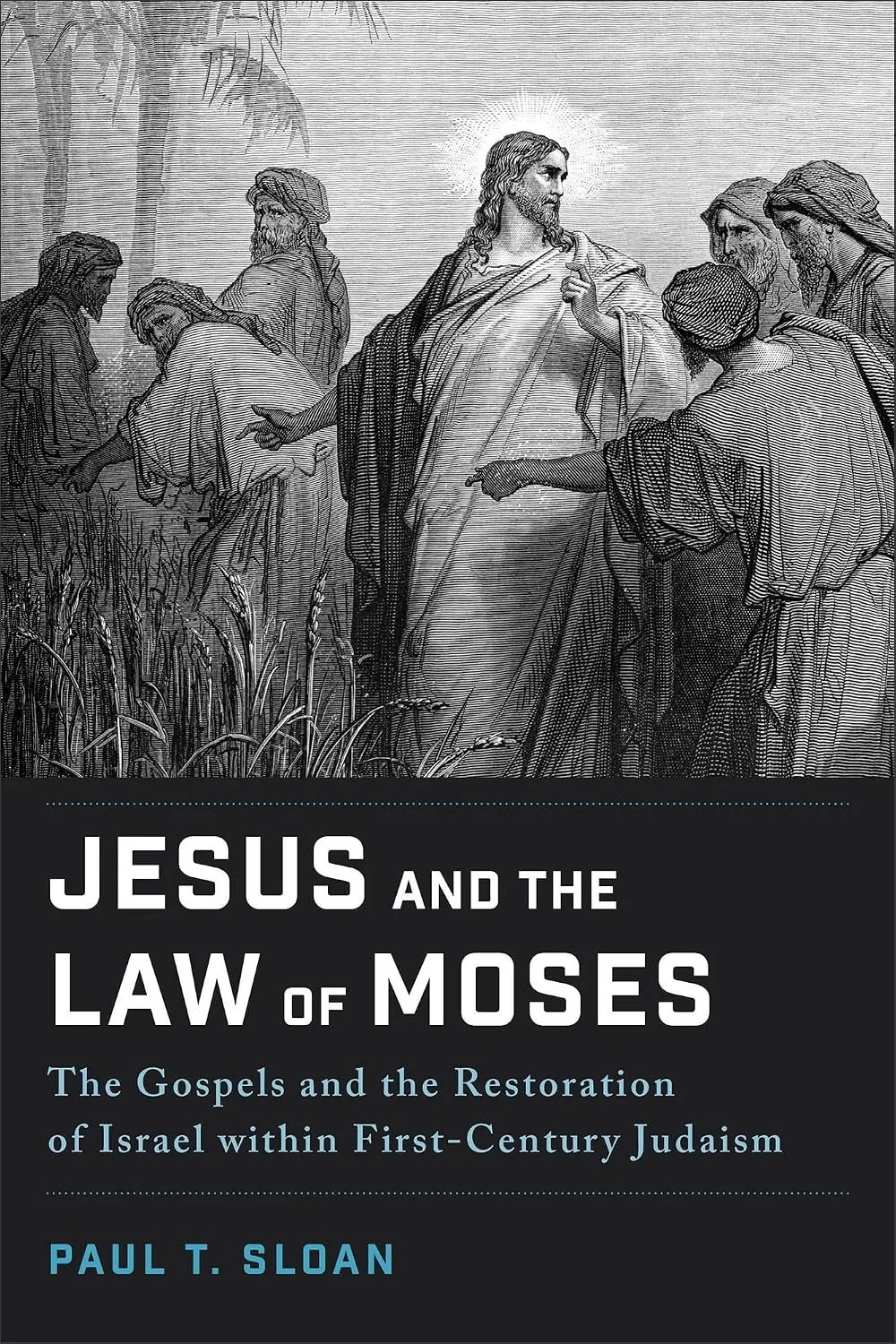
Jesus and the Law of Moses: The Gospels and the Restoration of Israel within First-Century Judaism
Paul T. Sloan
Baker Academic (2025). 270 pp.
Jesus declared, “Do not think that I have come to abolish the Law or the Prophets; I have not come to abolish them but to fulfill them. For truly, I say to you, until heaven and earth pass away, not an iota, not a dot, will pass from the Law until all is accomplished” (Matt 5:17–18). Yet most Christians live as though Jesus not only fulfilled the Law but abolished it. Paul Sloan, associate professor of early Christianity at Houston Christian University, disagrees with this functional antinomianism. In Jesus and the Law of Moses, Sloan argues that “Jesus’s legal teaching, his disputes about the Law’s proper keeping, and his calling sinners to repentance are not in opposition to the Law but are an intramural discourse about its keeping in light of the dawning of the eschatological age” (p. 6).
Key to understanding Sloan’s argument is understanding “restoration ist eschatology.” Following the New Perspective on Paul, Sloan notes how Israel keeps the Law not to become God’s covenantal people but to express their allegiance to God. Israel, however, breaks the covenant and so needs restoration. After experiencing the Lord’s discipline, Israel waits for restoration. The issue is that Israel fails to repent and to return to the Lord. Enter Jesus. Jesus is “God’s Son, appointed to restore exiled Israel” (p. 73).
With that context in mind, Sloan begins with Jesus’s Sermon on the Mount. “In Matt. 5, Jesus instructs his hearers in the practices and characteristics they should pursue to participate in the restoration” (p. 105). After addressing Jesus’s Beatitudes as benefits of restoration, Sloan turns to Matt 5:21–48, a section of the Sermon on the Mount known as the “Antitheses.” Sloan disagrees with this nomenclature: “these are not antitheses. These are Jesus’s interpretation of the commandments he references” (p. 80). He concludes: “Consequently, Jesus teaches that the Law’s commandments obligate his followers—from Israel and the nations—even after his death and resurrection” (p. 85).
In chapter four, Sloan discusses Jesus’s conflict and controversy in the Gospels, specifically purity regulations, healing on Sabbath, and the temple tax. These pericopes and teachings are often understood in light of Jesus’s opposition to the Pharisees, and rightly so. However, Sloan suggests the point is simply that “Jesus’s distinct practices are based on alternative readings of commands, and the differences of opinion is typically not governed by an alternative eschatological agenda but simply an alternative interpretation of the command in question” (p. 136).
Sloan returns to his restorationist framework in chapter five, discussing eschatological nomism. Sloan observes Jesus’s practice of dining with sinners, his claims about family, and a case of Sabbath profanation, all of which are “occasioned by his conviction that the kingdom is irrupting into the present” (p. 137). What sets apart these controversies is not a different interpretation of the Law but rather the unique identity of Jesus. “The legitimacy of such practices depends on [Jesus’s] claim to be the divinely commissioned and empowered healer of Israel sent by God to gather Israel and return them to God’s Law” (p. 170).
With the final chapter and conclusion Sloan makes some of his more controversial claims. In chapter six, Sloan addresses how Jesus’s actions in the temple and the cross relate to his understanding of the Law. Sloan sees Jesus’s actions in the temple as a judgment “for its failure to be the eschatological temple, which serves as evidence of the people’s unrepentance” (p. 178). Regarding the cross, Sloan makes the controversial argument that “Jesus’s death is best interpreted not as a sacrifice but as a voluntary submission to God’s punitive discipline as a ‘ransom for many’” (p. 206).
With the conclusion, Sloan draws connections to the rest of the NT. Since Jesus did not void the Law, Sloan concludes from the Jerusalem Council in Acts 15 that believing Jews continued to observe the Law and “the obligations that fall to gentiles derive from Leviticus” (p. 226). Thus the Law, though applied differently for Jew and Gentile, continued to be followed in the early church.
For those teaching and preaching the NT, Sloan’s Jesus and the Law of Moses is a must-read. This work is at the forefront of NT studies and biblical theology and will undoubtedly prompt future research on this topic. Sloan’s emphasis on restoration eschatology offers teachers and preachers a helpful framework to understand both the OT as well as Jesus’s ministry and see clearly how the two are related. Sloan demonstrates that Jesus is the divinely authorized interpreter and teacher of the Law. Sloan’s careful analysis of Jesus’s interpretation of the Law will help teachers and preachers make necessary distinctions in their own teaching.
Some readers will find significant disagreement with Sloan in his alignment with the New Perspective on Paul. Sloan’s conclusions argue for the necessity of both Jew and Gentile to follow the Law. Such conclusions seem to confuse the continuity between the Mosaic covenant and new covenant, as well as removing any discontinuity between them.
Perhaps most striking is Sloan’s rejection of Jesus’s death as a sacrifice. This conclusion flies in the face of the rest of the NT, including the Gospels. Such a conclusion, however, follows from Sloan’s understanding of the Law. Regardless of how much or how little the reader agrees with Sloan, Jesus and the Law of Moses will have every reader returning to the Scriptures to ponder the Law’s meaning anew.
Dustin Turner (PhD, New Orleans Baptist Theological Seminary) is the Lead Pastor of Vintage Church in New Orleans, LA. He is a member of the St. Irenaus Fellowship of the Center for Pastor Theologians.