The views expressed in this article are of the author only and do not necessarily represent those of the Center for Pastor Theologians.
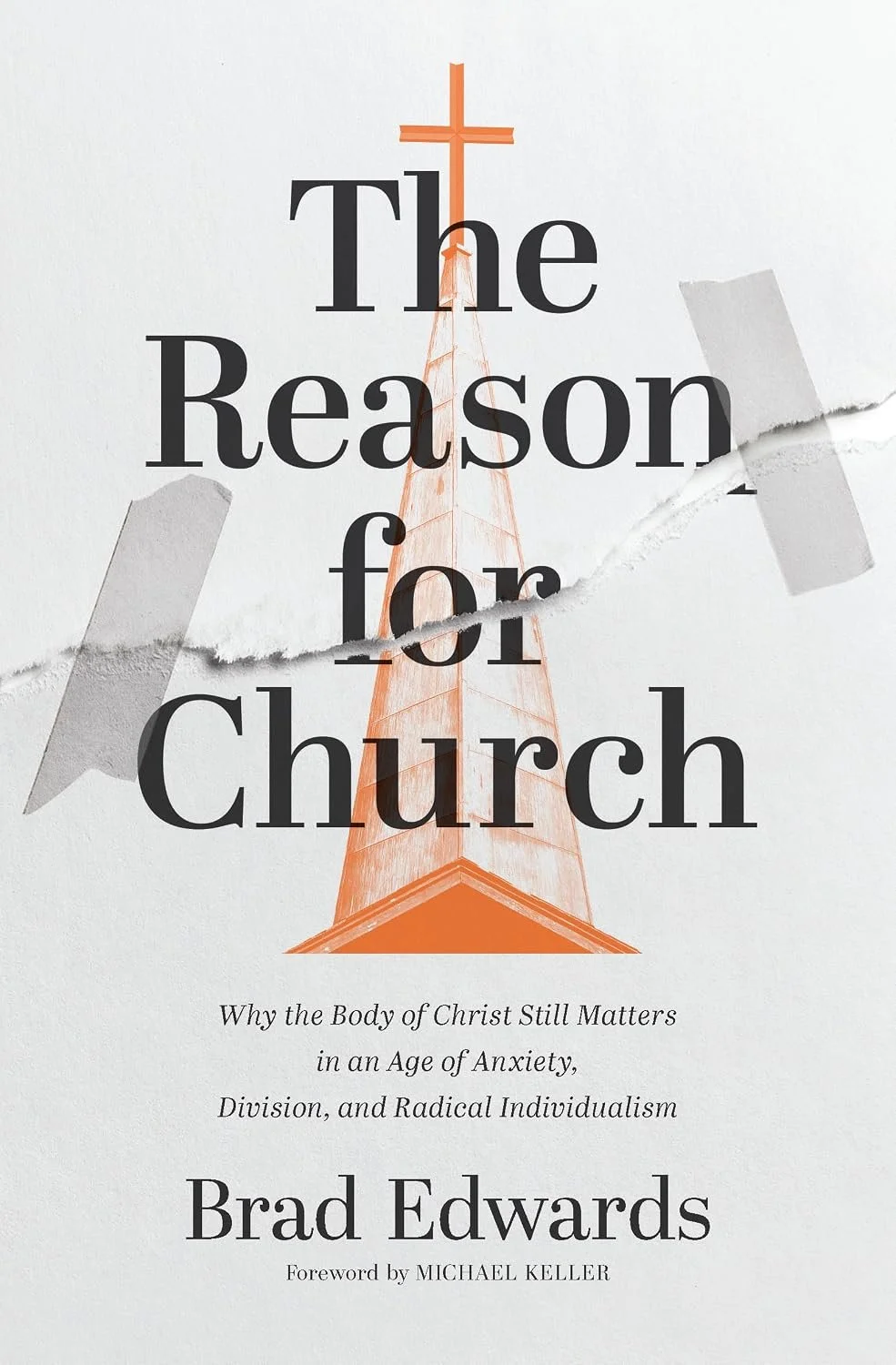
The Reason for Church: Why the Body of Christ Still Matters in an Age of Anxiety, Division, and Radical Individualism
Brad Edwards
Zondervan (2025). 214 pp.
Congregant: Pastor Jay, you make such a big deal about church and even meaningful membership…why? Me: Here, read this book! As I turned the pages, the vision of this book rang true for my context and it stimulated my heart and mind toward ways of approaching my people who succumb, often, to the anti-church and anti-grace worldviews Edwards aptly describes.
As the title suggests, Reverend Brad Edwards, pastor of The Table Church in Lafayette, CO, wants to contribute a unique architectural rendering for how important the church is. Utilizing Tim Keller’s language of defeater-beliefs and reflecting Charles Taylor’s analysis of the secular age, Edwards presents an argument that is both convincing and deeply helpful.
The book is divided into two parts, one deconstructive and the other constructive. Part 1 uses the metaphor of Babel (Gen 11), drawing on the imagery of brick and mortar from fallen humanity’s unholy tower to describe several defeater beliefs: Spiritual Pragmatism, or superficial efficiency; the Sacred Self, or therapeutic culture; Counterfeit Institutions, or social media; (Un)civil Institutions, or disunifying political identities; and Virtuous Victimhood, or inverted and weaponized passions (pp. 1–113). By contrast, the second half replaces the unholy tower with the beautiful community of the church. Some readers may wish the second half mapped more directly onto the first, but Edwards’s aim is not simply to offer a counterpoint to each defeater belief. Rather, he seeks to assemble the general truths and graces of the Spirit’s work through the local church. Thus, Part 2 presents the pastoral seeds to plant: A People Named for Glory, or true identity; A Greenhouse for Exiles, or slow and genuine growth; An Embodied Narrative, or the church as story itself; A Table for Belonging, or hospitality and sacrament; and A City on a Hill, or the true place of cultural renewal (pp. 115–214). In essence, the contrast between Parts 1 and 2 are the two stories of an “attractive” but un-graced life versus the counterintuitive and grace-full life.
Let me try to boil down the major lines of thought in The Reason for Church: the Un-grace of individualism; the Un-grace of our work, our way; and the Un-grace of actual friction. By Un-grace, I mean that Edwards essentially says that a life that mitigates the local church is destined to keep grace away.
The Un-grace of individualism. Each defeater belief, ranging from pragmatism to the displacement of real unity and love by social media, is essentially an outworking of how the “flesh” is animated by a self-orientation at the expense of community. I appreciate how Edwards distills each defeater belief on its own right, but individualism is always behind the curtain. The church, by contrast, demands costly community and thus magnifies grace.
The Un-grace of our work, our way. The Tower of Babel’s brick and mortar, according to the author, is a construct of a functionally godless way of acting. Period. That way of life, in essence, not only distorts a vision of God but keeps God and his presence at arm’s length. The church, by contrast (at least if lived out biblically), is the community of life in God, by his strength, built upon the ordinary (and non-individual) means of grace.
The Un-grace of actual friction. Edwards argues that all attempts at a frictionless life, unburdened by covenant and community, are bogged down in pragmatism, resulting in even greater friction, hardship, and lack of actual grace. The church, by contrast, requires a certain amount of friction as we serve, compromise, wait, and love well. That chosen friction of life together is a divine work of grace. The local church is the place that sacrifice turns to rest.
I think Edwards is correct, even spot on. And so, in Part 2, Edwards claims that the church is the necessary place of beauty, truth, and goodness. While he may lack a bit of nuance in how a church might make use of planning and ambition in his last chapter on mission, I think he sounds the right note. If one truly gives oneself to the life of a local church, change amongst unbelievers near that community will occur by the faithful presence of the people of God.
What Edwards explains requires us to go against the grain of so much cultural force right now, not least our own sinful tendencies: the local church is not just a wise option, it is the necessary option to be human in fellowship with God. This is not a sexy argument, but it is compelling and well-presented. For a first-time author, I found Edwards’s work to be mature writer; his prose sang. It is not a surprise that his book was given the Christianity Today Book of the Year award and that The Gospel Coalition gave him its First Time Author award.
As a pastor who has read many books on why the church matters, I found The Reason for Church to be a resource I would gladly place in the hands of fellow leaders and as many church members who would take the time to read and reflect on it.

Jay Thomas is the Senior Pastor of Chapel Hill Bible Church in Chapel Hill, NC. He is the co-author of Sex, Dating, and Relationships: A Fresh Approach (Crossway, 2012). Jay is a member of the St. Anselm Fellowship of the Center for Pastor Theologians.