The views expressed in this article are of the author only and do not necessarily represent those of the Center for Pastor Theologians.
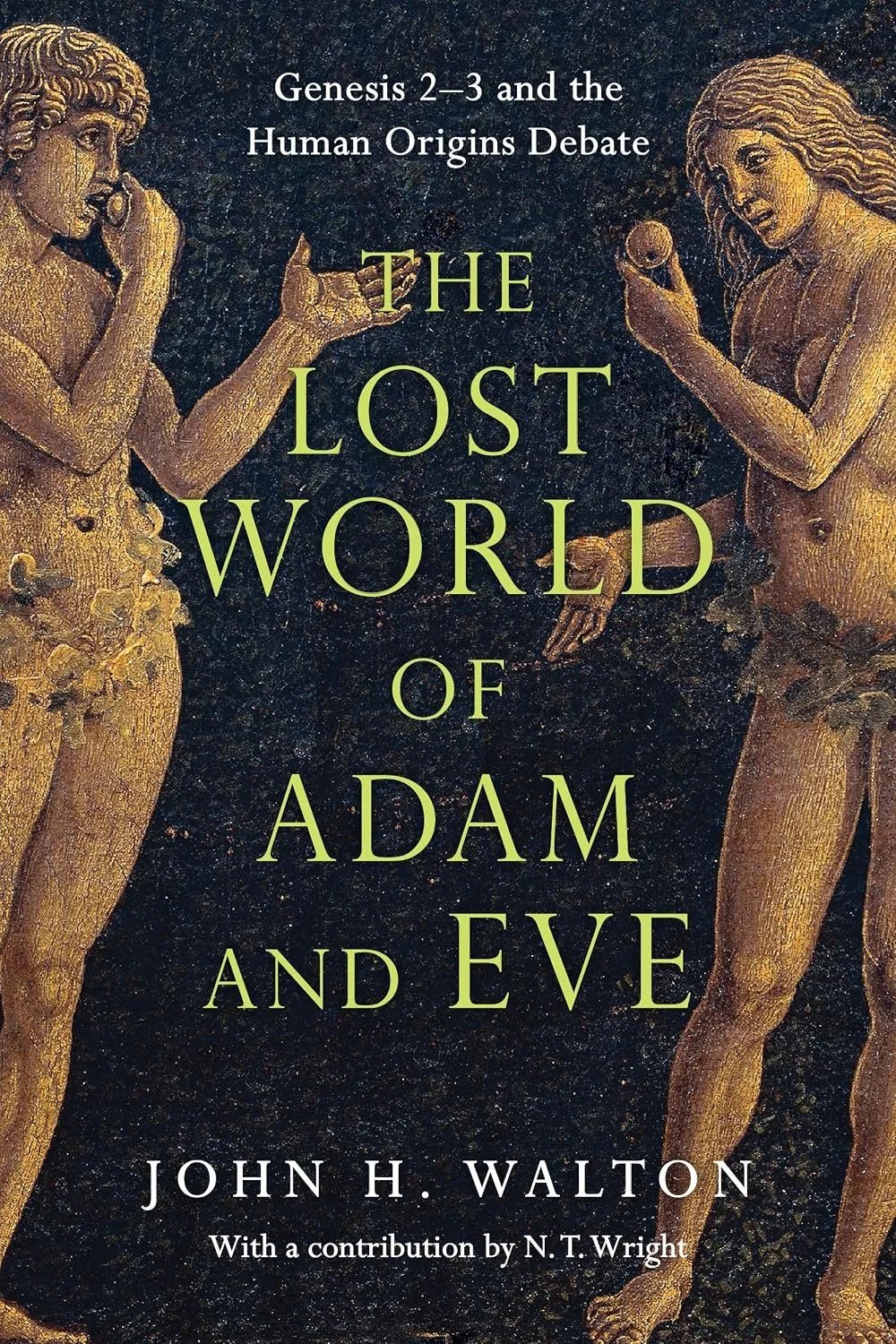
The Lost World of Adam and Eve
John H. Walton
IVP Academic (2015). 255 pp.
The basic thesis of this book is that, if we read Genesis chapter 2-3 in the light of its original contexts; Ancient Near East, we are able to resolve many issues that modern science tend to present and gain a much clearer understanding of the intention of the author and the message God wants us to learn from it.
He presents this book in twenty-one propositions addressing various issues that a generated when people approach the creation story in Genesis. He argues that, though we should not “overblow consensus on the principles of common ancestry and evolutionary theory as explanation for the existence of life” (p. 13). Whether the scientific conclusion stands the test of time or not, they do not pose any threat to biblical belief (p. 13).
Walton did not engage in verifying scientific claim but instead did a close reading of the Bible as an ancient document and as scripture, exploring its claims in it own terms. He did this against the context of the Near Eastern culture based on recent discoveries on the culture. He asserts that we do not expect a communicator to accommodate an audience that he or she does not know or anticipate (p. 15).
God reveals his work in world in the Bible, but he doesn’t reveal how the world works (p. 17); hence the Bible is not a science textbook. He reemphasizes, “we therefore recognize that although the Bible is written for us (indeed, for everyone), it is not written to us” (p. 19).
He opines that every time we read modern ideas into the text we arrogate authority to ourselves and compromise the text. He engages the text from Genesis and presents some noteworthy points. For example, He points out that in chapter one, voidness and formlessness (tohu wabohu) is not lacking in material but in lack of order and purpose (p. 28). Bara therefore is to bring something into existence by giving it a role and a function in an ordered system. He rejects the idea that creation ex nihilo as a material category comes from Genesis.
Walton examines the seven-day account of creation and working through each of the days he established that Genesis 1 is an account of functional origins and not material origins. An interesting point he makes is on the concept of good; he affirms that good “refers to a condition in which something is functioning optimally as it was designed to do, as God intended” (p. 53). Interestingly, Walton points out that, good does not suggest that everything before the fall was perfect including Adam and Eve (p. 57). This idea is radically different from what most of us as Evangelicals (especially from the majority world) have learned during our theological development, but I consider it worth pursuing.
He furthermore discusses the various ways Adam is used in Genesis 1–5, noting that Adam and Eve must be assigned names intended by the Hebrew-speaking users to convey a particular meaning. He affirms “more is going on than giving some biographical information about two people in history” (p. 59). He recommends that the name Adam refers to human beings as species, in others it refers to the male individual of the species, and in some it refers to the designation of a particular individual as the equivalent of a personal name.
He opines against popular believe that, Genesis 2 rather than detailing creation on day six is actually sequel to the first chapter. With this assertion, the people in Genesis 1 are not only Adam and Eve. It means, “that there may be other people (image of God) in Genesis 2–4, not just Adam and Eve and their family” (64). In interpretation helps to solve many problems for those wondering how many people were referenced in the early chapters of Genesis.
For Walton, forming from dust should not be rendered in a material sense but as representing the mortality of humans (pp. 71–75). He notes, “In the garden, God provided a tree of life. Immortal people have no need for a tree of life. The provision of one suggests that they were mortals (p. 73). The author strongly affirms that we can be born of a woman and still be formed from the dust. He notes, “even though Adam is formed from the dust, he could still be born of a woman” (p. 76).
The author again posits that Genesis does not offer a competing claim about origins. “He is the one responsible for our human existence and our human identity regardless of the mechanism or the time period” (p. 77) Furthermore, he examined the different ancient near eastern accounts on the origin of humans; Sumerian, Akkadian and Egyptian. He notes similarities in the way the ancients presented knowledge in their contexts but also notes that the Bible takes a departure from surrounding cultures.
Examining if Adam and Eve are historical persons, he affirms that theologically issues of sin and redemption may require a strong argument for historical Adam and Eve, but he also observes that to play these historical roles does not necessarily require them to be first human beings. He suggests that one can accept the historical Adam without making decision about material origin. Walton presents Adam as a priest whose assignment was to preserve sacred space. He was to do that with the help of Eve, his wife. Adam and Eve were significant by their election and their role set them apart, not in a generic sense but functional sense. He explains that the early parts of Genesis should be seen as ‘imagistic History’ which is impacted by this type of thinking and he differentiates this from the general idea of myth which may have interpreted Genesis.
An inquisitive reader may not find section on the relationship between the historical Adam, sin, and redemption will need more explanation from Walton. He asserts that all people are subject to sin and death because of disorder in the world not because of genetics (p. 153) therefore there was death before the fall. He concluded this work with the contribution from N. T. Wright dealing with the New Testament implications.
Born out of respect for God’s word and need for prosper understand ing, this book is very good for anyone trying to reconcile his scientific background and information with the Biblical narrative. As a person who has been very interested in the Old Testament and have been in Christian ministry in Africa for almost three decades, I find Walton’s arguments throughout the book compelling and helpful. He wrote this book in clear and precise language, avoiding technical words, so that anyone with an average biblical education can understand.
Pastors who are working with modern evolutionary minded congregations have a very viable tool for their work. Students in biblical and theological studies will find this book very instructive. It presents a faithful Evangelical perspective to the creation story without dismissing the recent scientific discussions that present alterative narrative on how humans came to existence. Walton presents the hope that it is possible to serve God without jettisoning of some long held scientific position. I strongly recommend this book for every pastor and Bible student.

Babatunde Oladimeji (PhD, Asbury Theological Seminary) is the Pastor of Chardon United Methodist Church in Chadron, NE. Tunde is a member of the St. Augustine Fellowship of the Center for Pastor Theologians.