The views expressed in this article are of the author only and do not necessarily represent those of the Center for Pastor Theologians.
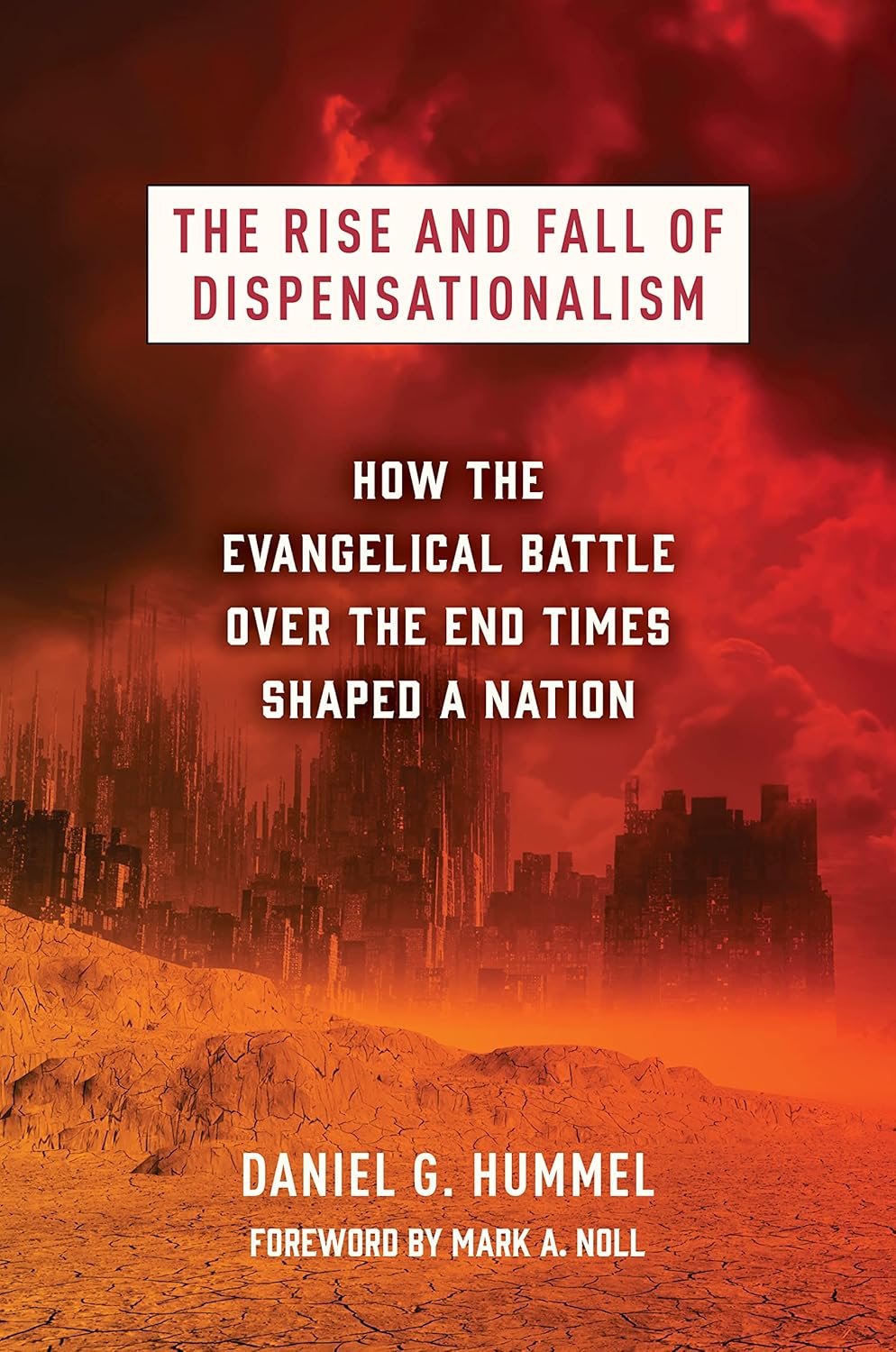
The Rise and Fall of Dispensationalism: How the Evangelical Battle Over the End Times Shaped a Nation
Daniel G. Hummel
Eerdmans (2023). 382 pp.
Daniel Hummel’s The Rise and Fall of Dispensationalism: How the Evangelical Battle over the End Times Shaped a Nation masterfully draws multiple threads of dispensationalism into a coherent narrative. It is no criticism of Hummel’s book to say that its subtitle is a bit misleading. He makes clear that dispensationalism was about much more than the end times; it was nothing less than a theory of the church itself and of its relationship to the world.
Historically, much Christian ecclesiology has been broadly covenantal, holding that God is in covenant with, as the Nicene Creed has it, “one holy, catholic, and apostolic church.” While the covenant has unfolded progressively over time, it is regarded as united, so that God’s people, including both those belonging to the nation of Israel and those added from “the nations” in the centuries following Pentecost, are fundamentally one. Dispensationalism rejects this unity. God’s covenant with Israel and that with the post-resurrection church are two distinct covenants, both in terms of who is included and the terms of their inclusion. Dispensationalism is likewise dualist in its understanding of time: there is no continuity between the kingdom of God existent in history and the eternal kingdom of heaven which he will bring about as an irruption within history at the eschaton.
This expectation has important implications for the mission of the church in the present day. Premillennial dispensationalists have no expectation that their efforts in time are building the eternal kingdom of heaven on earth, and thus downplay working for social justice, focusing instead on global evangelism. Hence Dwight Moody’s famous quote: “I look on this world as a wrecked vessel . . . God has given me a lifeboat, and said to me, ‘Moody, save all you can.’” But as Hummel notes, dispensationalists were not alone in this emphasis. Other fundamentalists, notably the Reformed minister J. Gresham Machen, lumped together Christian attempts to bring “heaven on earth” with what they considered a modernist and heretical move toward a world governance system. Opposition to liberal Christians such as Harry Emerson Fosdick was a force which united fundamentalists across denominational lines, with all manner of views on the end times.
Hummel thoroughly documents dispensationalism’s rise to dominance in American academic theology, elucidating how many of evangelicalism’s prominent institutions of higher education have their roots in dispensationalism or its off shoots. Many, but not all. Even as Dallas Theological Seminary was founded in 1924 to rival Princeton Theological Seminary, for instance, Machen was leaving Princeton to found Westminster Theological Seminary in 1929. During his tenure he tolerated the presence of faculty with premillennial views; in the wake of his departure, however, premillennialists were gradually ejected both from the school and from Machen’s Orthodox Presbyterian Church. Eventually they founded their own denomination (the Bible Presbyterian Church) and seminary (Faith Theological Seminary), neither of which were absorbed into the dispensationalist fold.
Hummel argues that dispensationalism largely fell victim to its own success. Dispensationalism spoke to the urgency of the Cold War moment, but many laypeople were deterred by the sophistication of dispensationalist scholastic theology. Entrepreneurial popularizers like Hal Lindsey, unaccountable to seminaries or denominational leadership, found success by taking their message directly to the masses. Lindsey’s The Late, Great Planet Earth—full of citations not to past theological scholarship but to contemporary newspapers—sold like hotcakes. Dispensational tenets found their way into the platform of the Republican Party (and Reaganism found its way into pop dispensational talking points), as Lindsey and others characterized the United States has having been raised up by God for the purpose of world evangelism and the defense of Israel. Meanwhile, dispensationalism found its way into mainstream entertainment, particularly music and publishing (including Tim LaHaye and Jerry Jenkin’s Left Behind novels).
In Hummel’s analysis, several factors led to dispensationalism’s wane and ultimate fall. Dispensational scholars followed Lindsey and other best-sellers into the popular market—but by responding to the demand for specific predictions, which then failed to materialize, they sacrificed the credibility they had held as scholars. Internal rifts sapped the movement’s momentum. Add to this disputes with other fundamentalists, and by the end of the twentieth century dispensationalism had been battered from all sides. At the same time, it was displaced by two generations of covenantal theologians and ministry leaders—including J.I. Packer, John Stott, D.A. Carson, and John Piper—who rose to academic prominence and led popular movements.
Dispensationalism undoubtedly shaped the nation, but some of its shaping influences crossed denominational lines. To take one more, sad example, Hummel notes how, time and again, dispensationalist Christians failed to confront overt racism within its ranks, on both sides of the Mason Dixon line, out of a desire to avoid dividing (majority white) Protestant churches and blunting the energy that was being funneled into global missions and evangelical institution-building. But as Hummel notes, the same failings could be found among covenantalists, such as the southern Presbyterians who stuck by James Henley Thornwell as he shifted from tolerance to explicit “biblical” defenses for segregation.
For all that, one can hardly look at the current role of evangelical Christianity in American and world politics without seeing residual elements of dispensationalism. Hummel has done the church a great service in so thoroughly and coherently documenting the origins of these elements and reminding us that the twists and turns we experience in the present day have precedent in past centuries of American Christianity.

Nathan Barczi (PhD, University of Nottingham; PhD, MIT) is the Associate Pastor of Preaching & Teaching at Christ the King Church in Newton, MA, and the Associate Director & Senior Theologian at The Octet Collaborative in Cambridge, MA. He is a Senior Fellow of the Center for Pastor Theologians.