The views expressed in this article are of the author only and do not necessarily represent those of the Center for Pastor Theologians.
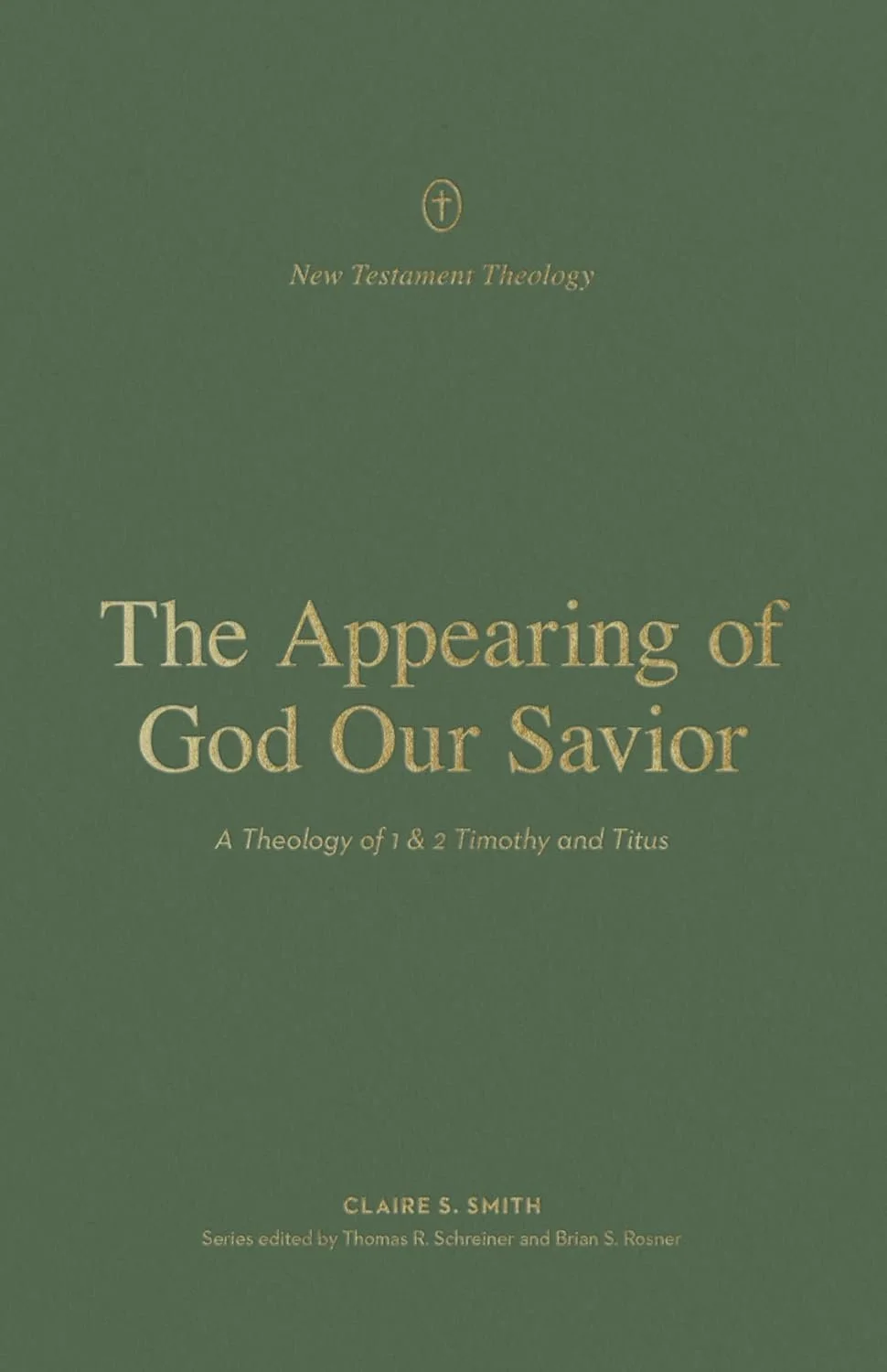
The Appearing of God Our Savior: A Theology of 1 & 2 Timothy and Titus
Claire S. Smith
Crossway (2025). 168 pp.
The letters to Timothy and Titus in the NT, commonly grouped together as the “Pastoral Epistles,” have long divided interpreters. As works outlining the ministry and organization of the second and third generations of churches after Christ, they are understood by some as important guides for the enduring institution of the church and by others as departures from the apostolic era portrayed in Acts. As works commenting directly on the roles of men and women in the church, they are understood by some as outlining the complementarity of men’s and women’s roles in the church and by others as patriarchal and anti-woman, out of step with contemporary understandings of gender. Impacting both debates is the most significant interpretive issue of all: was the author of these letters the Apostle Paul or someone who, after his death, assumed his authority to advance his own agenda? The issue of authorship has long dominated discussions of these letters, causing their unique theological contributions, particularly beyond the controversial issues mentioned above, to be minimized or ignored.
Claire S. Smith does not ignore the issue of authorship—she believes Paul was the author of each of these letters and that this understanding rightly plays a significant role in one’s approach to and conclusions about them—but she focuses more on the important themes and theological contributions of each of these letters. A Reformed, evangelical scholar from Sydney, Australia, Smith is the author of God’s Good Design (Matthias Media, 2019) and Pauline Communities as ‘Scholastic Communities’ (Mohr Siebeck, 2012), in addition to several journal articles on these letters. Her goal with this book is to demonstrate how the messages of who God is and how he is toward his people are the central themes of each letter. At the same time, she means to explain how each letter uniquely contributes to our understandings of God and his gospel plan. While Smith acknowledges the similarities between the letters, she eschews the “Pastoral Epistles” label, believing that it tends to overlook the real differences between the letters and, even if unintentionally, set them apart from the rest of Paul’s epistles, isolating their message(s) from his broader theology. Therefore, Smith explains each letter on its own, although she does compare and contrast certain aspects of the letters when appropriate.
After the introduction, the book develops in three parts, one for each letter. Each part is structured in a similar way. For example, each begins with a chapter on who the triune God is according to the argument in that particular letter. First Timothy emphasizes that God is the savior of his people; 2 Timothy emphasizes that God is powerful and near to his people, even in their suffering; and Titus emphasizes that God is gracious, which guarantees the salvation of his people. Each part then follows its chapter on God with a chapter on salvation. First and Second Timothy have chapters on the word of God as well as chapters on the hope to come, while 1 Timothy and Titus have chapters on their respective explanations of the church. Structuring the book in this way accomplishes Smith’s intent of highlighting each book’s unique contributions to these doctrines. It does mean, however, that in order to get a sense of how these themes harmonize and diverge across the three epistles one must read the entire book (something Smith acknowledges in her introduction).
The entire book is well worth reading for any student of the Pastoral Epistles. It is an introductory work. Smith explains her interpretations of the letters throughout without spending much time considering alternative views, but she does so in a thorough way that befits the purpose of the book series, which is to provide readable, book-length treatments of the distinctive theological themes of each NT book (or in this case, collection of books), and that is fulfilled in this volume. This book would be an excellent primer for pastors preparing to preach or teach through these letters. It is well-researched, focused on the gospel, and accessible to those without a strong background in these letters.

Gary L. Shultz, Jr. (PhD, Southern Baptist Theological Seminary) is the Associate Professor of Theology and Editor of Baptist University Press at Baptist University of Florida. He is a Senior Fellow of the Center for Pastor Theologians.