The views expressed in this article are of the author only and do not necessarily represent those of the Center for Pastor Theologians.
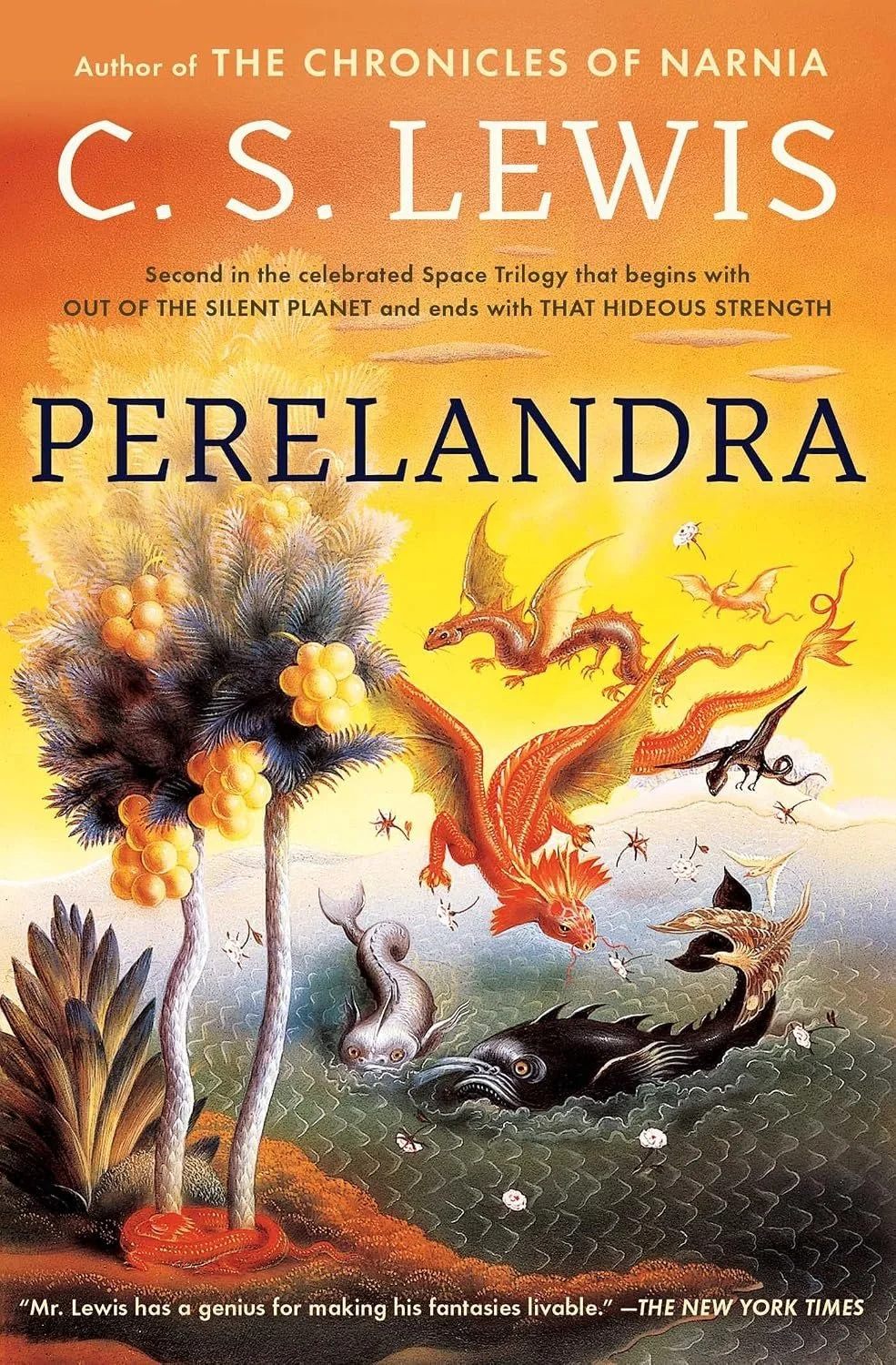
Perelandra
C.S. Lewis
Scribner (1944). 192 pp.
Analyzed on the backdrop of a rarefied form of A.J. Greimas’s “actantial structure,” Perelandra can be seen to follow a clear movement of commission to complication to resolution. Ransom, the novel’s chief protagonist and experienced interplanetary traveler, is supernaturally transported in a white coffin from Earth to Perelandra, or Venus, which turns out to be an unfallen world. His mission, as he learns some time after arrival, is to protect the unfallen but still innocent (“young”) Green Lady, as well as the world that she and the King govern, from the malevolent intentions of a satanic presence who has come to tempt her to disobey Maleldil (God). The complication to Ransom’s commission comes not, as one might expect, from the physical might of the demonically possessed Westin (who has given himself over to this power) but from the subtlety of his verbal machinations. The tempter is tempting because the tempter is convincing. Maleldil’s command to the King and Green Lady that they must not set up home on the Fixed Land (but remain vagabonds on the floating islands) is tested from every conceivable angle, and the Un-Man inhabiting Westin’s body makes slow but perceptible progress with the woman over time. Surprisingly, the final resolution to the problem does not come by Ransom’s capacity to answer sophistry with truth—though try and try he does; the ultimate resolution comes by Ransom’s shocking resolve to take out the Strong Man by means of violent struggle. A bloody battle ensues over many days until Westin—and the Un-Man possessing his body—is dead. Perelandra is saved from suffering the same fate as Earth and is thus liberated to live out the story that Adam and Eve failed to live out.
Lewis’s likely goal in writing this second of three novels dealing with interplanetary travel may well be summed up on the second page: “A man who has been in another world does not come back unchanged.” By inviting us into Perelandra, the world of Genesis 1 and 2 reimagined and reminted, and by putting two earthlings on this planet as dialectical presences to each other and the new world, Lewis clearly seeks our change; he is characteristically brilliant in doing so. His reflections on temptation, sex, and gender seem especially salient for the church in today’s world.
From one angle Perelandra can be seen as Lewis’s Screwtape Letters refashioned, with the problem of temptation being put on new display. Our world is “enemy-occupied territory” (p. 12), and Perelandra is threatened with becoming similarly infiltrated because of Westin’s possessed presence. In both worlds the struggle is presented as being most fundamentally against powers and principalities that seek to darken God’s good worlds. More specifically, history in each case (or at least proto-history for Perelandra) is presented as a dialogue—or, better, a duologue, where two distinct “words” are being spoken—and the struggle concerns to which voice/Voice one will ultimately listen. In our fallen world, malevolent voices become present to humans in our own thoughts and impressions. In the unfallen Perelandra, the malevolent voice is and can only be present to the Green Lady in Westin’s host body. Consequently, Lewis shows that redemption is enacted differently in each world. On Earth, where we have already internalized the lie about God, Christ countervails the powers by offering his body as the revelation of Truth (God is good, and you can still get in on this goodness). On Perelandra, where the lie has not yet taken root in human hearts but exists alone in Westin’s body, Ransom countervails malevolent power by destroying its vessel. In Lewis’s mind, redemption is particularistic, even though always Christological.
One of the things spared in Perelandra by Ransom’s action is Maledil’s vision for sex and gender. Lewis elsewhere observes that a child who has only ever played in a sandbox has no conception of the splendor of a day at the beach, and so stays content in his sandbox. Similarly, in this novel Lewis shows that most of our thinking and experiences with sex and gender on earth simply indicate that we’ve never experienced them in all their magnificence. Gender is deeper than its expression in a male and female. Sex is deeper than physical intimacy. Why? Because sex and gender are sacramental: visible signs of heavenly realities, parts that participate in a much greater and grander whole. This is why when Westin first stumbles upon Ransom with the Green Lady and accuses Ransom of having sex with her, and when Westin then scoffs at Ransom’s defense that he’s been communing with this goddess in a state of “sexless innocence,” Ransom qualifies:
Oh, sexless! . . . All right, if you like. It’s about as good a description of living in Perelandra as it would be to say that a man had forgotten water because Niagara Falls didn’t immediately give him the idea of making it into cups of tea (p. 76).
Sex is to sexuality what a drop of water is to a waterfall. Similarly, the Man and Woman’s respective genders—which are the “more fundamental realit[ies] than sex” (p. 172)— are themselves merely parts of a larger and heavenly whole. Gender is part of the deep structure of reality. This is manifested to Ransom in a vision of two sexless angelic figures. The one is masculine—Malecandra, who is not male, and the other is feminine— Perelandra, who is not female. Lewis’s description is worth quoting at some length, because it gives us an idea of what Lewis thought gender essentially is.
Both bodies were naked, and both were free from any sexual characteristics either primary or secondary. . . . Malecandra was like rhythm and Perelandra like melody. . . . Malecandra affected him like a quantitative, Perelandra like an accentual . . . the first held in his hand something like a spear, but the hands of the other were open, with the palms towards him. . . . At all events, what Ransom saw at that moment was the real meaning of gender. . . . Malecandra seemed to him to have the look of one standing armed, at the ramparts of his remote archaic world, in ceaseless vigilance, his eyes ever roaming the earth-ward horizon whence his danger came long ago. . . . But the eyes of Perelandra opened, as it were, inward, as if they were the curtained gateway to a world of waves and murmurings and wandering airs, of life that rocked in winds and splashed on mossy stones and ascended as the dew and arose sunward in thin-spun delicacy of mist. (pp. 171–172)
Lewis qualifies that “the male and female of organic creatures are rather faint and blurred reflections of the masculine and feminine. Their reproductive functions, their differences in strength and size, partly exhibit, but partly also confuse and misrepresent, the real polarity” (p. 172). Nevertheless, when Ransom at long last sees the Man and Woman together in all their sacred and gendered difference, he is filled with awe, and the book enters its climax and dénouement.
There was great silence on the mountain top and Ransom also had fallen down before the human pair. When at last he raised his eyes from the four blessed feet, he found himself involuntarily speaking though his voice was broken and his eyes dimmed. “Do not move away, do not raise me up,” he said. “I have never before seen a man or a woman. I have lived all my life among shadows and broken images. Oh, my Father and my Mother, my Lord and my Lady, do not move, do not answer me yet. My own mother and father I have never seen. Take me for your son. We have been alone in my world for a great time. (p. 176)
In sum, Perelandra is a masterpiece of creative and theological genius. It cannot be more heartily and enthusiastically recommended for reflection and digestion by our current generation. By God’s grace it will effect that transformation of the imagination to which Paul behooves us.

Ed Gerber (PhD, University of Wales, Trinity Saint David) currently serves as the University Chaplain & Director of Campus Ministries at Trinity Western University in Langley, British Columbia. Before that, he served churches as an ordained minister in Washington State, Iowa, New York, and Langley. Ed is a member of the St. Peter Fellowship of the Center for Pastor Theologians.