The views expressed in this article are of the author only and do not necessarily represent those of the Center for Pastor Theologians.
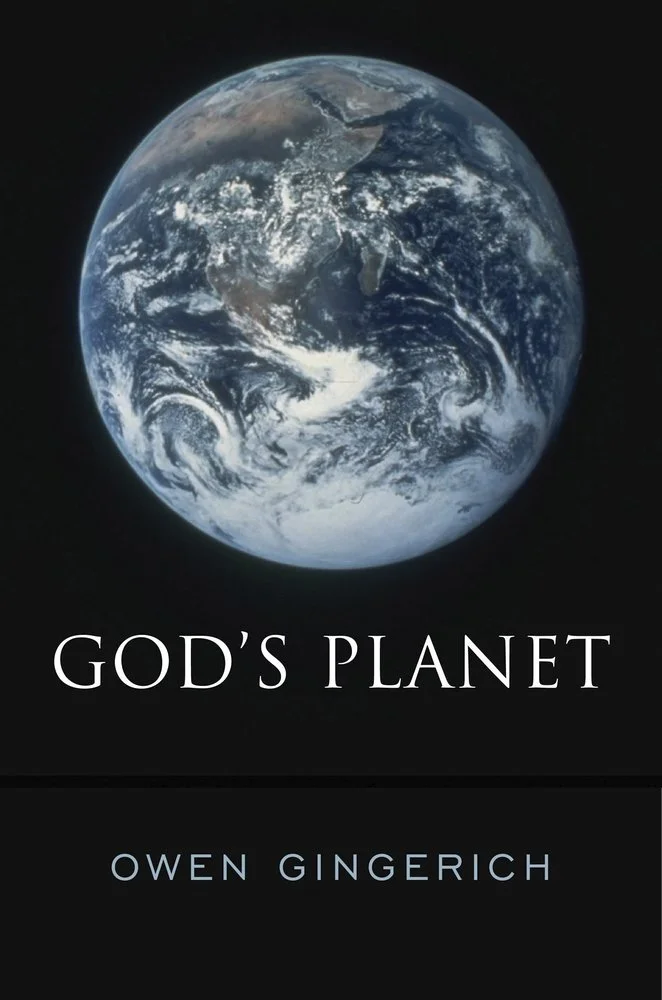
God’s Planet
Owen Gingerich
Harvard University Press (2014). 192 pp.
According to the late Harvard paleontologist Stephen Jay Gould, science and faith occupy two “non-overlapping magisteria,” or “NOMA.” While science and faith can “be friends,” they nonetheless must adhere to the rules and norms of their realms. NOMA has become the default position for many in contemporary society and in the church. However, while Owen Gingerich, an esteemed emeritus professor for the Harvard Smithsonian Center for Astrophysics, agrees with Gould that science and faith essentially ask different questions, he ultimately disagrees with Gould’s NOMA theory. In God’s Planet Gingerich argues that faith and science have enjoyed a complementary relationship throughout history and that history tends to side with coherent, integrative visions of scientific progress. Gingerich surveys the work of Copernicus, Darwin, and Hoyle, articulating how religious or antireligious sentiments often determine what society accepts as science. God’s Planet is based on a set of three lectures Gingerich delivered as part of the Hermann Lectures on Faith and Science at Gordon College.
Nicolaus Copernicus (1473–1543), in On the Revolutions of the Heavenly Spheres, asserted that the earth revolved around the sun, challenging the geocentric (Earth-centered) consensus held by the church and society at the time. In Part I Gingerich asks, “If Copernicus’ cosmology was right, why did it take a century and a half for a majority of educated people to accept the idea that the earth moved and the sun stood still?” (p. 9). Some have asserted that Copernicus’ work was inaccessible to society at the time; however, this was not the case. The existing overwhelming consensus of a geocentric universe, rooted in the work of Ptolemy and some theological speculation, created an insurmountable barrier for Copernicus to promote his heliocentric cosmology. The acceptance of Copernican cosmology was “slow, far from unanimous, and based not on proofs, but on the persuasion of what was increasingly seen as a coherent system” (p. 46). The subsequent work of Galileo and polymath Richard Hooke would slowly overturn consensus by the end of the seventeenth century.
In Part II Gingerich provides a brief yet comprehensive summary of how Charles Darwin (1809–1882) developed the theory of evolution. Gingerich, contrary to much of evangelicalism today, suggests that “the combined roles of geology, paleontology, chemistry, and biology have provided strong credentials for evolution today” and that he is “personally convinced that Darwin was on the right track” (p. 97). Gingerich posits that Christians are often uncomfortable with evolutionary theory because of how humans fit into the picture (pp. 97–98). The debate over evolution continues to rage within the church today, though scientists have overwhelmingly accepted its conclusions about the way species transform over time.
In Part III Gingerich describes Fred Hoyle’s (1915–2001) thinking on multiverses and metaphysics. Hoyle, along with the majority of scientists in his day, generally held that the universe existed forever, a theory described as “steady state cosmology.” In response to new discoveries challenging steady state cosmology, Hoyle pejoratively coined the phrase “Big Bang” to describe the emerging theory of a university with an origin. As the Big Bang theory gained prominence in scientific circles, Hoyle announced that his adherence to steady state cosmology was untenable (p. 117). However, Hoyle would posit that in order for the Big Bang to successfully occur, large amounts of carbon, combined with perfect amounts of helium and lithium, needed to be present. This concept of “fine-tuning” led Hoyle to acknowledge the possibility of an Intelligent Designer.
A primary theme of Gingerich’s book is that society often lags behind scientific developments for several decades, even centuries. As Gingerich has demonstrated, ideas such as heliocentrism and evolution took years to overturn scientific consensus and take root in society. One could argue that had Copernicus made his discovery today, the consensus would have quickly overturned, as the dissemination of information occurs at a much faster pace. However, Gingerich demonstrates that social, theological, and scientific milieu often play a role in inhibiting or supporting the acceptance of new science. In this case, the contributions of Copernicus, Darwin, and Hoyle all interacted with theology in significant ways, which presented numerous challenges to broad acceptance.
Pastor theologians bear the responsibility of leading their people in grappling with scientific revelations in light of theological realities. If we adhere to the old adage “all truth is God’s truth,” we will critically examine modern scientific advances through a robust theological lens in order to construct an expansive view of how God has created this world to function. I strongly recommend this book to pastor theologians who perceive the need for extended reflection on the relationship between faith and science. There exists a deep need to consider how our theological or scientific biases undermine the pursuit of truth in churches today. A book such as God’s Planet illustrates how accepting new truth often means retooling previous assumptions. In our day and age, the church must move beyond the binaries it perpetuates and construct a grander vision of God’s truth. As Gingerich writes, “If someone tells you that evolution is atheistic, be on guard. If someone claims that science tells us we are here by pure chance take care. And if someone declares that magisteria do not overlap, just smile smugly and don’t believe it” (p. 153).

Benjamin Espinoza is the Associate Vice President for Online Education and Assistant Professor of Practical Theology at Roberts Wesleyan College. He holds a PhD from Michigan State University. He is a member of the St. Peter Fellowship of the Center for Pastor Theologians.