The views expressed in this article are of the author only and do not necessarily represent those of the Center for Pastor Theologians.
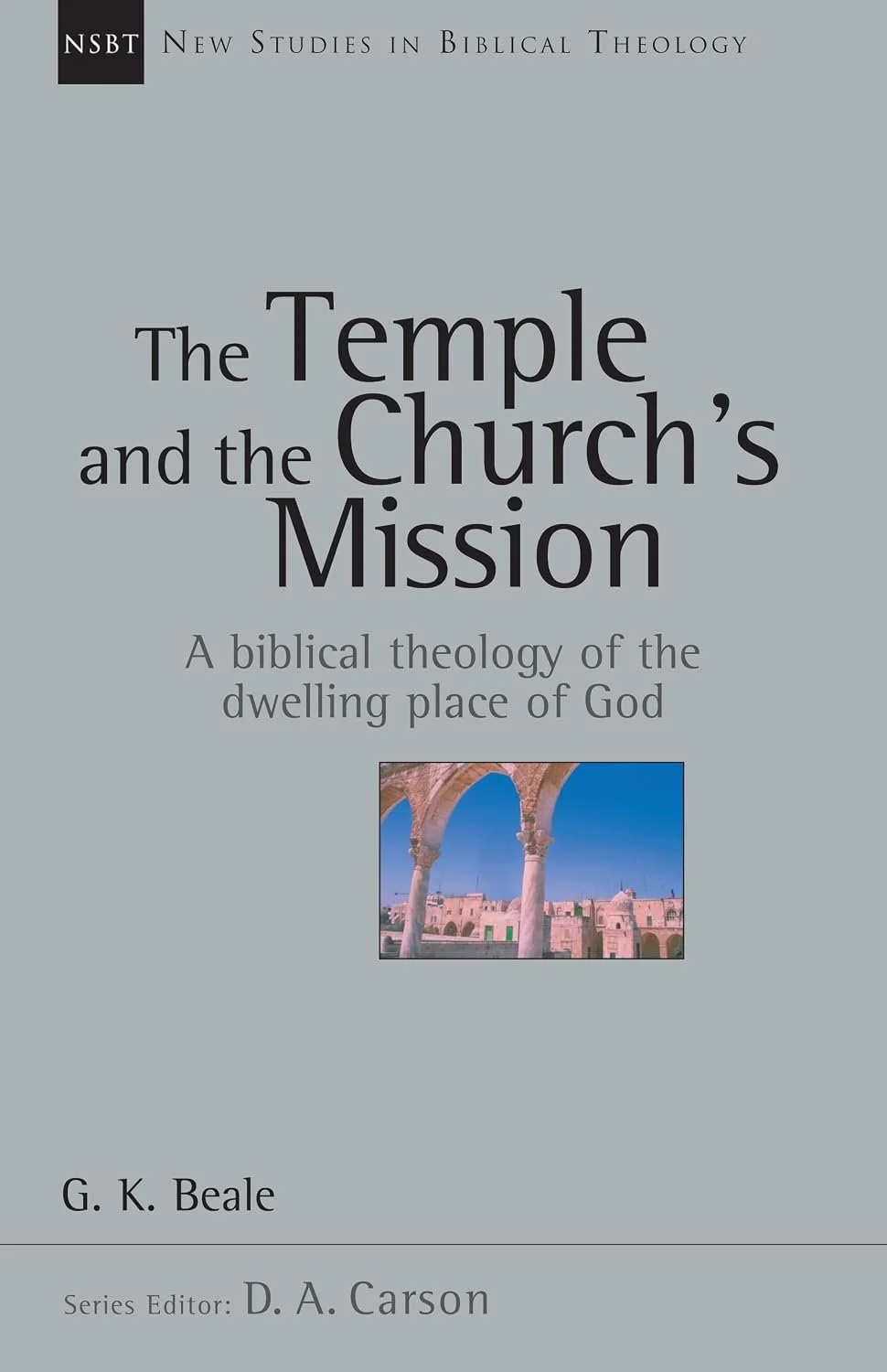
The Temple and the Church’s Mission: A Biblical Theology of the Dwelling Place of God
G.K. Beale
IVP Academic (2004). 458 pp.
This volume begins with an apparent and perplexing discrepancy found in Rev. 21:1–22:5. Beale observes that John claims to be seeing a new heaven and a new earth, and yet he goes on to describe merely a city—a city with the shape and structure of a temple. Beale wonders why the temple and the city and the new cosmos are seemingly being equated, thus compelling him into a substantive and wide-ranging Biblical theology of God’s dwelling place. Beale states, “My thesis is that the Old Testament tabernacle and temples were symbolically designed to point to the cosmic eschatological reality that God’s tabernacling presence, formerly limited to the holy of holies, was to be extended throughout the whole earth” (p. 25). Beale claims that this view of God’s presence not only resolves the tension of Revelation 21, but it opens new and important insights into the role of the temple in both the New and Old Testaments. In order to support his view, Beale 1) surveys the cosmic symbolism of temples in the Old Testament and Ancient Near East, especially their expansive aspects, 2) argues that the Garden of Eden serves as the archetype of the concept of temple, and 3) explores every important reference to temples in the New Testament, especially in relationship to Old Testament predecessors, before returning to Revelation 21–22.
Chapter 2 begins Beale’s exploration of the symbolism of temples in the Old Testament, suggesting that Israel viewed its temple as an earthly representation of God’s cosmic and heavenly temple. This symbolism begins with the Sabbath and the garden, which Beale compares to other Ancient Near Eastern literature. He concludes that the Garden of Eden was, symbolically, the first temple/tabernacle, and subsequent temples and tabernacles likewise included garden-oriented qualities (pp. 79–80).
Chapter 3 follows parallel arguments, focusing primarily on the mediatorial role of mankind (as priests and kings) in expanding the garden through the “be fruitful and multiply” mandate. Beale suggests that this shows up most clearly in in the building of altars (e.g., Israel at Sinai, David and Solomon, Israel and the building of the second temple after the return from Babylon).
Chapter 4 preliminarily concludes Beale’s work in the Old Testament. Here Beale connects his theme to that of kingdom, showing that the mandate to expand the garden is expressed in a mandate to expand the kingdom of Israel in Numbers, Isaiah, Jeremiah, Daniel, Ezekiel, and Zechariah.
Chapters 5–10 follow the development of Beale’s theme in the New Testament: in the Gospels; Acts; 1 and 2 Corinthians, Ephesians, and Colossians; 2 Thessalonians 2; Hebrews; and concluding with Revelation. Beale, a New Testament scholar, expertly draws the Old Testament work in rather fully. In the Gospels (ch. 5), Christ is the last Adam and last temple in the New Creation, the cornerstone of the last temple, and the greater temple that would be torn down. In Acts (ch. 6), Pentecost relates to Sinai and fulfills Joel’s prophecy. Stephen and James both view Christ as the temple and New Creation. In Paul’s epistles (ch. 7), temple imagery is applied to the Church, the representatives of the New Creation. In 2 Thessalonians 2 (ch. 8), Beale takes the position that Paul’s statements about the “man of lawlessness” are prophetic, but within the Church (seeing the temple in 2 Thessalonians 2:4 as a spiritual temple representing the Church). Depending on one’s eschatological framework, Beale’s conclusions could be quite challenging. More explanation of his position can be found in his commentary on 1 and 2 Thessalonians in the IVP New Testament series. In Hebrews (ch. 9), Jesus is the fulfillment of the temple and the tabernacle. Finally, in Revelation 11 and 21–22 (ch. 10), the temple once again is represented in cosmic fullness.
In Chapter 11 Beale returns to the Old Testament with an extended look at the temple in Ezekiel 40–48 and its relationship to the New Testament. Beale argues for a “non-structural end-time temple” (p. 336), which again may pose challenges for some eschatological perspectives.
Chapter 12 brings Beale back to Revelation and the broader description of the New Jerusalem (and its antecedents in the Old Testament). Beale concludes that God’s presence in the structural temple of the Old Testament was, indeed, a cosmic foreshadowing of God’s and Christ’s presence amongst his people as the true “paradisal city-temple” (pp. 392–93).
Chapter 13 introduces some practical applications of this massive theology of the temple, particularly how the Church is to understand its mission in light of the expansive nature of the garden temple.
Occasionally a book is so thorough and yet so helpful, so original and yet so important that the reader begins to sense that it must be destined to become a classic. While little more than ten years old, Beale’s The Temple and the Church’s Mission is such a monograph. It is both a compelling survey of one of the most important Biblical themes and an exemplary model of how to do Biblical theology, published well in advance of the recent notable increase in interest in Biblical theology within the academy and the Church.
Beale’s superior knowledge of the Bible is evident as every argument emerges from the text (and his expertise extends to the Ancient Near Eastern sources as well). His work is also careful, arguing each point from several angles and clearly organizing his lines of reasoning. Together these qualities result in a volume that has a new and compelling interpretation or profound elucidation of text on nearly every page. If you are fascinated by an author who has much to say and does so convincingly, this book will be hard to put down.
At the same time, it is a rather dense volume and written in an academic style. It is not an easy book to read, and parts of it will simply have “gotten through” (e.g., some of the sections on Ancient Near Eastern comparisons interspersed throughout chapters 2 and 3). As with most volumes of this type, its exhaustive qualities mean that it feels less accessible and therefore less practical. But for those looking to read some of the same content but in a little more approachable form, see his 2014 volume (cowritten with Mitchell Kim) called God Dwells Among Us: Expanding Eden to the Ends of the Earth. This present volume, however, was a necessary step in building the foundation for the later work and is worth every bit of energy required to mine its riches.

Robert Kinney is a priest at Christ Church in Vienna Austria and the Director of Ministries at the Charles Simeon Trust. He holds a PhD in New Testament from the University of Bristol. He is a member of the St. Peter Fellowship of the Center for Pastor Theologians.