The views expressed in this article are of the author only and do not necessarily represent those of the Center for Pastor Theologians.
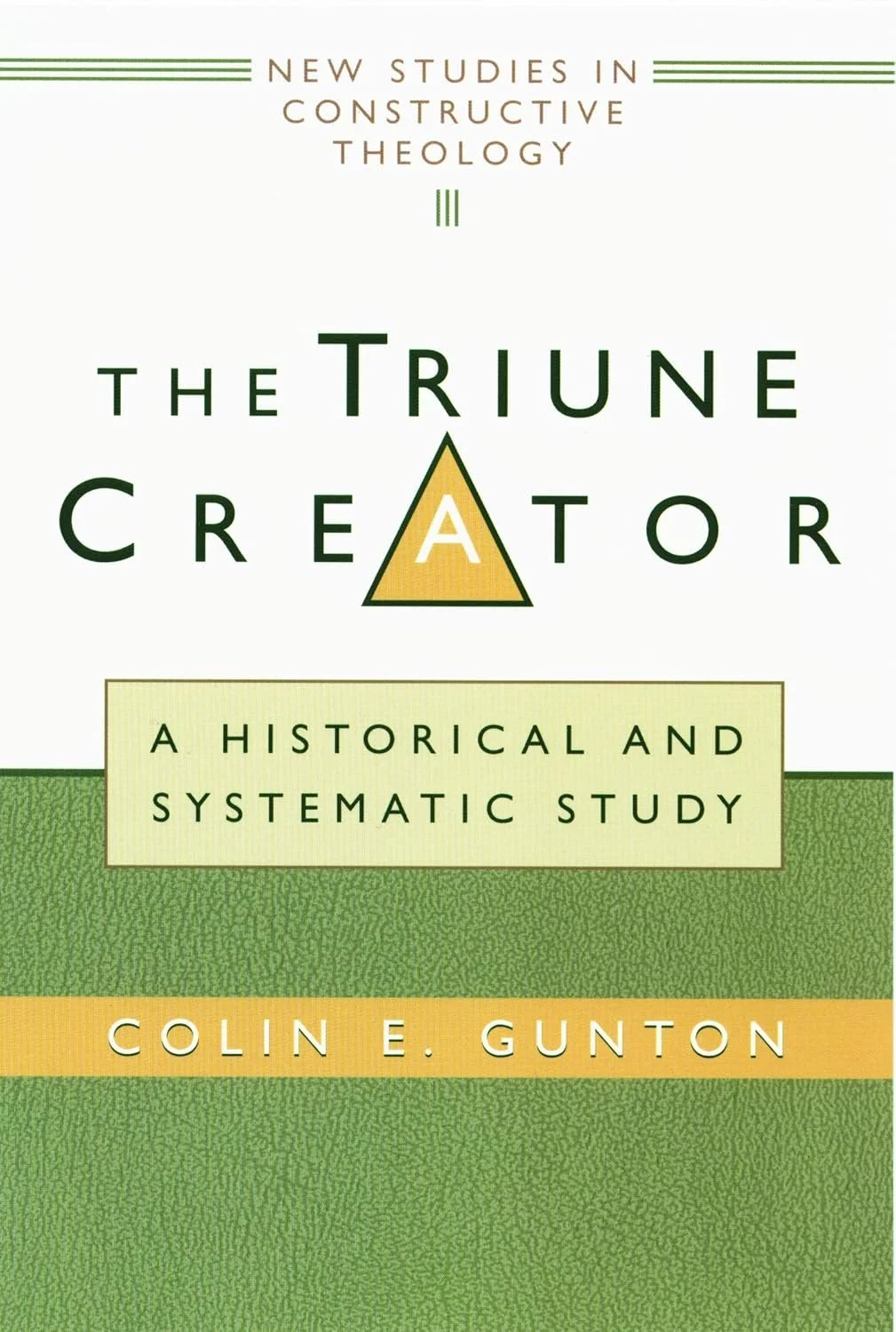
The Triune Creator: A Historical and Systematic Study
Colin E. Gunton
Eerdmans (1998). 246 pp.
The Triune Creator is a rich and ambitious historical and theological essay on the doctrine of creation. Its author was Professor of Christian Doctrine at King’s College London from 1984 until his death in 2003 and one of the most important and influential British theologians and teachers of the second half of the twentieth century. This volume more than lives up to expectations.
After an introductory chapter outlining the book’s themes, Gunton offers an exegetical sketch of some key Biblical material. Then in Chapters 3 to 7 he gives a sweeping theological history of the doctrine, beginning with various classical Greek philosophies, continuing through selected Church Fathers and on to the allegedly non-trinitarian contributions of the theologians of the Middle Ages and then the philosophers of modernity before recounting the contributions of Calvin and Luther, Barth and Pannenberg in returning to a more trinitarian account of creation. The hero of this narrative is undoubtedly Irenaeus, while the villains are the platonized theologies of Origen and Augustine. The final three chapters have a more doctrinal emphasis, considering God’s interaction with the world in creation and providence, the question of what it means for humans to be created in the image of God, and issues of eschatology and the ethics of createdness. Along the way there are various insightful theological interactions with modern science.
Gunton’s account of the historical material is definitely in the service of his own dogmatic proposals: this is theological history (p. ix). He draws heavily on Irenaeus’ account of the Father creating by means of his two “hands,” his divine Son and Spirit. This “trinitarian mediation” of creation ex nihilo allows him to emphasize the sharp distinction between Creator and creature over against the hierarchies of being and non-divine mediators of creation in Greek-influenced cosmologies. It also connects creation to redemption and allows, by means of the incarnation and resurrection, space for the goodness of the material creation. These themes of trinitarian mediation and the goodness of the material continue throughout the book.
Gunton’s other big theme is that creation was always a divine “project,” not a perfectly completed, static entity. In Gunton’s own words, “As created, it is perfect, because it is God’s project. . . . But it is not perfect in the sense of complete. It has somewhere to go” (p. 202). From the beginning, creation had an in-built eschatology; this is what Irenaeus understood and what Origen and Augustine lost. The tragedy of sin is that “from the beginning the human creation refused to be that which it was created to become, and so became the means . . . of subjecting to futility that which had quite another teleology.” This then enables Gunton to connect creation with redemption, providing an integrated trinitarian account of the divine economy from creation, through Christ, to eschatology: “The recapitulation of the human story by Jesus [in the Spirit] is then the means of perfection in the sense both of restoration and of completion. God re-inaugurates the project of creation by means of the life, death, resurrection and ascension of Jesus” (p. 202). This is a compelling account of the shape of the doctrine as revealed in Scripture and has the power to stimulate rich and fruitful exegetical, theological, and pastoral reflection.
Overall the scope of Gunton’s project is deeply impressive. The systematic rigor and coherence of his vision and his theological engagement with Scripture are admirable. His theological evaluations of the philosophies and worldviews of various scientific writers are also commendable, as is his concern to connect dogmatics with ethics.
As in all his writing, Gunton also shows a noteworthy commitment to wrestling with the Christian theological tradition and an enviable breadth of reading. However, this strength is also perhaps the book’s greatest weakness. His reading of the history is self-confessedly “Harnackian” (p. ix), claiming a theological fall into Greek metaphysics rather early in the tradition, although at least he is as critical of Kant and Hegel as he is of Origen and Augustine. The scope of his project means that Gunton paints on a vast canvas, using a roller and liberal dashes of paint in impressionistic style rather than the fine brushwork of detailed contextual readings that would have been required to sustain the historical side of his thesis. Whether he is entirely fair to his sources is questionable in places, and his historical case is hard to assess on the basis of the arguments put forth.
One other quibble: the book is perhaps mistitled. It is less a study of the triune Creator and more an account of his work of creation. Gunton himself notes that “the doctrine of creation . . . has its primary reference to God, and only secondarily to the world” (p. 207). This follows the conceptual order of dogmatics, which is the study of God and only then all things in relation to God. He does briefly address God’s life in se when he expounds the image of God as constituted by personal relations; in his emphasis on creatio ex nihilo he also maintains that God’s life is entirely independent of his creation; and in passing he mentions the Son’s eternal begottenness (p. 159). Nevertheless, the focus of his exposition is the works of God’s “two hands” in the economy, rather than on the Creator’s own being and life. A full account of this includes the processions, relations, and properties of the divine persons, and only then the divine missions, which receive their shape from the eternal processions. This dogmatic ordering would perhaps have enabled a more fully trinitarian account of creation by allowing for clearer articulation of the indivisibility of God’s economic works, while allowing for appropriation of aspects of the divine works by particular divine persons. This complaint may seem unfair, given the extensive attention Gunton paid to trinitarian theology elsewhere. But in this volume he claims that Aquinas’s account of creation is insufficiently trinitarian, despite passing over the subtle and detailed attention to the Trinity in the Summa Theologiae, which concludes with an account of the divine missions as the bridge from the doctrine of God into the account of creation. Elsewhere he has also placed severe strictures on Augustine’s account of the Trinity. It would therefore have been interesting and useful to see in more detail Gunton’s own account of the relation of God’s inner life to his temporal works in creation. As it is, in this book he relies on a right insistence on the Creator-creature distinction and a rather generic account of relationality that is applied both to God and to human creatures.
Notwithstanding these criticisms, The Triune Creator is a stimulating and helpful contribution from a modern theological master and provides much food for us as pastor theologians in our task of expounding the Bible’s teaching on this vital doctrine.

Matthew Mason (PhD, University of Aberdeen) is the Assistant Director of the Pastors’ Academy, Lecturer in Ethics and Contemporary Studies at London Seminary, and an Associate Fellow of the Kirby Laing Centre for Public Theology.