The views expressed in this article are of the author only and do not necessarily represent those of the Center for Pastor Theologians.
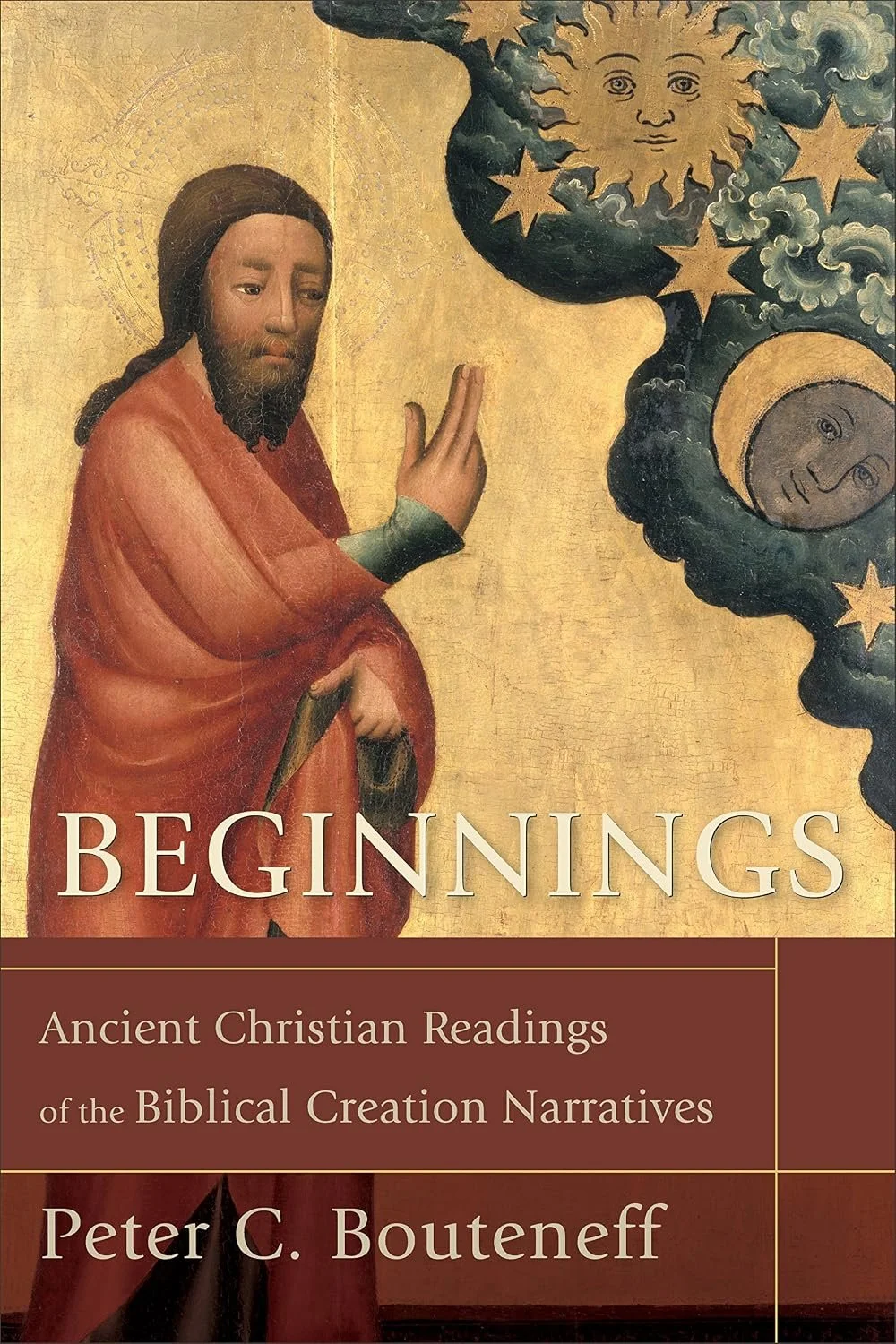
Beginnings: Ancient Christian Readings of the Biblical Creation Narratives
Peter C. Bouteneff
Baker Academic (2008). 240 pp.
Peter Boutenoff is an Orthodox ecumenical theologian who teaches at St. Vladimir’s Orthodox Theological Seminary. His volume, Beginnings, explored how significant ante-Nicene writers read the Hexaemeron (i.e. Genesis 1 “six-day” creation), the paradise narrative in Genesis 2 and 3, and the use of Adam. He traced how what was largely an oral Jewish tradition evolved into the written papyrus, transmitted widely by codices, with the Hebrew Scriptures being translated as the as early Septuagint texts in the 1st and 2nd century BCE, and then further disseminated and referred to by New Testament writers and the patristic writers covering the first four centuries of the Common Era. Through this evolution of translation, transmission, and teaching, the communities of faith appropriated and understood Genesis 1–3 in different ways. For instance, the 2nd century BCE texts did not refer much to the paradise nor Hexaemeron narratives not until well into the 1st century BCE texts. The name “Adam” in this period also had a multivalent usage depending on contexts and situations: “adam” referred generally to “humanity” or to the first physical human being.
Key features of the 1st through 4th century CE writers in their use of the biblical creation narratives included: seeing Christ as the new, renewed Adam such as Irenaeus’ approach of reading Scripture through “recapitulation” or summing up all things in Christ; Adam as the first among sinful humanity and not as the cause of sin; regarding a typological reading of the Scriptures (e.g. Christ as the fulfillment of the antitype Adam) as indicative of the triune God’s sovereignty and foreknowledge; limited use of allegory particularly in the Cappadocian Fathers selective use of and critique of Origen’s use of allegory; seeing the Hexaemeron as not a scientific account of the “how” of creation but rather as a positive affirmation that God is the creative Creator; that the Hexaemeron and the paradise narratives all lead to Christ and that both narratives, particularly the Paradise narration of sin, have a paraenetic, ethical thrust which prompts readers and hearers to worship and serve God. Additionally, some writers, like 2nd century apologists Theophilus of Antioch and Melito of Sardis see in the phrase “In the beginning” in the Hexaemeron not a reference to time, but to the person of Jesus Christ who is the Alpha and the Omega and who is the agent through whom God created all things. Other writers like Origen of Alexandria, Basil of Caesarea, and Gregory of Nyssa saw that the biblical narratives contained a so-called “rule of faith,” foundational principles and teachings about the triune God, Jesus Christ, and sin as essential for faith formation and as a proactive polemic and apologist contra the proliferation of heresies.
This volume is a helpful summary of the first four centuries CE in reading the creation narratives and taking readers on a survey tour of key writers of the patristic period, helping us to understand the contexts and the connection of writers of one century to another, or comparing contemporaries like Gregory of Naziansus to Gregory of Nyssa. Bouteneff did say at the outset that Augustine would not be a part of his examination. The presence of the great bishop of Hippo would have been a helpful point of contrast, particularly as the seminal theologian with respect to the doctrine of original sin.
Interestingly, Boutenoff unearthed for us modern readers patristic discussions of human sexuality, gender roles and gender equality, as for instance Nazianzen’s reflection on the equal deception of Adam and Eve by the serpent and the equal redemption men and women receive through Christ (p. 143).
While my own scholarship is in liturgical studies and not so much in patristics, early church liturgies express many areas addressed in this book with respect to the biblical creation narratives. Boutenoff, an Orthodox theologian, is familiar with the early liturgies as for instance in the third century CE The Apostolic Tradition or The Apostolic Constitutions. More recently, Paul Bradshaw’s seminal work The Search for the Origins of Christian Worship was conspicuously missing from the bibliography. The patristic writers were not just systematic theologians; they were committed to the worship life of the church and regularly engaged in liturgies, texts which ritually embodied early church communities’ exegesis of the creation narratives in their celebrations of baptism and the Eucharist.
Nevertheless, I very much appreciate Bouteneff’s work. His work helpfully reminds us modern readers that the patristic writers and early Christian communities regarded Genesis 1-3 as less than the mechanics of what God was doing and more about that God did create, that human agency did and continues to sin, and that God’s re-creation occurs finally and fully in Christ. Any attempt to read into the Hexaemeron and the paradise narratives 21st century questions or to extrapolate clearly defined positions to justify modernist impulses, would all do well to pause to consider these early writers for what they saw as the Christ-directed thrust of the creation narratives.

Neal D. Presa is an ordained minister in the Presbyterian Church (USA) and the interim associate vice president for admissions and a faculty member at New Brunswick Theological Seminary in New Jersey. He also helps lead the World Council of Churches Central and Executive Committees. He’s the author of numerous books and is a member of the St. Augustine Fellowship of the Center for Pastor Theologians.