The views expressed in this article are of the author only and do not necessarily represent those of the Center for Pastor Theologians.
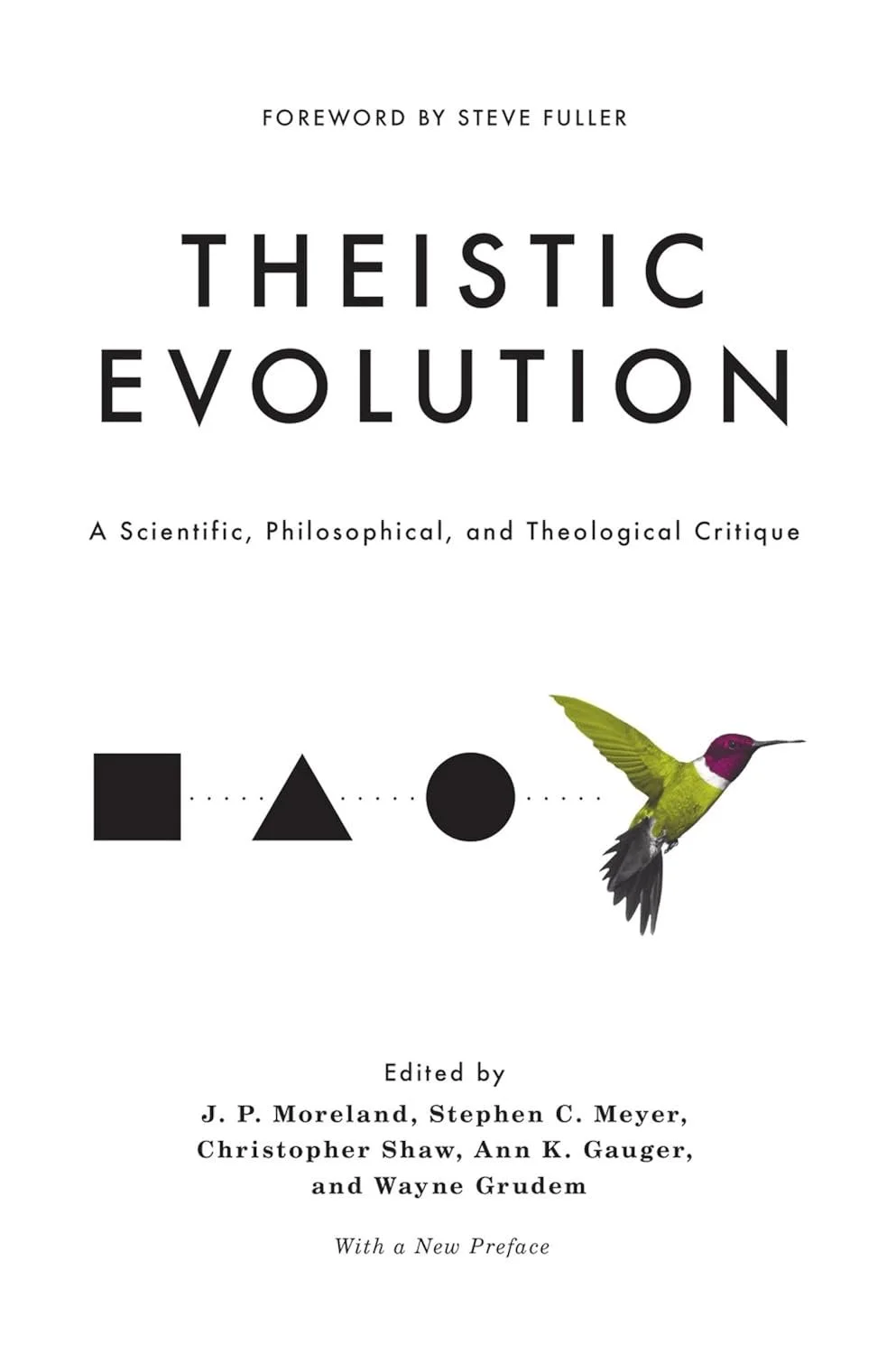
Theistic Evolution: A Scientific, Philosophical, and Theological Critique
J.P. Moreland et al., eds.
Crossway (2022). 1008 pp.
More now than ever before in my memory, thoughtful Christians engaged in serious Biblical reflection are comfortable with the possibility that Genesis 1 and 2 do not require the interpretation that God created the world in six distinct twenty-four hour periods. Because of this, scientific data that suggests the universe is quite old and that a long evolutionary process of development of living and non-living entities took place can be interacted with seriously and with welcome. The rift between Biblical faithfulness and good science seems to be waning, and that is a good thing.
However, can the pendulum swing too far? Are there scientific claims, even made by Christians, that go beyond the pale of Biblical, theological, and historical Christian thought? Crossway Publishers set several editors to the task of compiling a compendium of articles to critique one form of scientific analysis that they feel is a compromise of orthodox Christian doctrine on matters of God and the created order in Theistic Evolution: A Scientific, Philosophical, and Theological Critique. As the title suggests, the particular scientific course critiqued is what is referred to as Theistic Evolution (TE). As these things go, definitions are of prime importance, and Wayne Grudem, one of the editors, is clear that they are taking on a very particular definition, indeed. Grudem defines TE this way: “God created matter and after that did not guide or intervene or act directly to cause any empirically detectable change in the natural behavior of matter until all living things had evolved by purely natural processes” (p. 784). Working from this definition, three sections emerge in this book, the first on the science, the second on philosophical considerations, and third on the exegetical and theological issues.
The book is long and technical, but can be read a la carte if one wishes. One of the strengths of the compilation is that the science itself plays a central role. In fact, quite respected scientists, arguing from very technical scientific work, are making the case that TE is not scientifically established apart from issues with Biblical data. Let me say here that the thoughtful non-scientist may struggle with section 1, but having this section is critically important in order for a dialogue to persist and bear fruit. A main objection by those who hold to TE is that those who object simply do not respect or know the science. A book like this quells some of that objection.
What are the central arguments of this book? As one considers the definition of TE that Grudem provides, the concerns boil down to the issue of providence, the place of Biblical authority, and the methodological assumptions of the TE community. Let us look at these in turn.
First, this book maintains that the Bible clearly teaches that God did not just create the world in the first place but that he comprehensively, continually, directly, and meticulously upholds the universe. TE advocates want the process of evolution to be so respected that they do not find the idea of God untethering himself from the process after initial creation to be problematic, it seems. When there are very real gaps and ambiguities, rather than resting in the clarity of Scripture, a doubling-down on traditional evolutionary theory takes place, and this relates to the second strand of concern.
Second, the issue of Biblical authority now comes into play. The writers of this compendium consistently maintain that the work of science has the tendency to go beyond science as a discipline of observation and analysis to that of a worldview with metaphysical implications. Science becomes scientism. Science becomes not just a source of truth about our physical world but a metanarrative, to the point of calling the Biblical text to account at times. Each section of this book consistently points out times that TE advocates question the teachings of Scripture, even when those teachings are nuanced, take genre into account, and allow serious scientific work. The accusations are careful, though. The language of the TE community is one of respecting the text, while admitting the ancient writers were limited by their imaginative horizons.
Third, and quite interlaced with the previous two issues, TE advocates seem quite wed to materialist-naturalistic assumptions in how they do science, claiming that a lean into Biblical theology does not allow the scientist to truly seek inductive answers. But, data does not speak for itself. It needs interpretation. The hermeneutics of science, then, are just as important for science as they are for Biblical interpretation. One cannot avoid pre commitments, so the books must be cooked at some level.
The authors of Theistic Evolution are thus concerned that scientism has taken hold of many in the Christian scientific community and that a concern to show serious Christians can engage in serious science has led to a equalizing of Biblical authority with certain schools of thought within the physical sciences. In other words, while trying to wed certain parts of theology with science, yet another divorce has taken place unwittingly and faith and science unhinge again, perhaps at other junctures, but important junctures nonetheless. A Christian worldview cannot incorporate a naturalistic approach to anything, even when doxological reasoning is provided, and this conviction does not curb science.
The arguments in this book are nuanced and worth considering for those wrestling with the issues of just how some sort of evolutionary process is true, scientifically and theologically. Again, the book is not taking on an old universe, or that God used a long process of development in shaping the universe and our world in particular, or that some sort of evolutionary process has internal consistency and clear patterns, nor does this book necessarily deny certain features of pre-Adamic hominids of some fashion.[1] But, the writers are concerned, and I would concur, that the Bible does limit the possibilities of interpretation and calls us to embrace God’s direct and meticulous providence in upholding the universe, and that seeming contradictions between Biblical accounts of creation and science should call certain scientific theories to account since science is still a work in process, whereas the Scripture, though not perfectly understood, is a finished and complete revelation.
My one critique is that I wished more lines were drawn between the crisis that TE poses exegetically and Biblically to pastoral issues of spirituality and ethics. Let me finish with a pastoral account relating to this. Several years ago I taught on the Biblical ethics of sexuality at my church. One of the elders took issue with my teaching, which was the orthodox understanding of sexuality that sex was to be expressed within marriage only and that marriage could only be between one biological male and one biological female. The elder was a serious physicist at a very prestigious university in my region. His reasons for taking issue? Some were quite emotional of course, not least a close family member who is homosexual, but he also led with science. Like the TE assumptions laid out in this book, this elder assumed a certain authority to scientism such that if certain forms of homosexual desire were the result of credible evolutionary processes in some strands of people, then those forms of homo-erotic desire could be trusted. In his view the Bible spoke to an imaginative horizon that it was limited to, given its place in history. He also believed that the Bible focused on certain types of homosexual actions that were rooted in exploitation. I have faced a scenario where a sincere Christian who is a serious scientist let science become scientism, weighed scientism more highly than Christian theology in a key area of doctrine and ethics, and the fallout was painful for all. I did not back down. I believe Scripture, and Scripture alone, frames the larger picture and limits the possibilities of theorization. He eventually resigned his eldership and membership, and he and his wife left the church.
The crisis of science and Christian faith is often unnecessary. But, it is the role of the Bible to frame all of life with ultimate meaning and to limit the possibilities of theories that stem from observing our world. When science is moderated and humble, science itself bear testimony to this.
[1] From what I could glean, there are variances of opinion among the writers when it comes to Biblically acceptable conclusions regarding the age of the universe, pre-Adamic hominids, and the nuances of how God providentially created the world over time, etc.

Jay Thomas is the Senior Pastor of Chapel Hill Bible Church in Chapel Hill, NC. He is the co-author of Sex, Dating, and Relationships: A Fresh Approach (Crossway, 2012). Jay is a member of the St. Anselm Fellowship of the Center for Pastor Theologians.