The views expressed in this article are of the author only and do not necessarily represent those of the Center for Pastor Theologians.
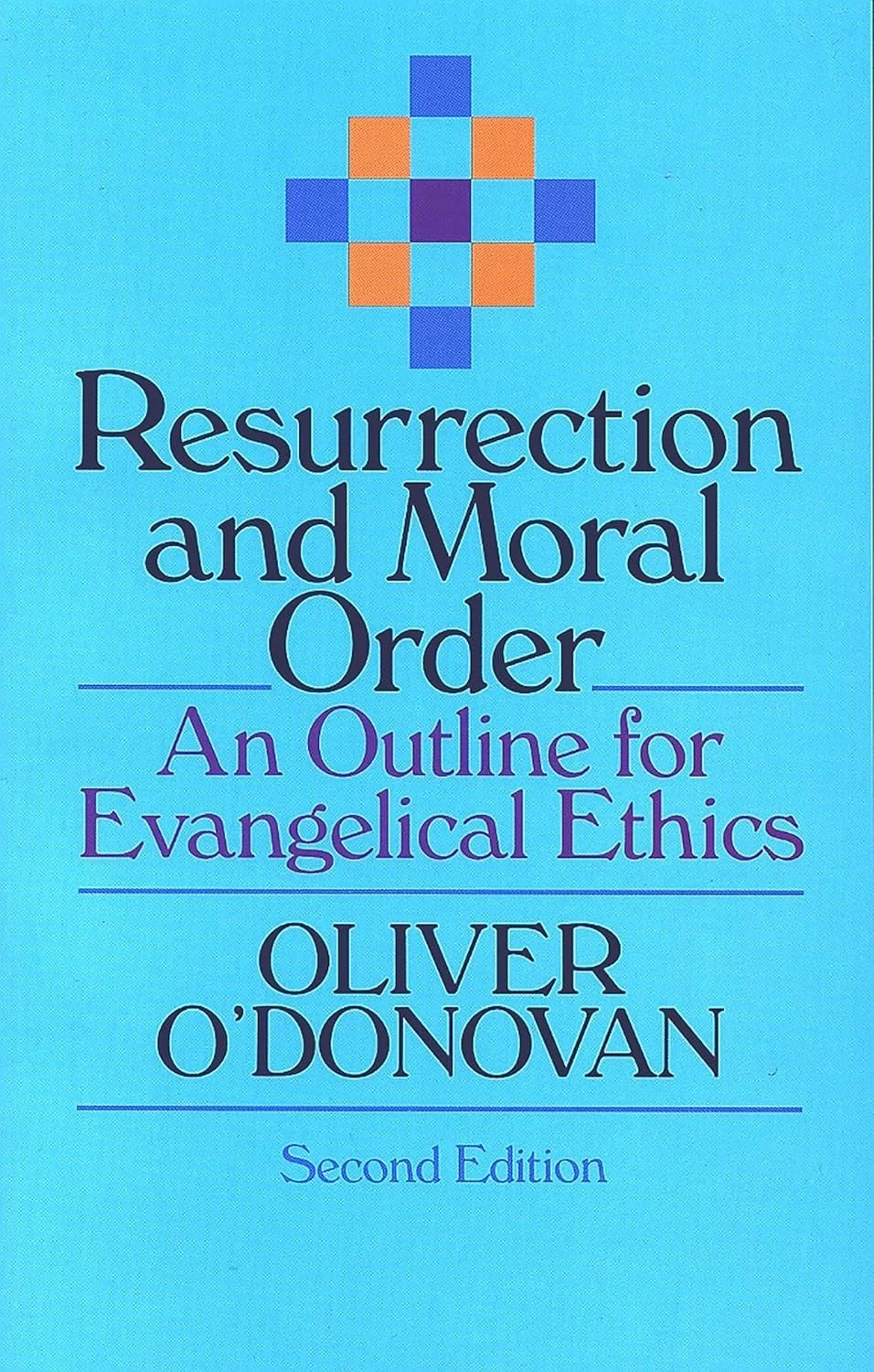
Resurrection and the Moral Order: An Outline for Evangelical Ethics
Oliver O’Donovan
Eerdmans (1996). 286 pp.
“The foundations of Christian ethics must be evangelical foundations; or, to put it more simply, Christian ethics must arise from the gospel of Jesus Christ. Otherwise it could not be Christian ethics” (p. 11). So reads the masterful first line of the opening chapter in Resurrection and Moral Order by Oliver O’Donovan. O’Donovan is Professor of Christian Ethics and Practical Theology at the University of Edinburgh and is an ordained priest in the Church of England. This seminal and ambitious work charts a course for a distinctly Christian approach to ethics.
By placing the resurrection at the center of his project, O’Donovan is positioned to look both backward to creation and forward to the coming kingdom in order to traverse the present. As he puts it, “In proclaiming the resurrection of Christ, the apostles proclaimed also the resurrection of mankind in Christ; and in proclaiming the resurrection of mankind, they proclaimed the renewal of all creation with him. The resurrection of Christ in isolation from mankind would not be a gospel message. The resurrection of mankind apart from creation would be a gospel of a sort, but of a purely Gnostic and world-denying sort which is far from the gospel that the apostles actually preached” (p. 31). His goal is to describe the Christian moral vision by articulating how ethics “responds to, and is itself an integral part of, the Christian gospel” (p. 26). Toward this end, the book is divided into three sections.
The first section (chapters 2–4) concentrates on the objective reality of Christian ethics. Through the resurrection we learn that God stood by his created order and will one day restore it. “Man’s life on earth is important to God; he has given it its order; it matters that it should conform to the order he has given it” (pp. 14–15). Ethics is part of the good news of the Christian message and includes an implicit moral epistemology.
The second section (chapters 5–8) turns to the subjective reality of the gospel, namely the work of the Spirit in the life of the individual believer and the corporate people of God. The Holy Spirit makes “the reality of redemption...both present and authoritative” and “evokes our free response to this reality as moral agents” (p. 102). Here O’Donovan arrives at the crucial intersection of rationalism and voluntarism. O’Donovan emphasizes that each of these approaches need to be heard and chastened by the other. Left to themselves each will lead to humanism. Voluntarism reminds us that we are not transcendent and that our rational judgments need to be evaluated by revelation. Rationalism provides “hope” in mystery, that while we have limited vision and thus remain trusting the divine light, “the paradox is not an ultimate contradiction of reality” (p. 136).
The third section (chapters 9–12) develops the theme of love as the shape of the Christian moral life. By investigating the relationship between moral rules and the moral character of an individual, O’Donovan sets the stage to show how Christian love “gives unity to the varieties of moral character” (p. 27). We are to love others as creatures destined for the Creator’s fellowship because that is what their “nature demands of us.” Moreover, we are to love Christ as our first priority because . . .
it is the love of Jesus as the Christ, the acceptance of him as the one whom the Father has sent. From it there follows that we are given to love the whole reality in due order: God, the neighbour, self and the world. . . . This brings us back to where we began, to the divine act by which God has designated Jesus as the Christ and has vindicated creation in him, his resurrection from the dead. In this act all Christian love, from the universal to the familiar, finds its spring. (p. 243
Throughout this work O’Donovan assumes knowledge of longstand ing academic conversations, the Christian tradition, and contemporary debates. So readers who are not as acquainted with this material might need to brush up on some foundational discussions or keep reference books handy as they read. Nevertheless, despite the challenges, the payoff for carefully wading through this tome is well worth the effort. O’Donovan displays his deep learning and awareness of a variety of disciplines, which is both refreshing and needed in the culminating discipline of Christian ethics. And by refusing to choose between “creation” and “kingdom” ethics, O’Donovan helpfully attempts to avoid false dilemmas and unbalanced conclusions.
As a former pastor and someone who now trains students for ministry, I have found that deep theological reflection built around the gospel is sorely needed in the area of ethics. It is up to pastor-theologians and pastoral-scholars to spell out in more detail and—for most contexts—to translate his insights for mapping the most faithful routes through the ethical issues facing the church.

Josh Chatraw Chatraw serves as the director for New City Fellows and the Resident Theologian at Holy Trinity Anglican Church in Raleigh, NC. His books include Apologetics at the Cross, Cultural Engagement, Truth in a Culture of Doubt, and Truth Matters. He holds a PhD from Southeastern Baptist Theological Seminary and is a member of the St. Anselm of the Center for Pastor Theologians.