The views expressed in this article are of the author only and do not necessarily represent those of the Center for Pastor Theologians.
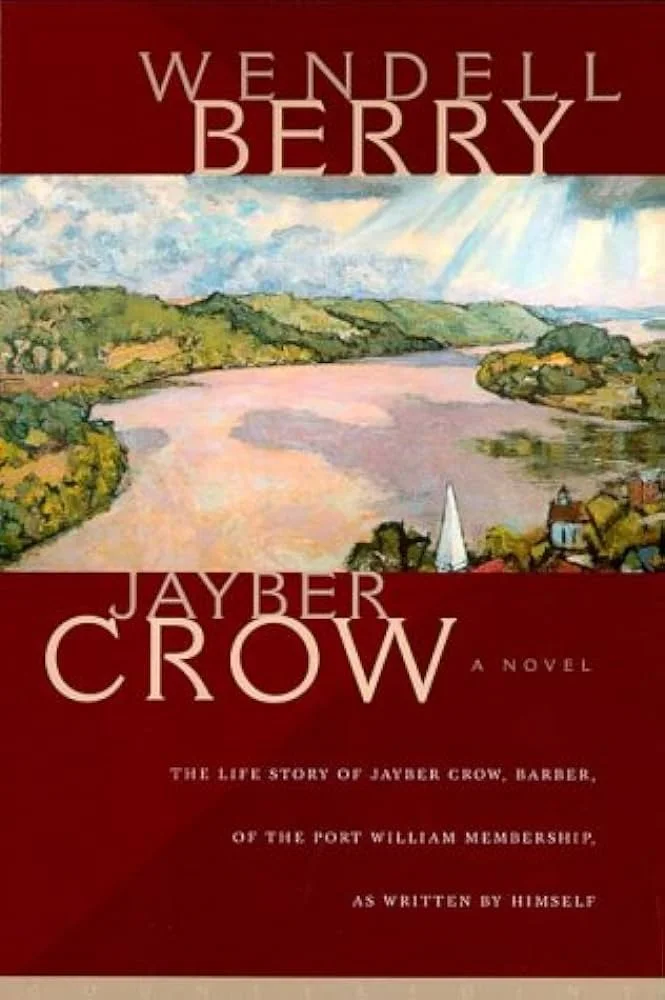
Jayber Crow
Wendell Berry
Counterpoint (2000). 384 pp.
His recent comments on gay marriage notwithstanding, in his essays (“Sex, Economy, Freedom, and Community”; “Poetry and Marriage”) and fiction (Hannah Coulter; The Memory of Old Jack), Wendell Berry has given us rich reflections on the joys, trials and disciplines of marriages good and bad. Jayber Crow is an intimate portrait of a single life, which offers to enrich our pastoral ministry to those called to singleness.
The book is the fictional memoir of the eponymous barber of Port William, a small Kentucky farming town. Although the voice is distinctively Jayber's, the prose is unmistakably Berry's: gentle and lilting, probing and patient, so closely-matched to his subject it might have grown out of his native Kentucky hills.
Berry is famous as an environmentalist: a farmer hostile to technology, a chronicler of the beauty and tragedy of twentieth century agrarian life in America. But perhaps the central theme of his work is affection: affection for God's good land, affection for place and community and stability, affection for people, with all their quirks and virtues and flaws. Jayber Crow explores this theme in a meditation on love and hatred. From the perspective of one particular man, as his life unfolds in ways he might not have wished, it probes the question: “Why is hate so easy and love so difficult?” (p. 328).
As the town's barber and gravedigger, transplanted into a community of farmers, Jayber remains something of an outsider throughout his life. He is a man among men with little natural contact with women, and his income and circumstances mean he cannot support a family. So he remains single into old age. But he is single by circumstance, not choice: central to the plot is his unrequited love for Mattie Chatham. Young Mattie makes a foolish marriage to an arrogant, callous husband, a union she endures for decades with dignity and love. Jayber determines that he too will honor her wedding vow; his love lasts for forty years, but it remains his secret.
The book, with its tripartite structure, takes significant inspiration from Dante's Divine Comedy. Before arriving in Port William, Jayber finds himself, in the middle of life, lost in the woods. He passes to his new life by a river crossing. Burley Coulter—a member of one of Port William's central families, but by instinct something of an outsider—is Jayber's Virgil, guiding him to the town and welcoming him in. Mattie is Jayber's Beatrice: loved and longed-for, but out of reach.
As the story unfolds, we experience an inferno of land despoiled, marriages shattered, a young child dying; a purgation of erotic desires disciplined and directed towards loving service; and glimpses of paradise: a dream of the child resurrected, a vision of a wonderfully earthy afterlife with dead friends restored to one another, sitting and talking on a farmhouse porch.
In Paradiso, Dante sets eyes on Beatrice in a beautiful wooded garden. So, too, the climax of Jayber's memoir begins with a series of encounters with Mattie in a paradisal wood. True to its model, the story ends with a light-soaked beatific vision. But is this lyrical novel a story about heaven or about hell? For a long time it is unclear, and for many years Jayber himself is unsure. But, finally, he comes to know the truth. Near the end, he describes his woodland encounters:
Mattie always preserved a certain discretion, not in anything she said, but in the way she was, the way she carried herself and looked. She was with me, but not for me, if you can see what I mean. There was a veil between us. We both kept her vow, as I alone kept mine. I knew there was a smile of hers that I had never seen. And that was well. That was all right. (pp. 350–51)
This chaste friendship endures to the almost unbearably moving final sentence. Jayber has lost virtually everything. Port William's community has been all but destroyed by the technological and social changes of the mid-twentieth century. His friends are dead, or ageing fast. The land he loves is scarred, perhaps beyond recovery. And the woman he has loved, yet never had, lies dying. But, for all his losses, Jayber's descent into sorrow and loneliness is also an ascent to love:
I whisper over to myself the way of loss, the names of the dead. One by one, we lose our loved ones, our friends, our powers of work and pleasure, our landmarks, the days of our allotted time...Finally a man stands up alone, scoured and charred like a burnt tree, having lost everything and (at the cost only of its loss) found everything, and is ready to go. (p. 353)
And so, “This is a book about heaven. I know it now” (p. 351).
Jayber Crow can neither capture nor possess Mattie Chatham. But he can love her, silently, faithfully, chastely.
Strikingly, the only truly tragic characters in the book are all married. Despite, even because of, their marriages, they are trapped: by longings to escape from their circumstances and themselves, by who they want to be but can’t become. And so although they are married, one of them to a wonderful woman, they are miserable and alone.
In contrast, although sadness and loss carve deep furrows through his story, Jayber is bigger than his unrequited love. There are other griefs he must endure: his orphan childhood, the death of friends, the gradual decline of the town he calls home. But there are good things too. He has a rich community and a place within it. He is loved and needed. He has friends. He gives and receives hospitality. Above all, he has a deep integrity and character: Jayber is a virtuous man, far larger and more wonderful than his marital status.
Fiction cannot make us good: vicious people sometimes possess exquisite aesthetic taste. But it can help form our moral imaginations. Marilynne Robinson has recently described her novel writing as an act of bestowing imaginative affection on her characters. As readers, we can learn the same virtue. Great literature invites us to enter someone else's experience of life. It invites us to learn love and sympathy for people different from ourselves. Aside from the sheer pleasure of a novel like Jayber Crow, this gift of access to an imagined—but very real—life, is perhaps its greatest value. This is true not least for those called to pastor, and so to understand and love, people with all kinds of joys and trials, victories and heartaches. If you want to form a pastoral imagination about marriage and community, loyalty and friendship, and, yes, one man's experience of singleness, I don’t think you can do better than this book.

Matthew Mason (PhD, University of Aberdeen) is the Assistant Director of the Pastors’ Academy, Lecturer in Ethics and Contemporary Studies at London Seminary, and an Associate Fellow of the Kirby Laing Centre for Public Theology.