The views expressed in this article are of the author only and do not necessarily represent those of the Center for Pastor Theologians.
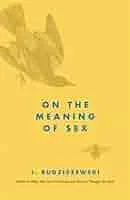
On the Meaning of Sex
J. Budziszewski
ISI Books (2014). 168 pp.
There is no shortage of conversations about the proper shape our sexual lives should take in this world. Yet J. Budziszewski’s slim yet powerful volume On the Meaning of Sex is one of those rare contributions that is not only edifying and helpful but thoroughly enjoyable to read. Allow me up front to save readers the trouble of determining whether to buy the book: go forth and order, and hurry. Everything Budziszewski spreads across his 155 pages is more worthy than this review could be.
As a college professor, Budziszewski is no stranger to the devastation and confusion that our current sexual climate has wrought on young people. Yet he is not paternalistic: he writes for his generation as well, which “invented the sexual revolution” and acknowledges that they “treated our friends, our spouses, and our children dreadfully” (p. 12). But it is a puzzle that emerges from an interaction with a student that opens Budziszewski’s reflections: how might it be that a young person would be revolted by Aldous Huxley’s vision of factory-made babies while simultaneously protesting that sex doesn’t have to have a meaning? Budziszewski takes the revulsion seriously, suggesting that perhaps it holds a latent or tacit knowledge about the meaning of sex. Budziszewski is a philosopher by trade, and so lays bare the reasons for that revulsion with an enviable clarity. But the book never loses its pedagogical edge amidst its explorations and its arguments.
Yet Budziszewski’s argument is densely packed. After exploring the initial puzzle, he turns toward providing a natural law argument for the meaning of what he helpfully dubs “sexual powers”—which not surprisingly turn out to be tied to procreation and unity. To readers unfamiliar with such teleological arguments, Budziszewski’s presentation is an excellent starting place. To others more familiar with the arguments, Budziszewski’s arguments will be familiar even while clearly stated.
Budziszewski then turns toward the two sexes, arguing that “sanity begins with the fact that men are potentially fathers, and women potentially mothers.” Budziszewski is aware he’s strolling a minefield by taking on the question of differences, but tiptoes around social constructionist arguments about gender and deploys (albeit necessarily controversial) social science studies in a helpful way to make his case. He is willing to compare fathers and mothers with kings and queens, while recognizing that such comparisons seem “naive, sentimental, and exaggerated” and “make us squirm.” So much the worse for our responses in this case, as Budziszewski argues the reasons for such responses are wanting.
After a helpful discussion of sexual love—or what he calls the “erotic mode of charity”—Budziszewski turns to the nature of sexual beauty. Budziszewski takes on “sexiness,” carefully arguing that it is an “outward sign of the inward reality of the beauty of womanliness itself.” (Budziszewski limits himself to speaking of women in this chapter, for reasons of simplicity.) But as with everything else in the book, distinctions await: there is a “dehumanized sexiness” that is simply a “sign of readiness for sex, but not every sign of readiness for sex is dehumanized.” Sexiness has its place, not only within the bedroom but within the structure of male and female erotic relations.
Budziszewski doesn’t stop, though, with discussing beauty. He takes on sexual purity as well, which he describes as a “sweetness” that we have to practice in order to understand. His imagery and metaphors here will be similarly “backwards” to many readers, as he defends the medieval chivalric tradition. Yet again, Budziszewski is not unilateral in his approach: his discussion of modesty is a sober and level-headed treatment that grounds modesty in a mutual respect between men and women. As he puts it, “Truly modest folk…are not just clean minded; they also avoid needless provocation to those who are easily provoked” (p. 122). Here too his discussion of purity depends upon and deepens his previous discussions of male-female complementarity and the nature of manhood and womanhood. The woman, he argues, is the “natural guardian of purity” who “teaches it to the man, who, as her natural protector, learns to love purity, too” (p. 130).
It’s these later chapters that push Budziszewski’s book into territory that is foreign for many academic treatments of sexuality, yet without losing its crystalline clarity. It’s also these chapters that make the book such a practical read, despite its contemplative orientation. Pastors and youth pastors with young people struggling with questions of modesty and purity would be well served to ingest Budziszewski’s arguments slowly, to ruminate on them and learn to see them from within.
In the final chapter of the book, Budziszewski turns toward transcendence, arguing that the inevitable imperfection of sexual love points toward a more permanent, divine solution. Here Budziszewski brings God back into consideration, as he had bracketed him in the introduction in order to make as much of his argument as possible on purely philosophical grounds. Budziszewski argues that human erotic love points toward union of the Trinity. His strategy here is not particularly novel, but it is fraught with danger. “As below, so above” type arguments need to be carefully constrained by Scripture—and it is interesting that the paradigmatic image for human marriage that Paul sets down in Ephesians 5 is not the inner life of the Triune God but the specific union of the Christ and the church. Whether Budziszewski’s argument impinges upon the specific creaturely reality of human erotic love is a question worth considering closely while reading. I leave it as a question because it is so still for me.
As to criticisms of Budziszewski’s work, any additional quibbles I have are not worth mentioning. I could find other superlatives to add to those I’ve already offered, but that might be tiresome. So I will close with this: in a world that alternates between being flagrantly flippant about sex, clinical and analytic, and hysterically cautious, Budziszewski’s book is a grave and insightful antidote that is appropriately reverential without being slavishly sentimental. Budziszewski says he seeks the “beauty of wisdom” in writing this. Judging by his prose and argumentation, he certainly caught a glimpse of it—and we are the better for it.

Matthew Lee Anderson (DPhil, Oxford University) is an Assistant Research Professor of Ethics and Theology at Baylor University’s Institute for Studies of Religion and the Associate Director of Baylor in Washington. He is an Associate Fellow at the McDonald Centre for Theology, Ethics, and Public Life at Oxford University.