The views expressed in this article are of the author only and do not necessarily represent those of the Center for Pastor Theologians.
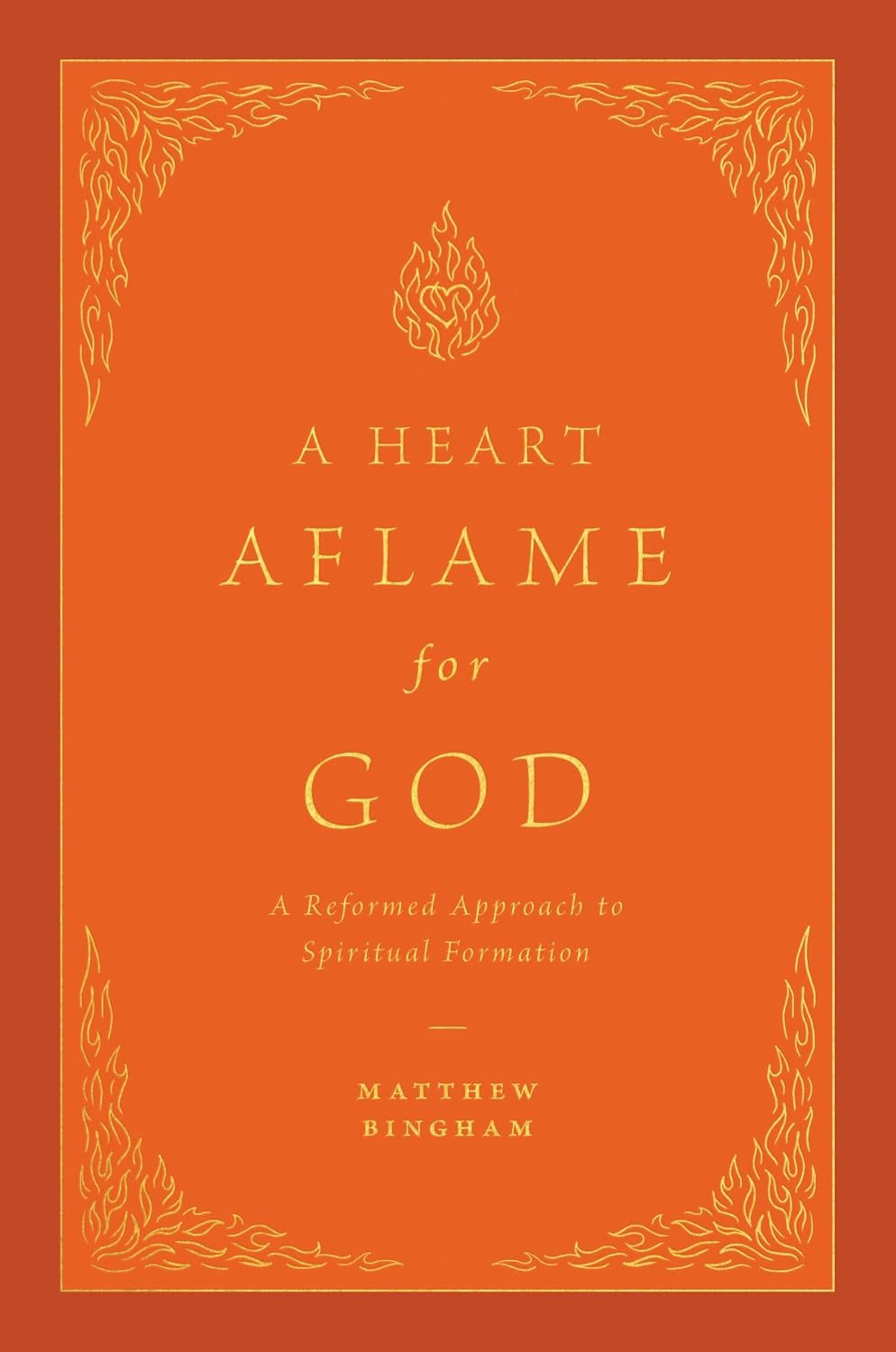
A Heart Aflame for God: A Reformed Approach to Spiritual Formation
Matthew Bingham
Crossway (2025). 354 pp.
Matthew Bingham engages in theological retrieval for the sake of evangelical formation in his recent A Heart Aflame for God. He draws on the Reformed tradition, and especially the seventeenth-century Puritans, to argue for a distinctly Reformed and word-centered approach to spiritual formation. He distinguishes his work from other books on spiritual formation by refusing to integrate non-evangelical traditions. He expresses particular concern that evangelical authors consistently adopt approaches from other traditions that are theologically inconsistent with Reformed theology—a problem exacerbated by the fact that many evangelicals are unaware of the Reformed tradition’s resources for spiritual growth. He suggests that evangelicals discontent with the resources of their own tradition are opting to migrate elsewhere in search of spiritual well-being. Others have observed similar trends in evangelicalism. Bingham highlights Richard Lovelace’s concerns about a “sanctification gap” in evangelicalism (p. 4) and offers evidence that evangelicals are discovering a new home in Roman Catholic and Orthodox churches (pp. 1–3).
Throughout his book, Bingham contrasts Reformed and Roman Catholic approaches to spiritual formation. He focuses on medieval Roman Catholicism (which is appropriate, since this was the target of the Reformers), but it comes at the expense of engaging with modern Catholic writers or considering how medieval Catholic writings have been reframed as they have been appropriated by evangelicals. This limited focus indicates a larger methodological problem. Retrieval must extend beyond simply repeating what people have said in the past; it requires expansion and development, what Kavin Rowe calls “traditioned innovation.” This methodological constraint means the book serves more as a work of historical theology than as a guide for modern evangelicals. While Bingham does regularly consider how to apply Reformed thinking about spiritual formation in the contemporary context, he does so without the kind of traditioned innovation necessary to fill in the gaps that might lead evangelicals to look to Roman Catholic and Orthodox traditions for spiritual resources.
Still, he offers a careful articulation of a Reformed approach to spiritual growth. He links the contemporary term “spiritual formation” to the Puritan concept of piety (p. 48), suggesting that spiritual formation can denote something narrower than sanctification (pp. 45–47) and be separated from its original Roman Catholic usage (pp. 29–31). He believes the term helpfully captures the Puritan concept of “keeping the heart” (pp. 23–27). For Bingham, spiritual formation refers to “the conscious process by which we seek to heighten and satisfy our Spirit-given thirst for God (Ps. 42:1–2) through divinely appointed means . . . and becoming ‘mature in Christ’ (Col. 1:28)” (p. 35). He believes that the Reformed can show us how to integrate theology and practice, offering a reliable guide for spiritual formation.
With a commanding grasp of the Puritan divines, Bingham identifies three resources for spiritual formation in the Reformed tradition: Scripture, meditation, and prayer. From Scripture, Christians hear from God. In meditation, they reflect on God. In prayer, they respond to God. These three activities can be considered “aspects of a single activity: communion with God” (p. 94). This “Reformation triangle” provides the foundation for Puritan piety, offering an essentially word-centered approach to spiritual formation. These chapters, one per resource, form the book’s core and offer the most valuable insights. His examination of these resources emphasizes their use by individual Christians, but he offers a brief appendix in which he considers spiritual formation in the context of corporate worship and the life of the local church (pp. 337–41).
Although the Reformation triangle occupies the majority of the book, Bingham also considers the roles that self-examination (related to meditation but with the focus on the self rather than on God), nature, and Christian relationships play in spiritual formation. In each case, he consistently shows that the Reformers and Puritans prioritized Scripture even as they made room for these practices. For example, although nature plays a role in spiritual formation, it can contribute to spiritual development only when it is interpreted or received through the lens of Scripture (pp. 234–35). These extensions add insights, but he never articulates why these practices are fitting while others (e.g., prayer beads or contemplative prayer) are not. Perhaps he assumes the application of the regulative principle for personal piety akin to Reformed corporate worship, but this gap in his presentation is noteworthy.
In the final section of the book, Bingham examines challenges to spiritual formation. He focuses on two categories of challenges: the body (Chapter 9) and when things go wrong (Chapter 10). His chapter on the reality of spiritual weakness that frustrates spiritual formation straight forwardly encourages Christians to persevere even when disappointed by limited progress.
His chapter on the body is more complicated, and one wonders why the body is considered a challenge to spiritual formation. He considers the body’s role in spiritual formation but focuses more directly on the relationship between the affections and the mind; on this point, he takes aim at James K. A. Smith’s argument that the way to the heart is through the body (pp. 279–304). When Bingham does address embodiment more directly, he rightly acknowledges the Reformation preservation of the scripturally-mandated rituals of baptism and the Lord’s Supper (p. 302); but throughout this section, he does not articulate a theology of embodiment using the Reformers or Puritans, making his proposed realignments feel somewhat out of place with the rest of the book (pp. 295–301).
Despite these criticisms, A Heart Aflame for God offers a valuable and much-needed contribution to evangelical literature on spiritual formation. Theologians, pastors, and lay readers alike will benefit from his presentation of a rich and unduly neglected tradition.
Aaron B. Downs (PhD, Midwestern Baptist Theological Seminary) is a pastoral resident at Trinity City Church in St. Paul, MN. He is a member of the St. Irenaus Fellowship of the Center for Pastor Theologians.