The views expressed in this article are of the author only and do not necessarily represent those of the Center for Pastor Theologians.
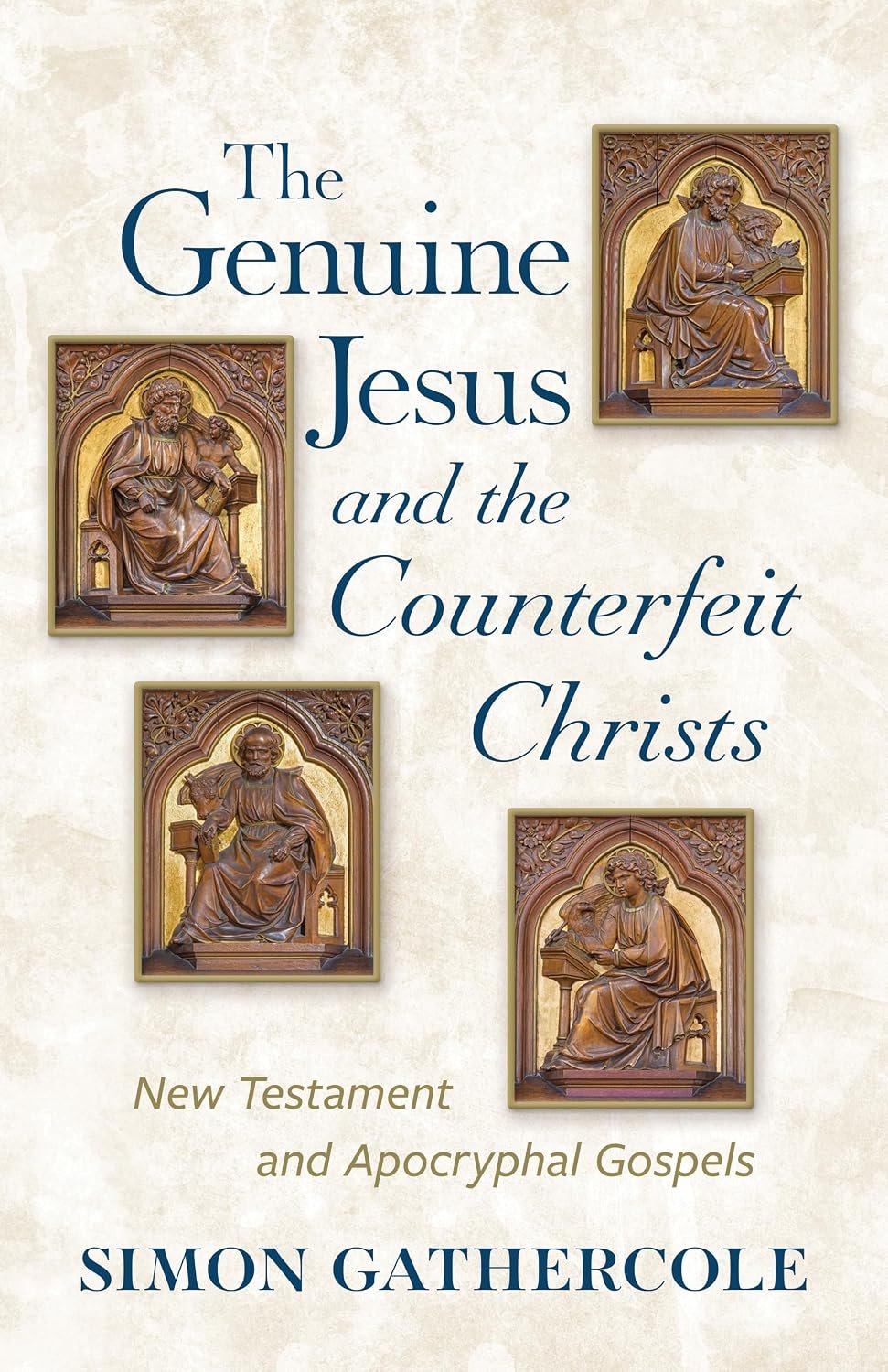
The Genuine Jesus and the Counterfeit Christs: New Testament and Apocryphal Gospels
Simon Gathercole
Eerdmans (2025). 160 pp.
In this short and accessible volume, Gathercole guides readers through a classic case of comparison and contrast, arguing for two propositions. First, Matthew, Mark, Luke, and John “share key elements of theological content that mark them out from most of the noncanonical Gospels” (p. 2). And second, the reason why the four canonical Gospels are theologically similar to each other is that (in contrast to most other accounts) they “follow the existing gospel message of the apostles” (p. 3).
Assuming his audience already shares background knowledge of the NT Gospels, Gathercole’s first chapter introduces the content of the eight most prominent apocryphal or noncanonical Gospels: Marcion’s Gospel, the Valentinian Gospels (the Gospel of Truth and the Gospel of Philip), the Gnostic Gospels (the Gospel of the Egyptians and the Gospel of Judas), the Gospel of Peter, the Gospel of Thomas, and the Gospel of Mary. Although the Gospel of Mary is mentioned, Gathercole does not consider its theology throughout the book because of its poor preservation status. Like the NT Gospels, these apocryphal texts attempt to present the good news about Jesus Christ. But the differences outweigh this commonality.
En route to highlighting such dissimilarities, Gathercole spends the second chapter exploring possible methods of telling the canonical and non-canonical Gospels apart. Whereas approaches that center their comparisons on normality, authorship, dating, biographical narration, and popularity run up against serious problems (though not bereft of usefulness), the ancient tactic (cf. Irenaeus) of distinguishing the canonical and noncanonical Gospels based on their theologies and the content of the original Christian message shows great promise.
The rest of the book applies Gathercole’s chosen method of theological differentiation. The apostolic and kerygmatic content of 1 Cor 15:1–4 informs how Gathercole structures the terms of comparison. In other words, the operative question is how the canonical and noncanonical Gospels treat the fourfold message that Jesus is the Christ of Israel’s Scriptures (1 Cor 15:3), that he died a saving death (1 Cor 15:3), that he was raised on the third day (1 Cor 15:4), and that he fulfilled Scripture (1 Cor 15:4). Gathercole shows that the canonical Gospels each contain all four of these features. By contrast, not one of the noncanonical Gospels includes the whole of this fourfold proclamation. They might include some apostolic ingredients but never all of them. For example, Marcion’s Gospel attributes saving significance to Jesus’s death but depicts Jesus’s messiahship as non-Jewish. The Valentinian Gospels likewise indicate that Jesus’s real physical death carries importance but hardly envisage Jesus’s resurrection as bodily in the Pauline sense.
The only surprising omission in the bulk of Gathercole’s argument is the lack of reference to Francis Watson’s What Is a Gospel? (Eerdmans, 2022). Watson’s conviction that the gospel genre is characterized by association with the apostles or people connected to the apostles—even if said association is fabricated—makes some sense of why pieces of the kerygmatic content might be present in the Gospel of Peter even if it is resistant to and ambiguous about the totality of apostolic substance conveyed by 1 Cor 15.
In larger scholarship, The Genuine Jesus and the Counterfeit Christs will not (and is not intended to) move the needle in historical Jesus studies. Many scholars will still express that the theological distinctions noted by Gathercole do not necessarily separate the genuine Jesus from counterfeits as much as 1) showcase the main form of early Christian teaching and 2) suggest the canonical Gospels contain a Jesus theologically interpreted by some of his apostles. On the one hand, the NT Gospels contain the full kerygmatic core of what early apostles believed about Jesus, thus disabusing us of the notion that their canonical inclusion was merely an episcopal and political power play. A text’s theological and historical proximity to Jesus’s apostles was central for consideration. On the other hand, such apostolic faith content is not inescapably revelatory of the genuine Jesus of history. One does not need to be Bart Ehrman or a full-blown skeptic to acknowledge this point. As such, the title selection is somewhat misleading. For this book to show that the Jesus of the canonical Gospels is genuine in contradistinction to the counterfeit Christs of apocryphal accounts, it would have to argue for why 1 Cor 15:1–4 is the most genuine depiction of the historical Jesus. Although this argument can be made (and the assumption is good to build on in the church), a better title would perhaps be The Apostolic Jesus and the Alternative Christs. Gathercole shows that the NT evangelists and the authors of noncanonical Gospels did not run in the same religious circles. But that he demonstrates “who the real Jesus is” (p. 112) is less clear.
In terms of ministry, the book’s value is obvious for teaching sessions focused on the theological unity and uniqueness of the NT Gospels. At the same time, churches (especially those in rural settings) are often devoid of skeptics concerning the canonical Gospels and why they should offer us a genuine Jesus as opposed to early counterfeits. Many parishioners simply reject that there are other gospel texts. But for the pastors in such contexts, this work is useful for showing congregants that we often read Matthew, Mark, Luke, and John as if they were apocryphal texts—like the Gospel of Judas and its call for disciples to escape material reality. Churchgoers frequently read and preach the canonical Gospels as they would other inspirational sayings and stories rather than as texts with unequivocal attachment to the summary kerygmatic truths of Jesus from 1 Cor 15 and the rest of the NT.
Benjamin J. Aich (PhD, Asbury Theological Seminary) is the pastor of Houghton Lake Global Methodist Church in Houghton Lake, MI. He is a member of the St. Irenaus Fellowship of the Center for Pastor Theologians.