The views expressed in this article are of the author only and do not necessarily represent those of the Center for Pastor Theologians.
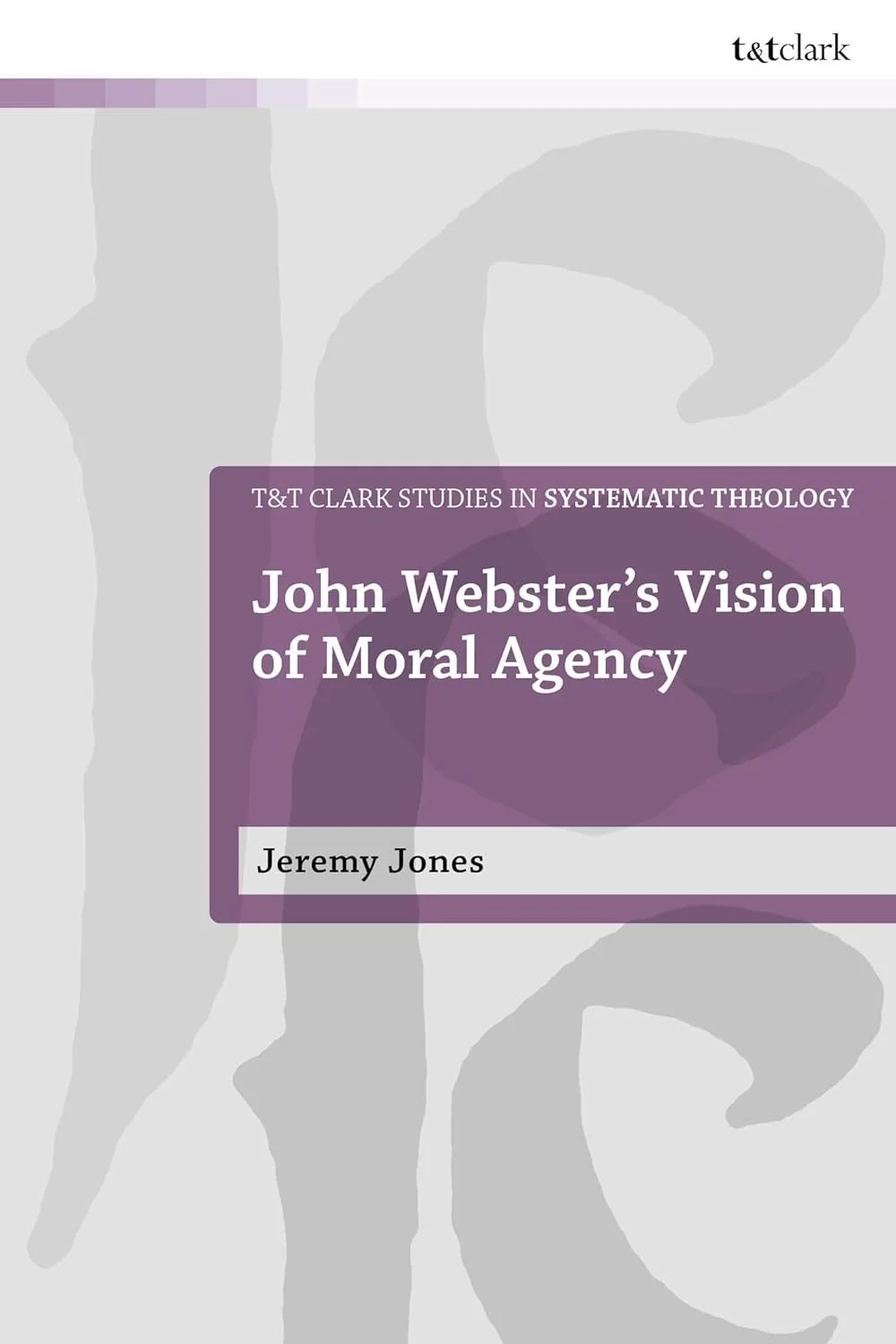
John Webster’s Vision of Moral Agency: A Study in Theological Moral Ontology
W. Jeremy Jones
T&T Clark (2025). 232 pp.
Scholarship on John Webster’s theological project is a small but growing swell. To date, a handful of dissertations have been completed, with another handful currently underway. Only a couple of these have yet been published as monographs. W. Jeremy Jones’s John Webster’s Vision of Moral Agency falls into this latter category.
Jones’s project follows a common patter in current Webster scholarship. Jones examines a particular theological question—for him, the nature of how human agency relates to God—in light of Webster’s theological development, with special focus on the latter half of Webster’s published works.
Jones advances three central claims. First, he argues that Webster’s approach to systematic theology is best characterized not as aiming to offer a complete treatment of the major doctrines of the faith (what is typically meant by systematic theology today) but as seeking “to discern and expound the theological connections that obtain between specific doctrines” (p. 3). For example, Webster deploys a theology of the divine processions to explain the full import of a theology of creation. Second, he argues that this method is displayed in essays concerned with moral theology, particularly in the latter half of his career (1996–2016). Third, Jones argues that analysis of “Webster’s moral ontology yields a unique perspective . . . on his theological development” (p. 6).
The argument progresses clearly and deliberately. Jones engages primarily with Webster’s own work, offering substantial and well-grounded exegesis and analysis, both of individual texts and the development apparent over a range of Webster’s corpus.
Jones makes several contributions to understanding Webster. First, while a few extant essays treat Webster’s work on ethics, Jones is the first to present a book-length treatment of the ontological framework Webster developed and deployed for his “moral vision.” In that framework, Jones exposits Webster’s understanding of the relationship between divine and human agency in its early stage as an attempt to “reintroduce late-modern minds to . . . a Christianly specific understanding of human agency and action” and in its late stage as dogmatically driven “mode and method of moral theology” (p. 187).
Second, Jones helps readers locate Webster in his relationship to contemporary theology and philosophy. Two points are worth mentioning. In Chapter 3, Jones explains Webster’s early indebtedness to Canadian philosopher Charles Taylor, especially his Sources of the Self. Jones illuminates an important intellectual connection between Taylor and Webster’s own understanding of modernity. In Chapter 7, Jones tackles Webster’s moral ontology in conversation with contemporary theological projects, arguing that in the face of these “Webster reconstructs an evangelical dogmatic metaphysics” (p. 163). Of particular note is Jones’s analysis of how Webster’s project digresses from Bruce McCormack’s “radical Barthian” project of revising classical trinitarian metaphysics (pp. 163, esp. 164–71).
Third, Jones addresses the question of development in Webster’s theological project, dividing his corpus into an initial phase of development (1987–1995) to “early dogmatics” (1996–2001), followed by “early middle” (2002–2005), “late-middle” (2006–2009), and “late” periods (2010–2016). By avoiding too strict a schematic, he is better able to articulate some of the continuities which exist across Webster’s corpus, adding weight to the observations of other scholars who see a less-demarcated development in Webster’s career.
Jones’s book is not the best point of entry for interested pastor theologians to Webster’s theological project. (For those interested in Webster, the best book-length introductions are Michael Allen and R. David Nelson, eds., A Companion to the Theology of John Webster [Eerdmans, 2021] and Michael Allen, ed., T&T Clark Reader in John Webster [T&T Clark, 2020]. For Webster’s own work, the collections of essays in Confessing God, 2nd ed. [T&T Clark, 2016], The Domain of the Word [T&T Clark, 2012], and God Without Measure I & II [T&T Clark, 2016] feature many of his most significant constructive contributions). However, Jones does provide a thorough analysis of the moral project of one who, at the time of his death, was one of theology’s leading contemporary lights, thus directing readers to the promise in which Webster hoped: “that Christ’s people might be re-formed by the gospel and, perceiving its depths, be emboldened to follow in the steps of their common Lord” (p. 191).
John Webster understood theology to be the joyful contemplation of God and all things relative to God. Jones has demonstrated that Webster understood this call to a life of contemplation as a simultaneous call to a life of action. Pastor theologians, as under shepherds of the church, are called to this joyful task of testifying to the God who reconciles his people to himself in Christ and teaching the church to obey him by walking in the cruciform footsteps of Christ. As Webster explains in a lecture on Mark 1, the summons to life in Christ is a summons “to life in a particular direction” (John Webster, “Discipleship and Calling,” Scottish Bulletin of Evangelical Theology 23 [2005]: 140). Jones helps readers understand the working out of that calling in the theology of John Webster, thus advancing Webster’s own desire to help the church follow its Lord.

Seth Porch (ThM, Bethlehem College & Seminary) serves as the Publications Coordinator for the Center for Pastor Theologians.